Sunday, August 12, 2012

SHANGAI


As we get ready to disembark from the Li River (cruise highway of 10,000 tourists), we see more civilization, bigger villages, and more activity.

Close to the village, we notice bamboo boats with cormorants and while Vicki  describes the treasures of the Li, a 1500 year old banyan tree, a Phoenix Tail Bamboo, (an evergreen), and a blind mandarin fish that lives inside of a rock cave, I’m excited about seeing a cormorant fisherman in action.

The port is  busy with many boats docking at the same place.

From our boat, we can see the fishermen on shore with their birds.

The fishermen have a daytime occupation, getting paid to have their picture taken. They fish at night. Vicky angrily tells us, “do not pay them”. I get a good picture of this fellow because another tourist has paid him and he is posing for her.

If you try to photograph them without paying, they turn their backs to you.

I managed to sneak another shot. At this village, where many  tour boats disembark, vendors of all types swarmed us and Vicki asks us to wait until we get to the Yangtze Market  in Shanghai .  We plow through the throng to our waiting bus.
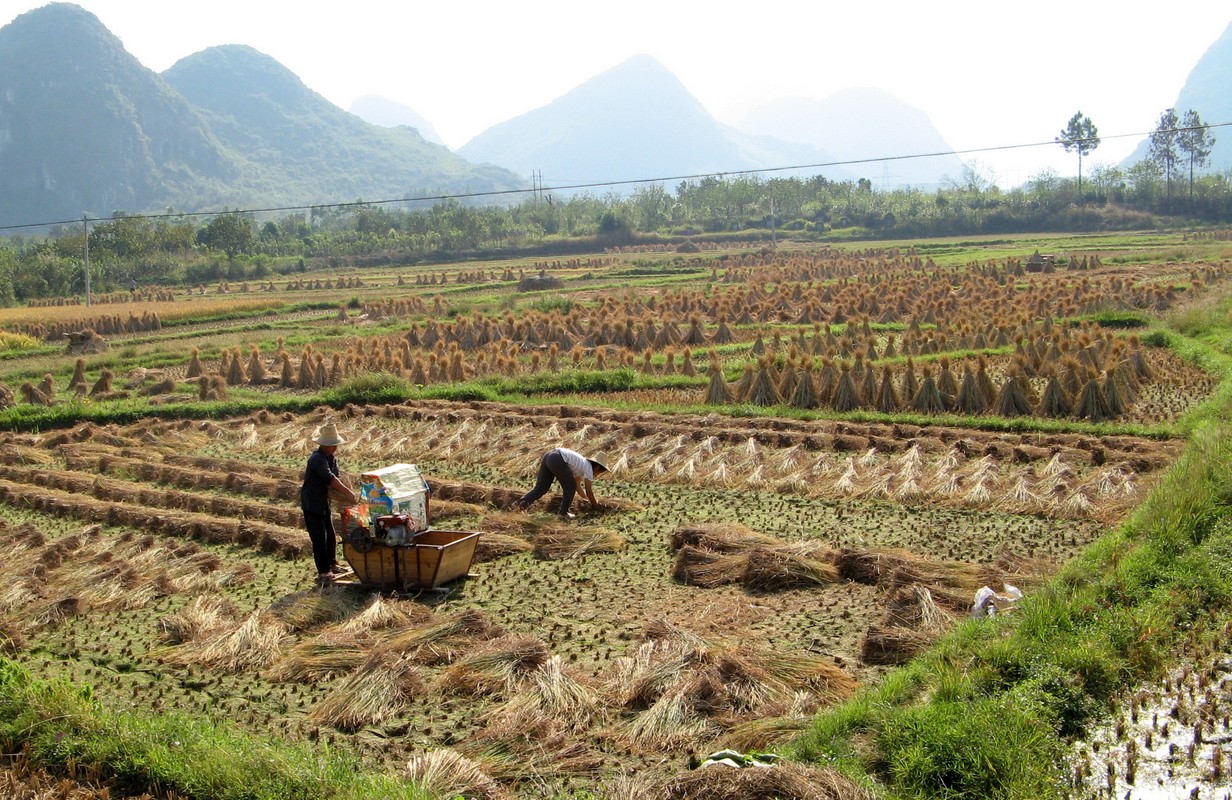
The next morning, we bus to the airport for our next stop at Shanghai. On the way, we see farmers working the fields. They harvest two crops per year, one in March and another from July to November. They still hand cut rice with a sickle. We ask to see a rice paddy. Vicki stops the bus. It is harvest time, but you can see new plants growing in the right hand corner of the picture.

In America, it would all me mechanized. Here people work with rudimentary equipment, hand threshing  hulls from the rice.

Rice plants look like grass; how the people farm is more interesting than the plant itself, and we move on.

Shanghai looks like a futuristic city. It is regarded as a baby city since it is only 200 years old. This is the place where able-bodied men were kidnapped and brought down to the river and put to sea. They were  forced to work on an ocean-going vessel. What was once an opium shipping port in the 1840′s to the 1930′s, with only 100,000 population, and a wild and tawdry reputation,  has become the biggest container shipping port in the world. Now 21,000,000 people live here in an extremely modern city where the Hang Po river and the Yangtze flow through the city of  huge ships and sprightly boats sporting lighted billboards facing the city at night.
We take a city tour by bus. Michele, our city guide,  points out the biggest skyscraper in the world, yet in 1964, no Shanghai building was over ten stories high. They have more skyscrapers than New York City and Hong Kong. Chinese people want to be the biggest, the tallest, the fastest and the best, yet we see business people riding what seems like a million bikes. Some people are licensed to drive cars on Mondays and Wednesdays, others on Tuesday and Thursdays. We see one man carrying a full sized bed on just an ordinary bike. The loads people carry here are legendary. My disk is full and I have no more pictures  until I can buy another disk. So many photo ops of  Shanghai I missed.  The Wedding Cake building, a Soviet building from 1952,  looks like a wedding cake.
Michele takes us to the BUND, Shanghai’s financial district with multiple banks and financial institutions with a sprinkling of old buildings mixed in. China’s  Wall Street. She explains that Shanghai is the business center of China, like New York is the business center of  America. One member of our group visited Shanghai twenty years ago. She said they found one hotel that would take foreigners and no restaurants. People were still wearing black sack cloth peasant clothing and you had to eat from a stand. In China, people over 80 and children under 20 speak English.
Vendors swarm the tourist spots wherever we stop. They sell rip off watches, hand bags, shoes, you name it. Michelle warned us not to buy from them but one member of our group bought a Mickey Mouse watch and before the bus pulled away, it fell apart. She laughed the hardest at her own folly.  The universities here are considered excellent. Michele sang a folk song for us before departing.
I finally get to a photo shop  after lunch to buy a disk, but the city tour is over. The food is bland compared to the marvelous spicy and different tasting specialties we tasted on the road.

And, I finally got a picture of a mother with her child in the split pants, defying the governments directives. Not many years ago, this woman would have had no choice but to obey.
More tomorrow.

Saturday, August 11, 2012

OLD CHINA ON THE RIVER LI.


We board our boat, that looks much like this one, for an 83 kilometer trip up the River Li. Ten thousand people a day tour this river to see mystical rock formations. The river bank is thick with blooming acacia; its fragrance fills the air. I would point out that both of these boats are in motion.

The vendor has hooked his boat to the tour boat and hands off  fresh vegetables and fish to the kitchen. The kitchens on these tour vessels are at the back of the boat in the open air.  We watch fascinated. The vendor is precariously balanced as he hands off his product.

The cook can be seen cutting up a chicken or duck.

The much vaunted rock formations everyone comes here to see are smooth, rounded hills and spears treasured for their mystical appearance and ever shrouded in mist.  I’ve seen professional aerial pictures of them that are beautiful, but I find my photos disappointing. They just don’t seem to have that same mystical effect. It doesn’t matter anyway, life along the Li is a glimpse of Old China and fascinates me.

The Dong people are known for their bamboo boats, houses and flutes. It looks like this boatman is offering a ferry service to get a bicycler and his package to the opposite bank. You can click on these photos to make them larger.

People live on their boats. The house boats we see are put together from whatever scrap can be  garnered.

Cows appear to be free ranging, but if you look closely, you will see their tether rope.

People carry heavy bundles. There is little mechanization.

They hand carry water up from the river the old way.

Water buffalo enjoy cooling off in the river. Notice the one with its head underwater; he is grazing.

Up he comes with a green morsel to eat.

These men have harvested and are preparing some type of green to sell. In China, everyone eats multiple types of greens.

A floating garden held up with oil cans. The bamboo fence and net protects the garden from ducks and flying birds.

People from the villages come down to the river to wash their clothes.

So many make their living from the river and work from their boats.

This fancy ferry boat has a motor. The boatman uses his petrol sparingly and prefers to paddle whenever possible.

We are passing a popular Chinese tourist area.

Everyone walks along the river.

The big draw here is an abandoned Yau village with beautiful 200-year-old buildings. People left here 120 years ago because they were persecuted and moved higher up the mountains.

Maybe the lucky ones are those who live on the river. We see villages of children watching and watering their water buffalo; dogs and pigs roam freely. Whole families living on sampans and all around the storybook shapes of the mystical hills.

Friday, August 10, 2012

ALL PETS GO TO HEAVEN.


Our newspaper says it is the hottest July on record for our area. Exacerbated by a low snow pack, meaning an extension of the drought.  It gets ugly out there.  Climate change deniers are holding up progress for the rest of us and thus we all suffer. I’m glad I can provide water for wild animals. I’m not so glad that I have to drive into the even hotter valley, a long day away from home “out in it”.

People may destroy the earth as we know it, but All Pets Go To Heaven.

Thursday, August 9, 2012

SUN AND MOON PAGODAS.


We’ve left the Urumichi area, which means oasis. It is part of the Gobi desert and we saw oil refineries that the government controls.  We are headed for Guilin, pronounced guay-leen and the roadsides are lush with terraced gardens. In 1998, this area flooded and 1500 people died. The government let the area return to farmland and forest. Makes me think of New Orleans, where the best solution is to let the river have its way, but we don’t have an autocratic government, we have property rights and developers rights and political sensitivity.  The horrifically expensive taxpayer fix will result in  more flooding, reduced wetlands necessary to buffer severe storms, more loss of property and life, and eventually the City of New Orleans will  sink anyway. The Army Corps of Engineers keeps building levees and moving sand from one beach to another ignoring science and heeding the popular political fix.

Clustered housing here is practical and uses less land than individual farms. A collective. It is a method that can stifle innovation and experimentation. But, Vicki says, it is tried and true. After all, people have occupied the area along the Li River since 214 B.C.  Why not high rises? Because no one can build higher than 20 floors so not to obscure the view of the beautiful mountains. Oh, my. A sentiment to admire.

Guilin was destroyed by Japanese bombs, but has been rebuilt. We are aghast when Vicki calls Guilin a small city of only 640,000 people covering 67 kilometers. We stop at a tea factory for a formal tea tasting.  As in days of old, tea is packed into bales, bricks, wheels and multiple sized rounds. We find the same shapes we saw in Jiliang that we didn’t recognize as tea. Not a tea bag in sight.

Everything here is loose leaf and smells divine. The city is famous for its osthumansis (acacia) trees that are in bloom. Intensely fragrant, like orange blossoms, they are used to make wine, tea and perfume. Guilin has 13 nationalities. The Yau and Dow are predominant. There are 3,000 caves in the mountains here, many of them open to tourists.

This magnificently carved wooden Buddha tray is outfitted with a gas burner and we are about to taste ten different kinds of tea. The rules are thus:  First, you smell the cup. Then you sniff the tea and chew the leaves a bit to make sure it is good and strong. Then hot water is poured in the cup to warm it while the tea is brewing in hot (not boiling) water. You surround the cup with your hands to warm them. You can drink the water or pour it out before the tea is poured. Then you slurp noisily. That is considered the best way. It was fun. Then there was theatrics of tea. A dragon tea pot that turns from green to red when the hot water is poured into it. And a baby boy tea pot that pisses into your cup when the water heats it.  There was a lot of slurping and laughing and talking and comparing. They sell aged, 28 year old  Puer tea, said to reduce blood pressure, cure diabetes and clean your liver. You can use the leaves nine times before the flavor and benefits disappear. Hmmm!  I bought some. It stayed flavorful for about four cups made with the same leaves. Their cups are smaller than mine, though.

We get to our beautiful hotel and Michal is taken by a carved jade dragon boat. Priceless. It is a free day for us and we can wander the town and eat anywhere we want though Vicki warns us to beware of pick pockets and even some merchants are rip-off artists. Our stop here is to boat up the Li River and see a part of old China and some famous, mystical rock formations.

Guilin is quite modern and university students go to coffee shops like Western students do. The whole city smells like orange blossoms though we don’t see the trees. The Dau people hold a folk song festival in Guilin in the spring. The Dau people have a beautiful courtship ritual. A woman throws her bouquet at the man she wants. If he catches it, that is his acceptance and they are one.

As we gaze around we run into Vicki and she points out a modern Chinese pharmacy.

Kind of reminds us of a fish and herb market. But, there are lizards and insects and worms and animal parts, very clean and dried.

The Chinese have centuries of medicinal experimentation with herbs and such and it seems prudent to respect it, even while we know many remedies don’t work, such as rhinoceros horn and other animal parts. Our own drug companies have learned much from the Chinese. They are healthy people.

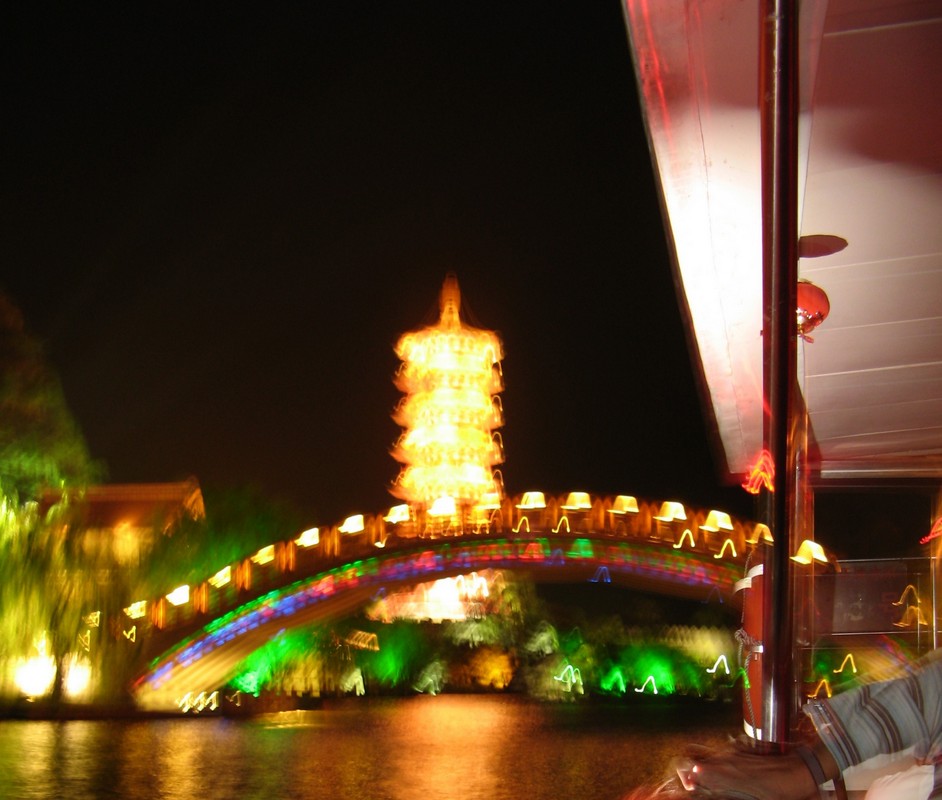
After dinner we load into a boat near these Twin Pagodas for a ride on the Li and Peach Blossum Rivers as they merge together and form four city lakes. These pagodas are joined underwater and one can swim into and out of them. At night they are lit up beautifully.

Pictures are impossible, but you get the idea, anyway. The lake shores on all sides are lit up like Christmas trees. Entertainers sing from various famous boat replicas, like the Marble boat from the Summer Palace, and a dragon boat. Bands play modern and traditional music every section of the way.  You see people dining on shore or in pretty boats as  you continually pass under bridges, all replicas of famous bridges. Twelve of them. Each has frescoes of great beauty and interest. We point and guess, the Brooklyn Bridge, Golden Gate, Glass Bridge, Cambridge Math Class Bridge. We didn’t recognize them all.  It was another dreamland journey as we stayed mesmerized by the passing scenes. Near the turning point we saw  fishermen night fishing with their cormorants. The boatman smacks them with his cane if they try to steal a fish out of the basket and pretend they caught it.  He calls to them, “Ai, ai, ai!”  The birds continually fly out and back. We see live fish, flopping in the baskets that will soon be delivered to a local restaurant. Another magical experience that clings forever in memory.

Tuesday, August 7, 2012

A MINORITY VILLAGE AND CEMETERY.


When I’m home, I always have projects to do that take gobs of time. Or, I’m having gobs of fun. The next three weeks,  I’ll be having therapy for my hip three mornings a week plus other doctor’s appointments, and my blog may be quite sporadic. I wonder at times like this how our travel companions who were severely injured in the May 27th accident are faring? I’m back revisiting my 2006 trip to China, and, suffering embarrassment as I was reminded that I had blogged my China trip last year. I totally forgot. Maybe it was the bap in the head during the accident that made me forget.  In any case, UNESCO made this cemetery a place of interest because China has not allowed burials for over 200 years. All bodies by law must be cremated. This rare cemetery belongs to the minority Yi people, and we visit their nearby village.

The minority Yi living here are poor. The place is littered with garbage.

Raw sewage runs through the  town in these runnels. They have electricity now, fairly new for them.

The streets are narrow; the buildings show their layers of history from old to ancient.

The major crop for them is corn. They raise pigs and we see dogs and wonder if they are raised for meat rather than pets.

The people mostly ignore us or hide their curiosity.  Like most minority villages, they work together and share the work and the harvest.

And, like old China, women go to work in the fields with their babies on their backs.

We saw women and children and our group engaged them. The child with the mother in the blue sweater was scared of we big noses and ran away from us.

She managed to bring him close to us. Vicki told us, do not give these people money and turn them into beggars. But, here we see that a member of our group did it anyway, and the little boy in red has his hand outstretched for more. The Cemetery is a new UNESCO site and soon, these people will have a steady parade of tourists with money in hand. Handouts warp their way of life,  rather than enhance it.

The children seem quite happy and well fed.

Who are we to decide their lifestyle needs improving?  The minority people are allowed two babies per family.  The government handed out condoms and demonstrated them by slipping them on their fingers. On the next visit, they found condoms on fence posts, hanging in the windows and on bushes. The people thought they were magically going to work by having them around.

Superstition is handed down from generation to generation.  Some of the practices of the minority people in the region are pretty strange.  These Suni-Yi believe spider webs are good luck and will not break up a web. The Wah minority favor rat meat. In older times they lent their wives to friends, or two sisters were allowed to share one husband. Some Wah are still nomadic. Girls live in white tents. Any man can fornicate with her because she has to have a baby to prove that she is fertile before she can marry.  But, the tent is guarded by a dog and the man must fight off the dog with stones and fists. The government discourages these old rituals and practices with some success.

We leave the area thinking of the vast differences in culture there is in the same country without the influence of immigration as in our own melting pot of diverse cultures. We are truly stepping back in time, here.