Showing posts with label cormorant fishermen. Show all posts

Sunday, August 12, 2012

SHANGAI


As we get ready to disembark from the Li River (cruise highway of 10,000 tourists), we see more civilization, bigger villages, and more activity.

Close to the village, we notice bamboo boats with cormorants and while Vicki  describes the treasures of the Li, a 1500 year old banyan tree, a Phoenix Tail Bamboo, (an evergreen), and a blind mandarin fish that lives inside of a rock cave, I’m excited about seeing a cormorant fisherman in action.

The port is  busy with many boats docking at the same place.

From our boat, we can see the fishermen on shore with their birds.

The fishermen have a daytime occupation, getting paid to have their picture taken. They fish at night. Vicky angrily tells us, “do not pay them”. I get a good picture of this fellow because another tourist has paid him and he is posing for her.

If you try to photograph them without paying, they turn their backs to you.

I managed to sneak another shot. At this village, where many  tour boats disembark, vendors of all types swarmed us and Vicki asks us to wait until we get to the Yangtze Market  in Shanghai .  We plow through the throng to our waiting bus.
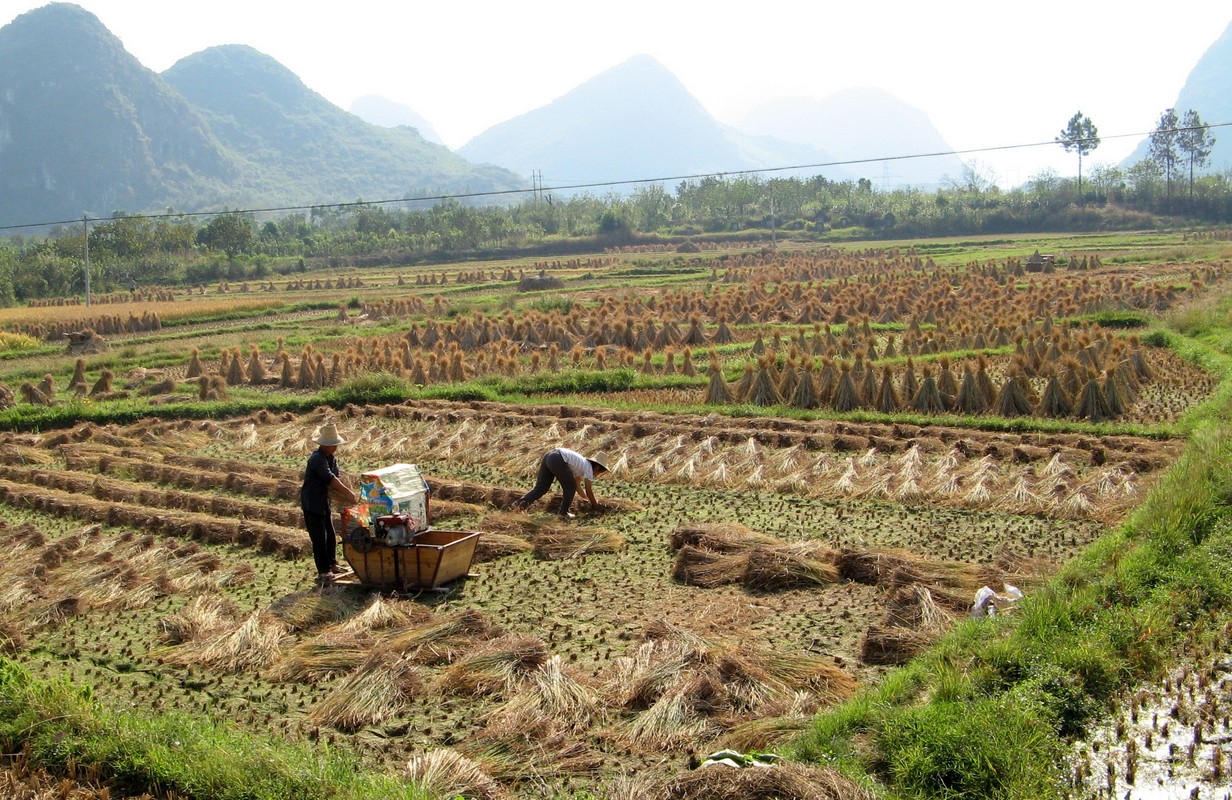
The next morning, we bus to the airport for our next stop at Shanghai. On the way, we see farmers working the fields. They harvest two crops per year, one in March and another from July to November. They still hand cut rice with a sickle. We ask to see a rice paddy. Vicki stops the bus. It is harvest time, but you can see new plants growing in the right hand corner of the picture.

In America, it would all me mechanized. Here people work with rudimentary equipment, hand threshing  hulls from the rice.

Rice plants look like grass; how the people farm is more interesting than the plant itself, and we move on.

Shanghai looks like a futuristic city. It is regarded as a baby city since it is only 200 years old. This is the place where able-bodied men were kidnapped and brought down to the river and put to sea. They were  forced to work on an ocean-going vessel. What was once an opium shipping port in the 1840′s to the 1930′s, with only 100,000 population, and a wild and tawdry reputation,  has become the biggest container shipping port in the world. Now 21,000,000 people live here in an extremely modern city where the Hang Po river and the Yangtze flow through the city of  huge ships and sprightly boats sporting lighted billboards facing the city at night.
We take a city tour by bus. Michele, our city guide,  points out the biggest skyscraper in the world, yet in 1964, no Shanghai building was over ten stories high. They have more skyscrapers than New York City and Hong Kong. Chinese people want to be the biggest, the tallest, the fastest and the best, yet we see business people riding what seems like a million bikes. Some people are licensed to drive cars on Mondays and Wednesdays, others on Tuesday and Thursdays. We see one man carrying a full sized bed on just an ordinary bike. The loads people carry here are legendary. My disk is full and I have no more pictures  until I can buy another disk. So many photo ops of  Shanghai I missed.  The Wedding Cake building, a Soviet building from 1952,  looks like a wedding cake.
Michele takes us to the BUND, Shanghai’s financial district with multiple banks and financial institutions with a sprinkling of old buildings mixed in. China’s  Wall Street. She explains that Shanghai is the business center of China, like New York is the business center of  America. One member of our group visited Shanghai twenty years ago. She said they found one hotel that would take foreigners and no restaurants. People were still wearing black sack cloth peasant clothing and you had to eat from a stand. In China, people over 80 and children under 20 speak English.
Vendors swarm the tourist spots wherever we stop. They sell rip off watches, hand bags, shoes, you name it. Michelle warned us not to buy from them but one member of our group bought a Mickey Mouse watch and before the bus pulled away, it fell apart. She laughed the hardest at her own folly.  The universities here are considered excellent. Michele sang a folk song for us before departing.
I finally get to a photo shop  after lunch to buy a disk, but the city tour is over. The food is bland compared to the marvelous spicy and different tasting specialties we tasted on the road.

And, I finally got a picture of a mother with her child in the split pants, defying the governments directives. Not many years ago, this woman would have had no choice but to obey.
More tomorrow.

Thursday, August 9, 2012

SUN AND MOON PAGODAS.


We’ve left the Urumichi area, which means oasis. It is part of the Gobi desert and we saw oil refineries that the government controls.  We are headed for Guilin, pronounced guay-leen and the roadsides are lush with terraced gardens. In 1998, this area flooded and 1500 people died. The government let the area return to farmland and forest. Makes me think of New Orleans, where the best solution is to let the river have its way, but we don’t have an autocratic government, we have property rights and developers rights and political sensitivity.  The horrifically expensive taxpayer fix will result in  more flooding, reduced wetlands necessary to buffer severe storms, more loss of property and life, and eventually the City of New Orleans will  sink anyway. The Army Corps of Engineers keeps building levees and moving sand from one beach to another ignoring science and heeding the popular political fix.

Clustered housing here is practical and uses less land than individual farms. A collective. It is a method that can stifle innovation and experimentation. But, Vicki says, it is tried and true. After all, people have occupied the area along the Li River since 214 B.C.  Why not high rises? Because no one can build higher than 20 floors so not to obscure the view of the beautiful mountains. Oh, my. A sentiment to admire.

Guilin was destroyed by Japanese bombs, but has been rebuilt. We are aghast when Vicki calls Guilin a small city of only 640,000 people covering 67 kilometers. We stop at a tea factory for a formal tea tasting.  As in days of old, tea is packed into bales, bricks, wheels and multiple sized rounds. We find the same shapes we saw in Jiliang that we didn’t recognize as tea. Not a tea bag in sight.

Everything here is loose leaf and smells divine. The city is famous for its osthumansis (acacia) trees that are in bloom. Intensely fragrant, like orange blossoms, they are used to make wine, tea and perfume. Guilin has 13 nationalities. The Yau and Dow are predominant. There are 3,000 caves in the mountains here, many of them open to tourists.

This magnificently carved wooden Buddha tray is outfitted with a gas burner and we are about to taste ten different kinds of tea. The rules are thus:  First, you smell the cup. Then you sniff the tea and chew the leaves a bit to make sure it is good and strong. Then hot water is poured in the cup to warm it while the tea is brewing in hot (not boiling) water. You surround the cup with your hands to warm them. You can drink the water or pour it out before the tea is poured. Then you slurp noisily. That is considered the best way. It was fun. Then there was theatrics of tea. A dragon tea pot that turns from green to red when the hot water is poured into it. And a baby boy tea pot that pisses into your cup when the water heats it.  There was a lot of slurping and laughing and talking and comparing. They sell aged, 28 year old  Puer tea, said to reduce blood pressure, cure diabetes and clean your liver. You can use the leaves nine times before the flavor and benefits disappear. Hmmm!  I bought some. It stayed flavorful for about four cups made with the same leaves. Their cups are smaller than mine, though.

We get to our beautiful hotel and Michal is taken by a carved jade dragon boat. Priceless. It is a free day for us and we can wander the town and eat anywhere we want though Vicki warns us to beware of pick pockets and even some merchants are rip-off artists. Our stop here is to boat up the Li River and see a part of old China and some famous, mystical rock formations.

Guilin is quite modern and university students go to coffee shops like Western students do. The whole city smells like orange blossoms though we don’t see the trees. The Dau people hold a folk song festival in Guilin in the spring. The Dau people have a beautiful courtship ritual. A woman throws her bouquet at the man she wants. If he catches it, that is his acceptance and they are one.

As we gaze around we run into Vicki and she points out a modern Chinese pharmacy.

Kind of reminds us of a fish and herb market. But, there are lizards and insects and worms and animal parts, very clean and dried.

The Chinese have centuries of medicinal experimentation with herbs and such and it seems prudent to respect it, even while we know many remedies don’t work, such as rhinoceros horn and other animal parts. Our own drug companies have learned much from the Chinese. They are healthy people.

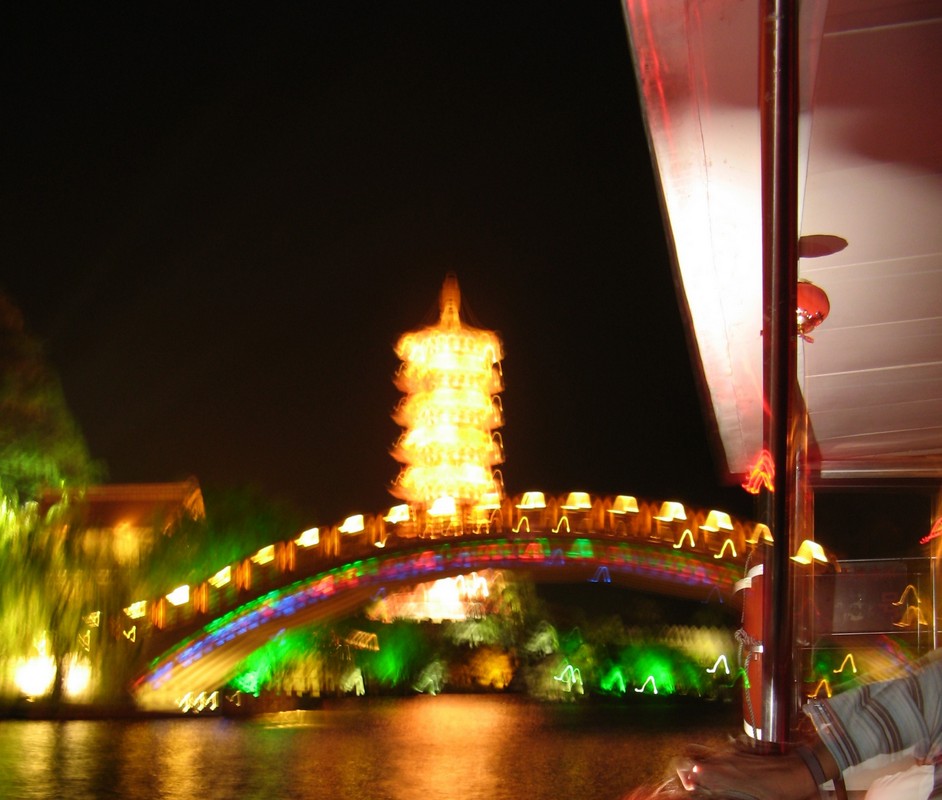
After dinner we load into a boat near these Twin Pagodas for a ride on the Li and Peach Blossum Rivers as they merge together and form four city lakes. These pagodas are joined underwater and one can swim into and out of them. At night they are lit up beautifully.

Pictures are impossible, but you get the idea, anyway. The lake shores on all sides are lit up like Christmas trees. Entertainers sing from various famous boat replicas, like the Marble boat from the Summer Palace, and a dragon boat. Bands play modern and traditional music every section of the way.  You see people dining on shore or in pretty boats as  you continually pass under bridges, all replicas of famous bridges. Twelve of them. Each has frescoes of great beauty and interest. We point and guess, the Brooklyn Bridge, Golden Gate, Glass Bridge, Cambridge Math Class Bridge. We didn’t recognize them all.  It was another dreamland journey as we stayed mesmerized by the passing scenes. Near the turning point we saw  fishermen night fishing with their cormorants. The boatman smacks them with his cane if they try to steal a fish out of the basket and pretend they caught it.  He calls to them, “Ai, ai, ai!”  The birds continually fly out and back. We see live fish, flopping in the baskets that will soon be delivered to a local restaurant. Another magical experience that clings forever in memory.

Thursday, September 8, 2011

TWELVE BRIDGES AND OLD CHINA

The Li and Peach Blossom rivers merge together at Guilin  and form four city lakes before they move on down the mountain. The lakes are joined by locks and we take a night boat tour to see  the twelve bridges  joining the mainland to an island in the center of the lakes.

Picture taking is difficult as the boat chugs along.  The twelve bridges  are small imitations of world-famous bridges with frescoes and decorations of great beauty and interest. It‘s ooo and aahh time. They imitate the Brooklyn Bridge, Cambridge Math Class Bridge, The Golden Gate, the Glass Bridge… I didn’t recognize all of them or get them into my journal. The Cambridge Math Class Bridge is so-called because students at Cambridge supposedly took it apart to understand how it was built and then put it back together again.  In the dark, night fishing with their cormorants, the boatman uses a cane to keep them moving. He smacks and scolds when a bird circles behind him and  tries to steal a fish out of the basket and pretend  it was newly caught. He calls to them, “Ai, ai, ai”!  The birds work quickly,  fly out,  dive,  and return. It was musical;  his voice echoing  over the water as the boat moved away.

The famous Sun and Moon pagodas are beautifully lit up at night.  One leads to another under water. We saw a charming tea house on an island with a replica of the Empress’s Stone Boat we recognize from the Summer Palace.
The  trees, on shore and on the islands, the bridges, are all  lit up with specialized lighting.  Bands play from the shore as we pass by.  Built to entertain, More realistic  than  Disneyland, we floated along, mesmerized by the sights,  thinking, how lucky we are to take this magical boat ride

The next morning, we load onto a boat like this one for an 83 kilometer trip up the Li to view unique karst rock formations. The osmanthus, a type of purple acacia,   is in bloom. It  reflects its color on the water and fills the air with a fragrance like orange blossoms. It is used for tea, medicine and perfume in China.

Ten thousand boats a day cruise the Li. Sampans furnish them with fresh fish and greens for the meals they prepare. Chinese people do not eat  “dead” fish. Restaurants in China have aquariums full of fish and only kill it when you sit down and order. The boat kitchens are always at the back of the boat.

Uniquely shaped hills of the Li are often clouded with a fine mist giving them a mystical quality.

The formations are world-famous and many artists and photographers come to see one of China’s great  “pearls”.

I find myself more interested in a glimpse of “old China” revealed on the banks and water of the River Li, like this boatman ferrying a man and his bike across the river. We see many of these flat bamboo boats that seem barely able to float without swamping.

A house boat.

The age-old manner of carrying a heavy burden.

Washing clothes.

If you don’t have running water you must carry it up from the river in buckets.

While some farmers depend solely on water buffalo, others have a modern motor.

We  see kids bathing their water buffalo. Buffalo, pigs, and dogs roam quite freely, sometimes invading a golf course near Guilin.  Vicki tells us that on another tour she saw a farmer drive a herd of buffalo across the lanes of the freeway. People drive slowly here, and they stopped and none were harmed.

A crude fish trap.

A fancier ferry. The boatman chooses to paddle even though his ferry has a motor. Vicki says he saves gas.

A fisherman’s hut.

Vicki tells us that the minority people from this village were persecuted 120 years ago and moved up higher in the mountains. The buildings still stand. Some tours take you into various villages along the Li.

When our boat docks, the cormorant fishermen are waiting for the tourists.

If they see you are trying to take their picture, they turn their backs to you.  They want you to pay. Vicki gets angry and says don’t pay them. We try our best to sneak a few shots.