Showing posts with label vendors. Show all posts

Thursday, February 23, 2017

Dehli India, Chandin Market by Richshaw

dsc09274-copy
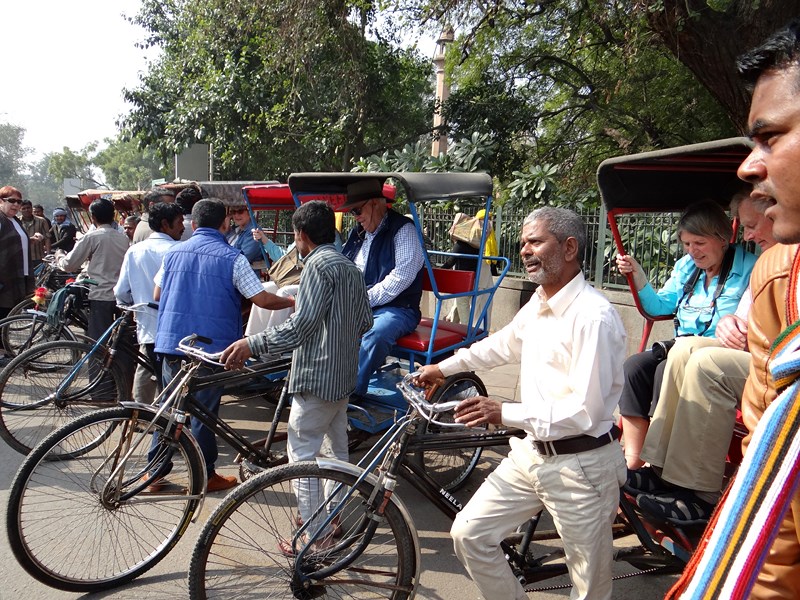
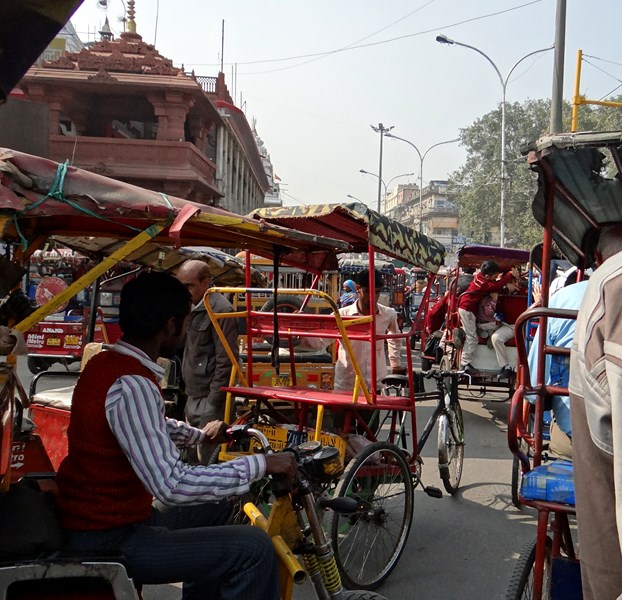
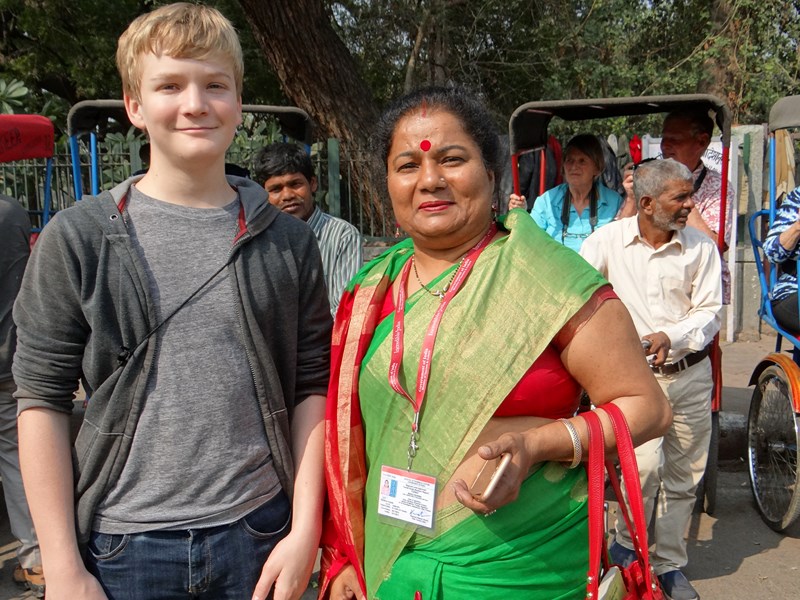
Dehli is the capitol city of India, a diverse, swarming polyglot of people, vehicles, shops and sights. I traveled with my Grandson Theo, who posed with our Dehli City Guide, Manju, as we loaded into bicycle rickshaws at Chandin Chowk Market.
dsc09272-copy
Here members of our group load in with a pre-arranged group of rickshaw drivers. Otherwise we'd be besieged by any driver trying to pick up a customer. The rules are, traffic is heavy, the driver may make a sudden stop. Brace your feet and hold on tight.
dsc09278-copy
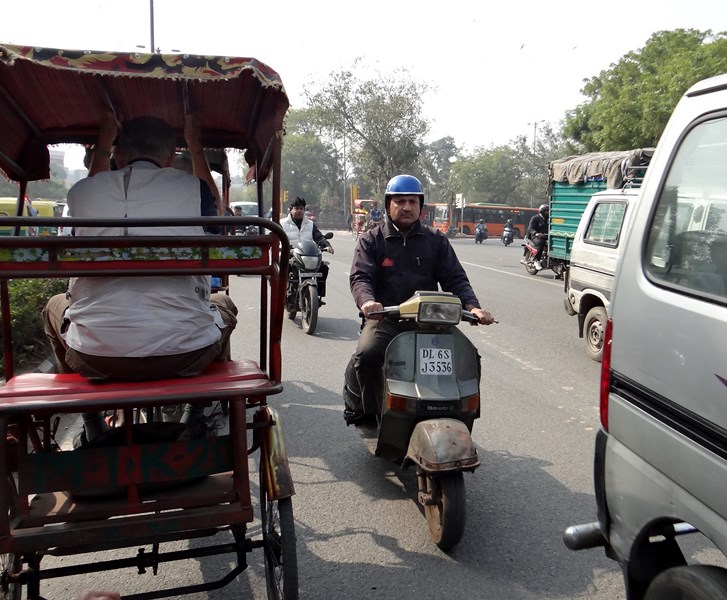
As we begin, it is a bit disconcerting because our driver is going against the flow of traffic. Doesn't it matter what side of the street you drive on?
dsc09283-copy
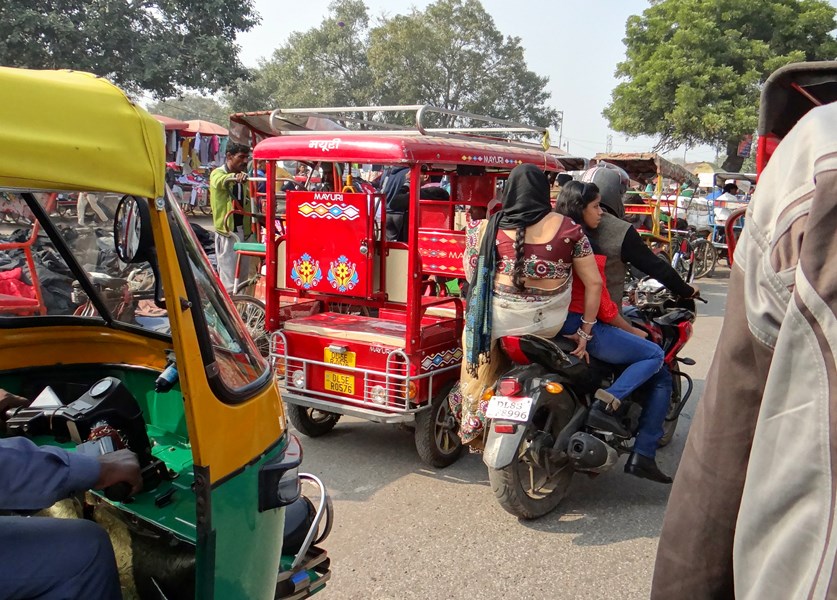
We are soon in the midst of the traffic and we are astonished at how varied and interesting the traffic is. Cars, along with trucks and people walking, motors, and tuk tuks, the green and yellow motors that serve as cabs are mixed together in what seems an impossible ability to get anywhere.
dsc09287-copy
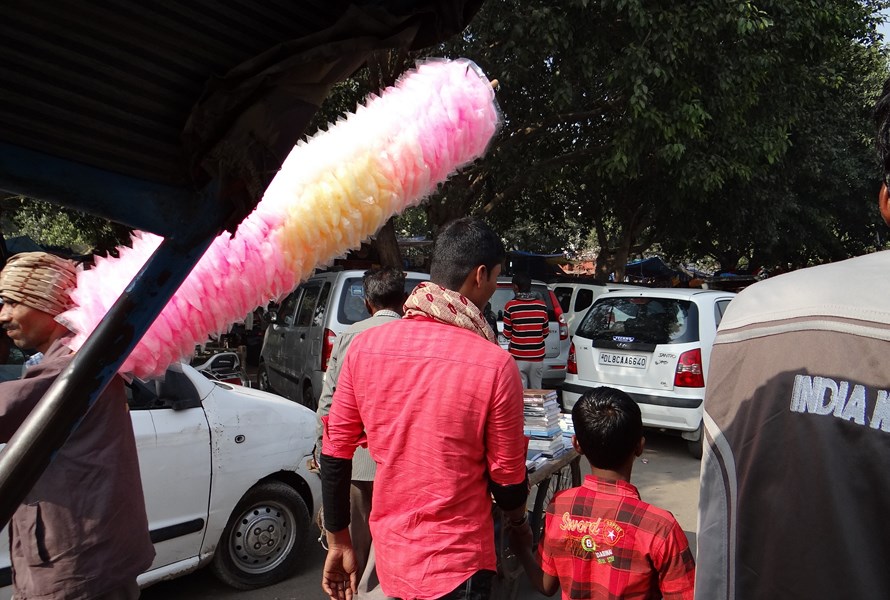
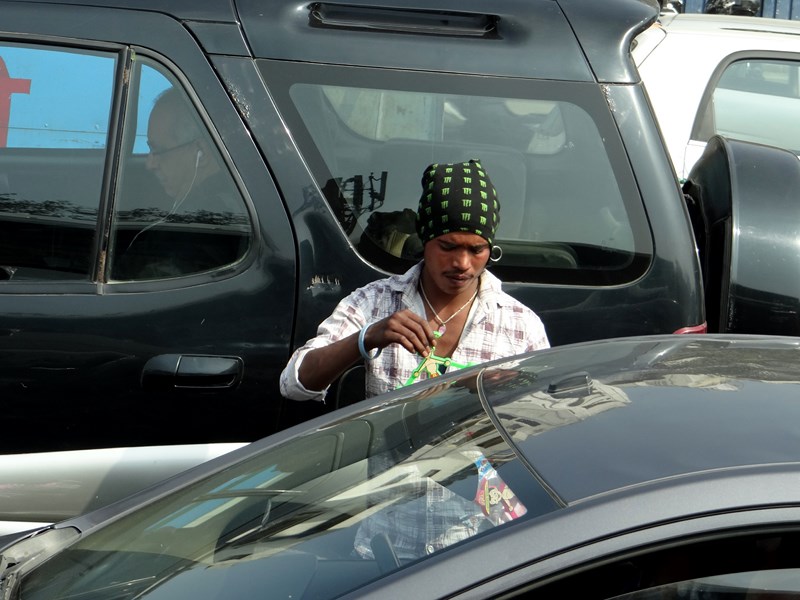
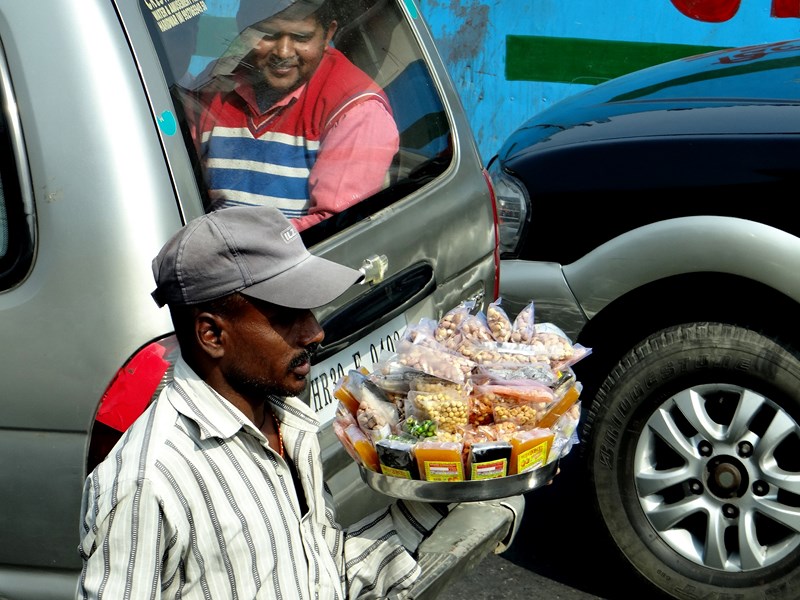
Vendors walk among the traffic selling goods if they can.
dsc09266-copy
This is just business, nothing unusual.
dsc09268-copy
Traffic is slow. No one gets hurt and at some point you realize that driving a car might just be impractical. dsc09298-copy
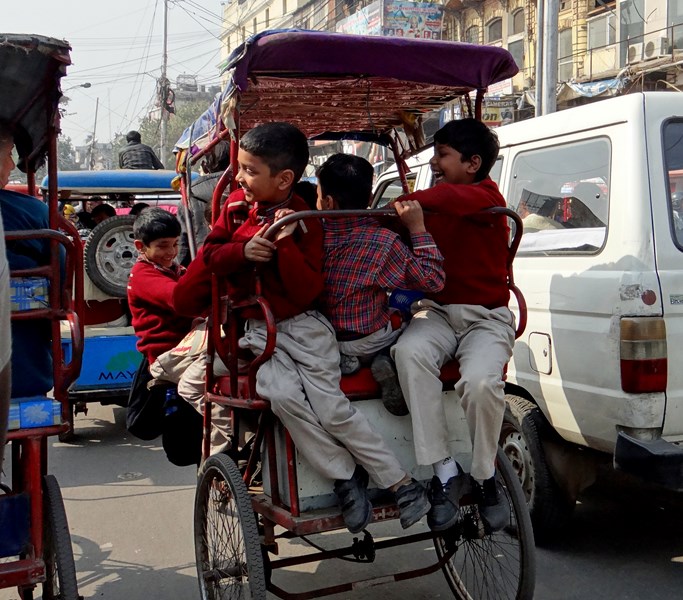
These school boys, you know by their uniforms, are not the least bit upset by being crowded into a rickshaw and holding on to the outside.
dsc09289-copy
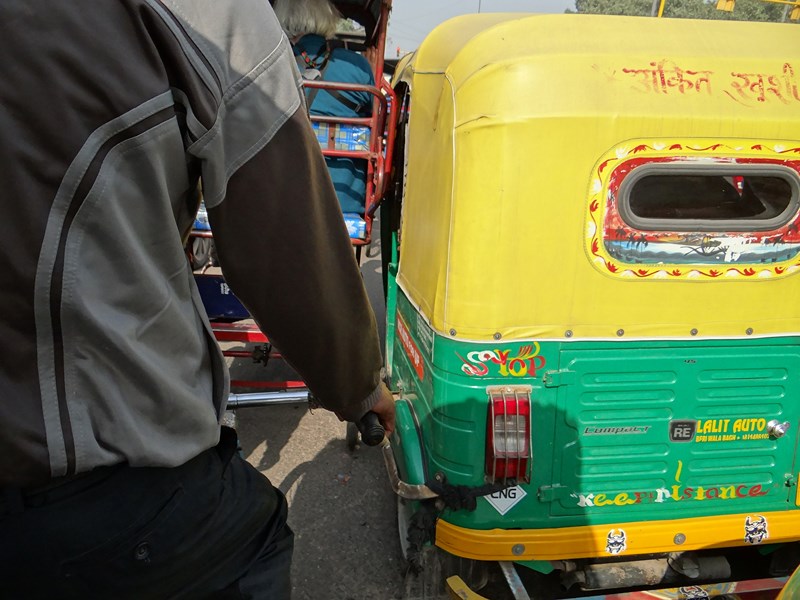
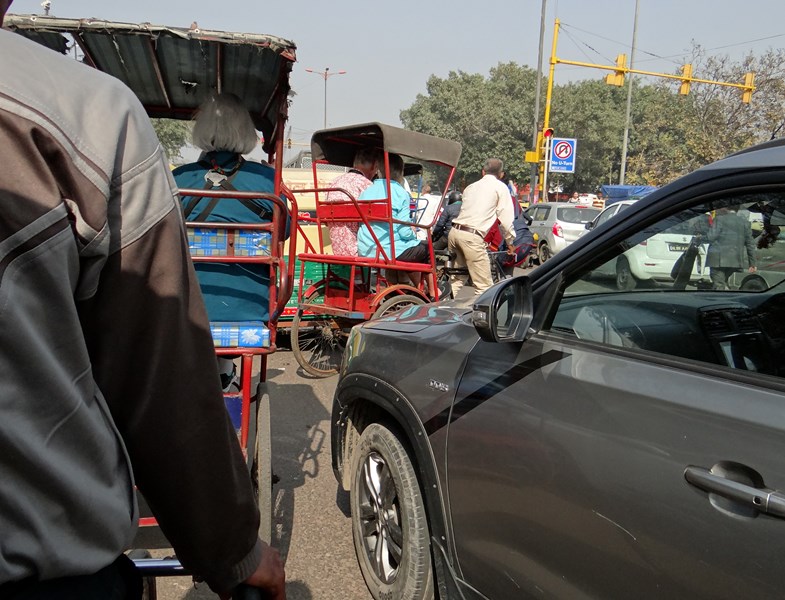
There are times the rickshaw is practically touching a tuk tuk and at one point a car was calling up to our driver,  indicating he wanted him to watch out for his side mirror which he was covering with his hand to avoid a miner collision.
dsc09390-copy
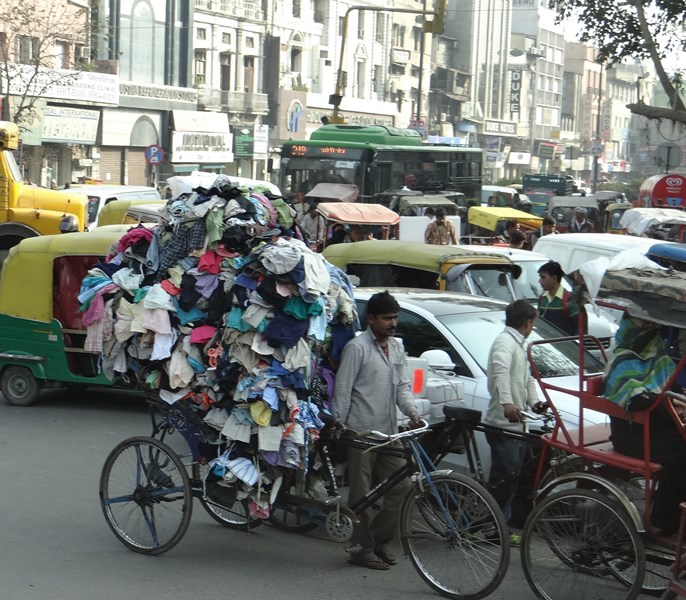
At an intersection we see one of those famous "loads" you see in pictures on the internet. People here work very hard and they carry impossible loads.
dsc09292-copy
We are getting closer to our destination but traffic never let's up.
dsc09290-copy
The rickshaws take us to Jama Masjid, the biggest temple in India where 25,000 people can worship in their square. We will return by bus. More Tomorrow.

Sunday, August 12, 2012

SHANGAI


As we get ready to disembark from the Li River (cruise highway of 10,000 tourists), we see more civilization, bigger villages, and more activity.

Close to the village, we notice bamboo boats with cormorants and while Vicki  describes the treasures of the Li, a 1500 year old banyan tree, a Phoenix Tail Bamboo, (an evergreen), and a blind mandarin fish that lives inside of a rock cave, I’m excited about seeing a cormorant fisherman in action.

The port is  busy with many boats docking at the same place.

From our boat, we can see the fishermen on shore with their birds.

The fishermen have a daytime occupation, getting paid to have their picture taken. They fish at night. Vicky angrily tells us, “do not pay them”. I get a good picture of this fellow because another tourist has paid him and he is posing for her.

If you try to photograph them without paying, they turn their backs to you.

I managed to sneak another shot. At this village, where many  tour boats disembark, vendors of all types swarmed us and Vicki asks us to wait until we get to the Yangtze Market  in Shanghai .  We plow through the throng to our waiting bus.

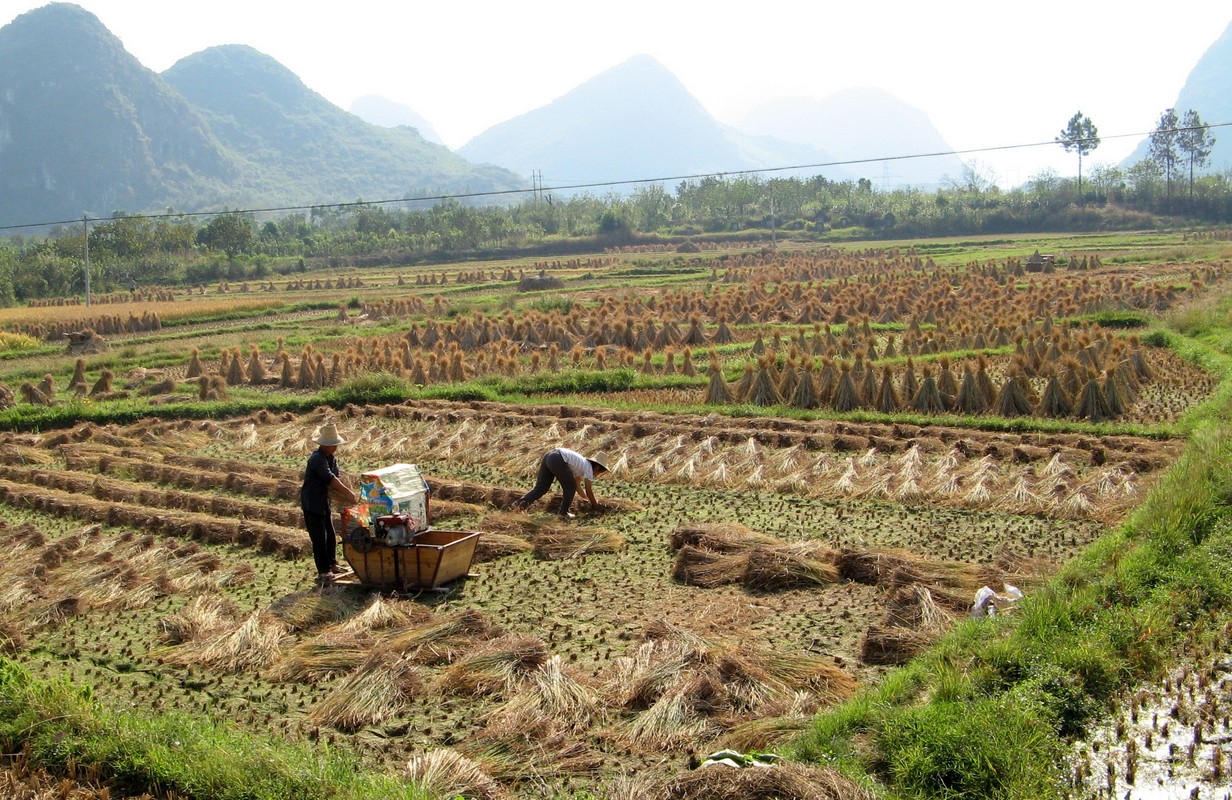
The next morning, we bus to the airport for our next stop at Shanghai. On the way, we see farmers working the fields. They harvest two crops per year, one in March and another from July to November. They still hand cut rice with a sickle. We ask to see a rice paddy. Vicki stops the bus. It is harvest time, but you can see new plants growing in the right hand corner of the picture.

In America, it would all me mechanized. Here people work with rudimentary equipment, hand threshing  hulls from the rice.

Rice plants look like grass; how the people farm is more interesting than the plant itself, and we move on.

Shanghai looks like a futuristic city. It is regarded as a baby city since it is only 200 years old. This is the place where able-bodied men were kidnapped and brought down to the river and put to sea. They were  forced to work on an ocean-going vessel. What was once an opium shipping port in the 1840′s to the 1930′s, with only 100,000 population, and a wild and tawdry reputation,  has become the biggest container shipping port in the world. Now 21,000,000 people live here in an extremely modern city where the Hang Po river and the Yangtze flow through the city of  huge ships and sprightly boats sporting lighted billboards facing the city at night.
We take a city tour by bus. Michele, our city guide,  points out the biggest skyscraper in the world, yet in 1964, no Shanghai building was over ten stories high. They have more skyscrapers than New York City and Hong Kong. Chinese people want to be the biggest, the tallest, the fastest and the best, yet we see business people riding what seems like a million bikes. Some people are licensed to drive cars on Mondays and Wednesdays, others on Tuesday and Thursdays. We see one man carrying a full sized bed on just an ordinary bike. The loads people carry here are legendary. My disk is full and I have no more pictures  until I can buy another disk. So many photo ops of  Shanghai I missed.  The Wedding Cake building, a Soviet building from 1952,  looks like a wedding cake.
Michele takes us to the BUND, Shanghai’s financial district with multiple banks and financial institutions with a sprinkling of old buildings mixed in. China’s  Wall Street. She explains that Shanghai is the business center of China, like New York is the business center of  America. One member of our group visited Shanghai twenty years ago. She said they found one hotel that would take foreigners and no restaurants. People were still wearing black sack cloth peasant clothing and you had to eat from a stand. In China, people over 80 and children under 20 speak English.
Vendors swarm the tourist spots wherever we stop. They sell rip off watches, hand bags, shoes, you name it. Michelle warned us not to buy from them but one member of our group bought a Mickey Mouse watch and before the bus pulled away, it fell apart. She laughed the hardest at her own folly.  The universities here are considered excellent. Michele sang a folk song for us before departing.
I finally get to a photo shop  after lunch to buy a disk, but the city tour is over. The food is bland compared to the marvelous spicy and different tasting specialties we tasted on the road.

And, I finally got a picture of a mother with her child in the split pants, defying the governments directives. Not many years ago, this woman would have had no choice but to obey.
More tomorrow.
Wednesday, June 27, 2012

THE GREAT WALL OF CHINA.


We take a bus to visit one of the seven wonders of the world, the Great Wall of China. I’m so excited, I can hardly believe I’m going to actually walk on the Great Wall of China. On the way, Vicki gives us a history while we look at the passing scene out the windows. We see the Beijing Romance Club, a matchmaking club, which seemed strange in 2006. Now, don’t we all know about on-line matchmaking?  We see farms, fruit orchards, vendors along the highway lay out their produce on blankets. Highway workers in droves sweep the edges of the roads with straw brooms. I mean straw brooms that look like “witches” brooms. China doesn’t buy machinery to do a task that can be accomplished by human labor, though, that is changing. But what then do you do with a huge population of workers without work asks Vicki?  People don’t drive as fast here and the highway is teeming with people on foot.

The walk up to one of the Great Wall’s entrance places is lined with vendors, since the Great Wall is the biggest tourist attraction in all of Asia.

I took a picture of this camel and was shushed away by the owner. Vicki explained that this man makes his living by charging for pictures taken of his camel, usually with mom and the kids standing near it. I felt bad for my “sin”, but I couldn’t read the sign nor undo the picture. Vicki explained that most of these vendors have been licensed to sell here because they were once farmers displaced by the flooding of the Yangtze River.

We enter near one of the towers built to house the soldiers and their families who lived  there and manned the towers all day and night.  I was stunned to learn that. It isn’t as though the Great wall could be driven to from a nearby city during the 1200′s. Somehow, I thought the wall was its own defense, a deterrent. Vicki took us to an entrance that is the farthest from Beijing and not as busy as others. Notice the dip on the right to take rain water away from the steps.

This gives you an idea of the height of the walls at the top, just over five feet tall.  From magazine pictures and travel ads I’d seen, I  thought of the wall as this smooth brick roadway for miles. It is smooth here.  This section has been restored and looks quite new.

I guess I expected an even structure built in a ring at the Chinese borders, never giving much thought to the undulating terrain of the mountain passes it guarded. It is mind-boggling just trying to see in the distance as it traces the tops of the mountains in every direction you look.

It’s uphill, jagged, stairs both straight and crooked; weathered and broken.

You can hike the wall for days, or weeks. We met a family that backpacked in for miles and found vistas, and wild animals, and broken, crumbling sections of the wall where they could climb down and explore the woods and meadows.

When you look over the edge, you realize that the wall is much taller than it looks on the “inside”.  Here Vicki pointed out the remnants of an old fruit orchard the soldiers and their families depended on when they guarded the border. They had to grow their own food and carry or pipe water to farm on the Chinese side of the wall.  On the opposite side, it was part of their job to cut away all vegetation within 30 feet of the enemy side of the wall. Ascending and descending the wall many times a day, to toilet, haul water, tend gardens, and other tasks,  tests the sense of believability.

This is a spot where soldiers could get out to their work detail off the wall.

In inclement weather, you can imagine how treacherous it would be to patrol this wall. It drains one way and then another. Like castle walls, cut outs were built for the soldiers to fire their arrows.  The towers and exits are located I’m guessing about every 300 to 400 feet, or so. Inside those towers, all open to the air above, the families kept warm by body heat and a charcoal brazier, also used for cooking. The feat of building the wall is hard to put your mind around. It at one time stretched 13,171 miles. And, while we were in China, news came that archeologists had uncovered another 400 kilometer section of earthen and stone wall from ancient times. The original wall was started in 200 B.C.  Each section has a distinct character, an individuality, as one worker differed slightly in his method than another. Hauling and mixing the cement in a remote area, hauling the water, again, it tests the sense of believability. I expect they used horses and donkeys to help with the work. Even so, a monumental achievement.

You can see this section of the wall is  shorter, warmer and sunnier.

This was an emotional experience for me. I felt it was worth the whole trip’s expense just to see the wall. I cast one last look at this impossible place, straining my eyes through the mist to see, as far as I could, this amazing wall etched like a painting  on the mountain tops. I hated to leave.
The website below gives some history, facts and pictures of this one of seven of the greatest world wonders.
http://www.chinahighlights.com/greatwall/fact/