Showing posts with label Shanghai. Show all posts

Sunday, August 12, 2012

SHANGAI


As we get ready to disembark from the Li River (cruise highway of 10,000 tourists), we see more civilization, bigger villages, and more activity.

Close to the village, we notice bamboo boats with cormorants and while Vicki  describes the treasures of the Li, a 1500 year old banyan tree, a Phoenix Tail Bamboo, (an evergreen), and a blind mandarin fish that lives inside of a rock cave, I’m excited about seeing a cormorant fisherman in action.

The port is  busy with many boats docking at the same place.

From our boat, we can see the fishermen on shore with their birds.

The fishermen have a daytime occupation, getting paid to have their picture taken. They fish at night. Vicky angrily tells us, “do not pay them”. I get a good picture of this fellow because another tourist has paid him and he is posing for her.

If you try to photograph them without paying, they turn their backs to you.

I managed to sneak another shot. At this village, where many  tour boats disembark, vendors of all types swarmed us and Vicki asks us to wait until we get to the Yangtze Market  in Shanghai .  We plow through the throng to our waiting bus.
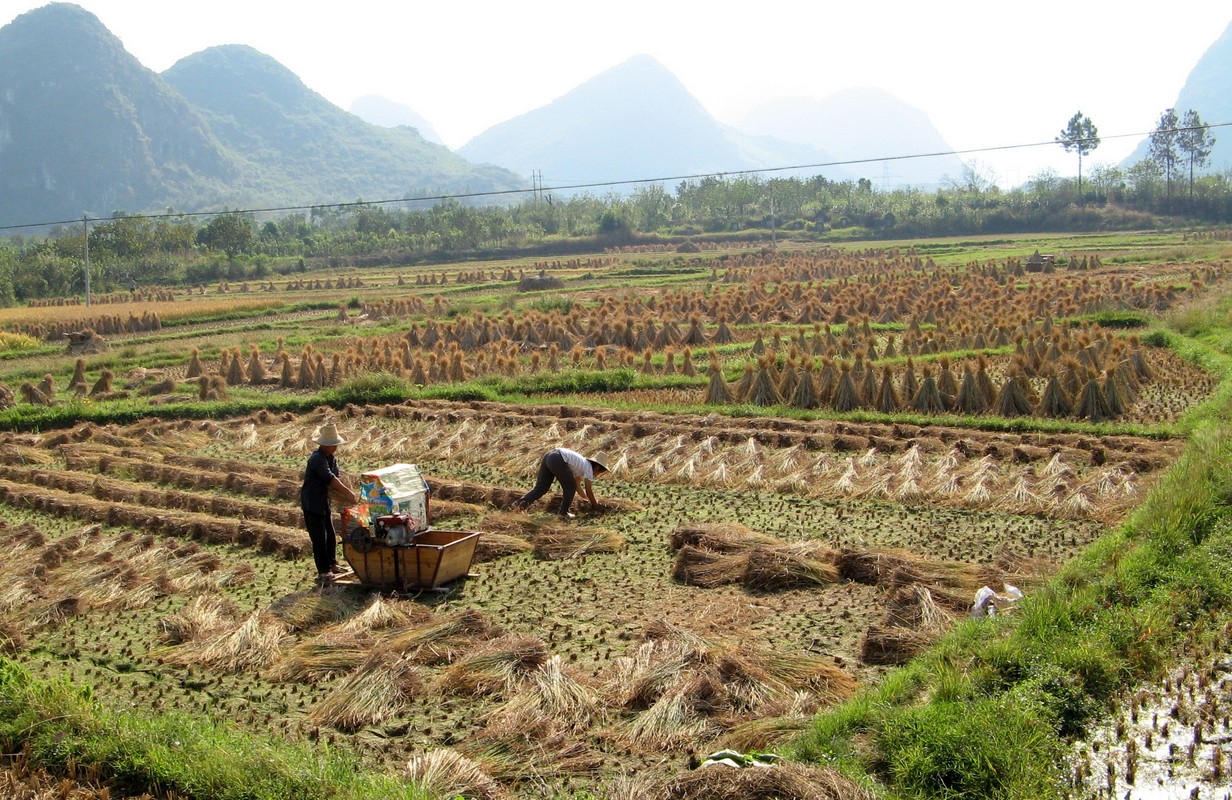
The next morning, we bus to the airport for our next stop at Shanghai. On the way, we see farmers working the fields. They harvest two crops per year, one in March and another from July to November. They still hand cut rice with a sickle. We ask to see a rice paddy. Vicki stops the bus. It is harvest time, but you can see new plants growing in the right hand corner of the picture.

In America, it would all me mechanized. Here people work with rudimentary equipment, hand threshing  hulls from the rice.

Rice plants look like grass; how the people farm is more interesting than the plant itself, and we move on.

Shanghai looks like a futuristic city. It is regarded as a baby city since it is only 200 years old. This is the place where able-bodied men were kidnapped and brought down to the river and put to sea. They were  forced to work on an ocean-going vessel. What was once an opium shipping port in the 1840′s to the 1930′s, with only 100,000 population, and a wild and tawdry reputation,  has become the biggest container shipping port in the world. Now 21,000,000 people live here in an extremely modern city where the Hang Po river and the Yangtze flow through the city of  huge ships and sprightly boats sporting lighted billboards facing the city at night.
We take a city tour by bus. Michele, our city guide,  points out the biggest skyscraper in the world, yet in 1964, no Shanghai building was over ten stories high. They have more skyscrapers than New York City and Hong Kong. Chinese people want to be the biggest, the tallest, the fastest and the best, yet we see business people riding what seems like a million bikes. Some people are licensed to drive cars on Mondays and Wednesdays, others on Tuesday and Thursdays. We see one man carrying a full sized bed on just an ordinary bike. The loads people carry here are legendary. My disk is full and I have no more pictures  until I can buy another disk. So many photo ops of  Shanghai I missed.  The Wedding Cake building, a Soviet building from 1952,  looks like a wedding cake.
Michele takes us to the BUND, Shanghai’s financial district with multiple banks and financial institutions with a sprinkling of old buildings mixed in. China’s  Wall Street. She explains that Shanghai is the business center of China, like New York is the business center of  America. One member of our group visited Shanghai twenty years ago. She said they found one hotel that would take foreigners and no restaurants. People were still wearing black sack cloth peasant clothing and you had to eat from a stand. In China, people over 80 and children under 20 speak English.
Vendors swarm the tourist spots wherever we stop. They sell rip off watches, hand bags, shoes, you name it. Michelle warned us not to buy from them but one member of our group bought a Mickey Mouse watch and before the bus pulled away, it fell apart. She laughed the hardest at her own folly.  The universities here are considered excellent. Michele sang a folk song for us before departing.
I finally get to a photo shop  after lunch to buy a disk, but the city tour is over. The food is bland compared to the marvelous spicy and different tasting specialties we tasted on the road.

And, I finally got a picture of a mother with her child in the split pants, defying the governments directives. Not many years ago, this woman would have had no choice but to obey.
More tomorrow.

Friday, September 9, 2011

SHANGHAI

Saturday morning, we bus to the airport and fly to Shanghai. Shanghai is the business center of China and Beijing is the government center, much like New York and Washington D.C.  We notice the air here is awfully polluted.
We tour the city by bus and  important buildings are pointed out to us by our City Guide, Michelle. A Soviet building from 1952 called the Wedding Cake. All the important banks and financial institutions of the Bund. The Bund is China’s Wall Street, the financial center of China, in the old days,  and now. My one gigabyte sandisk , as it filled to the end, had blank spots during the unloading, and burning process and many of my pictures were lost. The best way to see The Bund is at the following website.
http://en.wikipedia.org/wiki/The_Bund

My one surviving picture of the modern skyline of Shanghai from across the Yangtze. Our City Guide, Michele tells us Shanghai means to the sea. We think of Shanghai as kidnapping and that is part of  Shanghai’s reputation when able-bodied men were taken against their will and brought down the river and put to sea on an ocean-going vessel. Shanghai is regarded as a baby city since it is only 200 years old. What was once an opium shipping port in the 1840’s to the 1930’s, with only 100,000 populations has become one of the biggest container shipping ports in the world. Their biggest exports are silk and tea. Now an astonishing  21,000,000 people live here.   They have the highest building in the world and more  skyscrapers than New York City and Hong Kong. Yet in 1964, no building was over ten stories high. . Chinese people want to be the biggest, the tallest, the fastest and the best.
The city is so modern, yet we still see people driving on different types of  slow-moving motors, and a zillion bikes. Here and in Beijing  people are licensed to drive on Mondays and Wednesdays, others on Tuesdays and Thursdays and so on.  We see one man carrying a full size bed on just an ordinary bike. The loads people in China carry on bikes are legendary. There are many beggars swarming us at bus stops and anywhere tourists congregate selling rip off watches, hand bags, shoes, you name it. One member of our group, though warned, bought a Micky Mouse watch and before the bus had pulled away, it fell apart. She laughed the hardest at her own folly.

Traditionally, Chinese babies and toddlers do not wear diapers. They wear split pants. I tried many times to get a picture of them and finally caught one. The problem is, the children squat in the street and the parents pick up after them;  part of  old China where nothing, including human fertilizer was wasted. The government discourages this practice but notice  resistance from young mothers like this one.

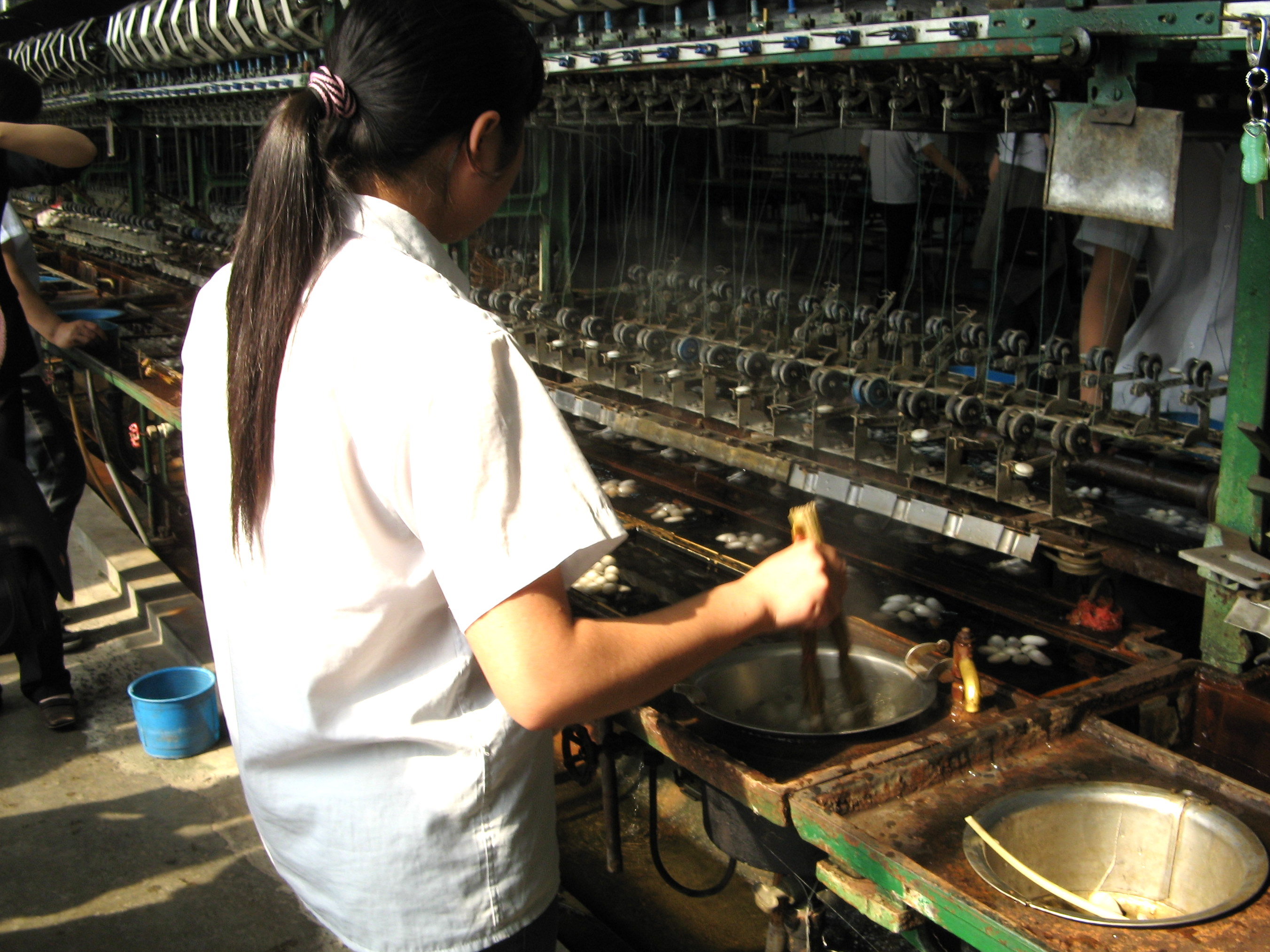
In the afternoon, we visit a silk factory. They harvest these small cocoons, boil them to kill the worm, then dye the silk various colors and spin the silk into large batts.  They sell silk “quilts” and we had a hard time understanding how you could have a quilt made of silk until we watched them take a silk batt and stretch, stretch, and stretch it until it was bed size.

In reality, the silk quilt is a comforter not a  quilt. Silk quilts are reputed to be  very warm for their weight. You do not wash them, we are told.  You air them out twice a year and only wash the outer cover in shampoo. They machine squeeze them so small, you can carry a queen sized quilt like a medium-sized purse.  These factory visits are sales pitches, all tours have them.  They can be educational and worth going to. The whole silk making process was interesting.
We passed a section of freeway where a cement column supporting an over crossing was approximately twelve  feet in diameter?  It was beautifully decorated with writhing dragons. I asked why the need for such a heavy support column. Our city guide explained that it allows the dragons to escape. The road worker found trouble in that spot. They insisted there was a dragon there  and it would be bad luck to cover it up. The government architects came up with a solution. The column is partly hollow and has an exit window. Now, knowing what we do of Chinese culture,  and their superstitions of centuries embedded in  their character, we understand.
We stayed at the Gorgeous Hilton Hotel and ate out our first night. Food here tastes bland compared to the spicy Szechuan food we enjoyed and prefer. The hotel rooms sell condoms and you can buy a large bottle of water for $28. Expensive in this city. To buy a small condo here costs about $200,000. Seems high when they pay workers so little. It was nice to have a good scotch at the bar instead of the tasteless Chinese beer and wine.
That night, we are taken to visit the tallest building in the world, a brand new building with 88 floors.  It costs us $7 to ride the elevator to the top in 45 seconds. Amazingly, you feel no stomach churning lift, it is a seamless ride. The lines to get on the elevators are never-ending. We suspect the building will be paid for by tourism. From the top, we look at a new building being built right next to it by the Japanese which will be even higher at 105 stories. The view from the top is stupendous.

It is a Saturday and all the city lights are lit on the weekends, but not during the week;  a cost saving measure. At the top we see a video of men parachuting from the building. It is against the law, but they did it anyway. What an amazing technology. We have no doubt that China will some day replace the U.S. as the pre-eminent super power. There are, by the way, 20 million Christians in China.
(The photo above  is copyrighted by the Creative Commons Attribution given to wikipedia.)