Showing posts with label tourists. Show all posts

Saturday, June 13, 2015

MURPHYS MUSIC IN THE PARK.

I guess you can say Murphys is a tourist destination. It is an attractive place to visit. The first thing I loved about Murphys when I moved here in 1978 was the creek running through town.
DSC06675 (Copy)
I used to swim in the creek with the other "kids". Now the park is filled to the brim  all summer long with activities, including this venue of Music In The Park. Local caterers prepare dinner you can buy or bring your own along with your ice chest. Or buy wine, beer, tea, coffee and sodas.  My neighbor asked me to come with her, but I had much to do and arrived very late.
DSC06676 (Copy)

I met some old friends in the park, but didn't feel up to dancing so I relaxed and listened to the music. The other side of the creek has room for people along the bank. Not everyone likes the full, crowded areas of the park. Nice to have a choice.
DSC06677 (Copy)
Dogs have to be on a leash and often get invited by their owner's to swim. This one took a long, cool drink before heading back to it's master.
DSC06679 (Copy)
My friend, Jan's,  great granddaughter was hoping to catch the ball in a game the kids were playing.
DSC06680 (Copy)
She caught it and took careful aim at the next person. Ava had been in and out of the water for half the day. We didn't take her home until she turned blue.
I remember those days on the shores of Lake Michigan when I was a kid. Coming in with lips of blue, chilled to the bone, but happy as a clam.
Murphys really is a special place. A lovely way to cool off on a hot day.

Friday, July 19, 2013

POKING AROUND SOULSBYVILLE

IMG_6901 (Copy)
I’ve never stopped in the little gold-rush town of Soulsbyville until my treatments at SpineForce brought me here. My friend Jan and I decided to kind of meander and poke around town.
DSC07602 (Copy)
An old sawdust burner caught my eye. They are huge and hard to miss, of course. I didn’t know there were any left. They’ve all been removed or just fallen down. This one is being cared for and preserved. Bully for Soulsbyville.
DSC07605 (Copy)
Soulsbyville is located above Sonora, CA. on highway 108. And while it was a rip-roaring gold town at one time when the gold petered out, it became a lumbering town. Thus the sawdust burner.
DSC07609 (Copy)
And here, you can just pull over and enjoy a feast of blackberries along the road. Of course, Jan and I ate the big fat black ones before I remembered to get out my camera.
DSC07611 (Copy)
Back on 108 headed down hill, I stopped to take a picture of this funky mailbox. A nearby company manufactures that pipe this fellow is made from. Jan wondered why I took a picture of this mailbox.
DSC07613 (Copy)
This question from a woman who builds pyramids in her yard. Huh?  I like pictures of funky mailboxes. And, in fact, I’m in the process of designing one of my own since my mail box post is rotting and needs replacement.
DSC07614 (Copy)
I was telling Jan how I missed the old Byrd House since they widened the highway and voila! There it was, not gone after all. I was truly surprised and even though it is crowded by a power pole and practically touching the electric wires, I had to record this strange building. It was once Byrd Realty Office, many years ago. I’m glad it has been preserved. I guess I like Eclectic things.
DSC07615 (Copy)
We eventually got to the gold-rush town of Columbia. I told her I knew where there was a dragon but it is in someone’s yard and I’ve never gotten a good picture of it. Well…
DSC07621 (Copy)
Jan pointed out that his snout was blackened and he must snort flames.
DSC07620 (Copy)
Isn’t he handsome?  We found the pipe and propane tank hiding near his tail. And, no one came out and took a shot at us. People are pretty laid back here.
DSC07625 (Copy)
As we were leaving the “dragon” road, we spotted this old miner’s cabin. The Motherlode used to be full of little miners cabins. They, too, are falling apart, being removed and are just supposedly useless relics from the past. This miner knew to build on top of a rock to prevent his foundation from rotting away.
DSC07627 (Copy)
I’m glad this old cabin is still around to remind us of the rudimentary places the miners called home. This one is quite big compared to others I’ve seen, and must have housed a wife and children, too. The brow over the window, or former window, is still holding on.
DSC07628 (Copy)
From the front, you can see a modern address and electric meter. It is very possible someone still lives here.
Jan wanted to visit Spineforce and if she hadn’t been with me I’d have probably just headed for home instead of seeing things from a tourists eyes. It was fun.

Sunday, August 12, 2012

SHANGAI


As we get ready to disembark from the Li River (cruise highway of 10,000 tourists), we see more civilization, bigger villages, and more activity.

Close to the village, we notice bamboo boats with cormorants and while Vicki  describes the treasures of the Li, a 1500 year old banyan tree, a Phoenix Tail Bamboo, (an evergreen), and a blind mandarin fish that lives inside of a rock cave, I’m excited about seeing a cormorant fisherman in action.

The port is  busy with many boats docking at the same place.

From our boat, we can see the fishermen on shore with their birds.

The fishermen have a daytime occupation, getting paid to have their picture taken. They fish at night. Vicky angrily tells us, “do not pay them”. I get a good picture of this fellow because another tourist has paid him and he is posing for her.

If you try to photograph them without paying, they turn their backs to you.

I managed to sneak another shot. At this village, where many  tour boats disembark, vendors of all types swarmed us and Vicki asks us to wait until we get to the Yangtze Market  in Shanghai .  We plow through the throng to our waiting bus.

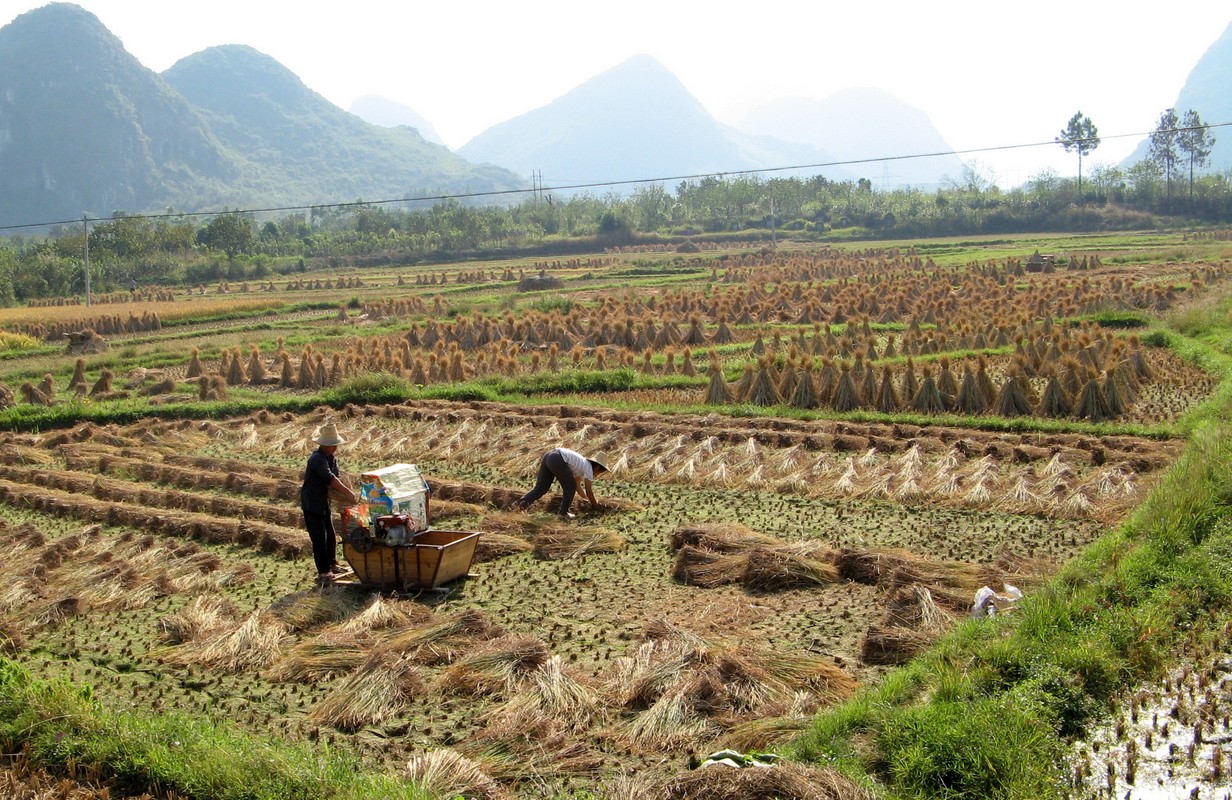
The next morning, we bus to the airport for our next stop at Shanghai. On the way, we see farmers working the fields. They harvest two crops per year, one in March and another from July to November. They still hand cut rice with a sickle. We ask to see a rice paddy. Vicki stops the bus. It is harvest time, but you can see new plants growing in the right hand corner of the picture.

In America, it would all me mechanized. Here people work with rudimentary equipment, hand threshing  hulls from the rice.

Rice plants look like grass; how the people farm is more interesting than the plant itself, and we move on.

Shanghai looks like a futuristic city. It is regarded as a baby city since it is only 200 years old. This is the place where able-bodied men were kidnapped and brought down to the river and put to sea. They were  forced to work on an ocean-going vessel. What was once an opium shipping port in the 1840′s to the 1930′s, with only 100,000 population, and a wild and tawdry reputation,  has become the biggest container shipping port in the world. Now 21,000,000 people live here in an extremely modern city where the Hang Po river and the Yangtze flow through the city of  huge ships and sprightly boats sporting lighted billboards facing the city at night.
We take a city tour by bus. Michele, our city guide,  points out the biggest skyscraper in the world, yet in 1964, no Shanghai building was over ten stories high. They have more skyscrapers than New York City and Hong Kong. Chinese people want to be the biggest, the tallest, the fastest and the best, yet we see business people riding what seems like a million bikes. Some people are licensed to drive cars on Mondays and Wednesdays, others on Tuesday and Thursdays. We see one man carrying a full sized bed on just an ordinary bike. The loads people carry here are legendary. My disk is full and I have no more pictures  until I can buy another disk. So many photo ops of  Shanghai I missed.  The Wedding Cake building, a Soviet building from 1952,  looks like a wedding cake.
Michele takes us to the BUND, Shanghai’s financial district with multiple banks and financial institutions with a sprinkling of old buildings mixed in. China’s  Wall Street. She explains that Shanghai is the business center of China, like New York is the business center of  America. One member of our group visited Shanghai twenty years ago. She said they found one hotel that would take foreigners and no restaurants. People were still wearing black sack cloth peasant clothing and you had to eat from a stand. In China, people over 80 and children under 20 speak English.
Vendors swarm the tourist spots wherever we stop. They sell rip off watches, hand bags, shoes, you name it. Michelle warned us not to buy from them but one member of our group bought a Mickey Mouse watch and before the bus pulled away, it fell apart. She laughed the hardest at her own folly.  The universities here are considered excellent. Michele sang a folk song for us before departing.
I finally get to a photo shop  after lunch to buy a disk, but the city tour is over. The food is bland compared to the marvelous spicy and different tasting specialties we tasted on the road.

And, I finally got a picture of a mother with her child in the split pants, defying the governments directives. Not many years ago, this woman would have had no choice but to obey.
More tomorrow.

Thursday, October 13, 2011

BOONEVILLE, CALIFORNIA

We left Mendocino late in the day with plans to have a beer at the Anderson Valley Brewing Company. I had never visited the small town of Booneville, but I had tasted their awesome beers. As in most craft breweries, they have offerings you cannot buy bottled at your local store.  The place was ten deep at the bar and Jim impatient to move on. (He isn’t a fan of craft brews.)
I believe this is the only North American town that has its own folk language called Boontling. Since he had never heard of Boontling, I thought maybe some of you may not have. The beer labels have this to say in Boontling:  “It’s bahl hornin’”   Which means, it’s good drinking.
An explanation of Boontling  from the Boonville Historical Society:

Boontling

A Little Boont

Boontling has received worldwide interest as a linguistic phenomenon. A few of the words you might see or hear while in Anderson Valley include: bahl gorms (good food), buckey walter (pay phone), pike (to walk or travel), rookie-to (quail), harp (to talk or speak), horn of zeese (cup of coffee) and Boont (Boonville).
Around the turn of the century, Anderson Valley was a very isolated farming and logging community. To pass the time (and have a little fun at it), the locals began to use self-developed terms. The language originated with the women and children workers in the hop fields and eventually spread to become the spoken word for most valley residents. Today, with most fluent “boonters” in their elder years, the Boonting Club, Historical Society and many local businesses work to keep the language alive. Listed below are some common Boontling Terms:
  • Aplenty Bahl Steinber Horn: Really great beer.
  • Apple Head: A girl friend.
  • Bahlest: excellent or great
  • Bahl Hornin’: good drinking
  • Barney Flats: Hendy Woods National Forest. A spectacular forest of virgin redwoods, located in Anderson Valley.
  • Belk Region: Bell Valley. A scenic valley located just beyond the baldies, northeast of Boonville. It was here in the hop fields, during the turn of the century, that the language of Boontling originated.
  • Boont: Boonville. The largest community and focal center of Anderson Valley. The town where the language of Boontling originated. Now famous for its local brewery.
  • Bucky: A nickel (A politically incorrect reference to the Indian head).
  • Bucky Walter: A telephone
  • Charlie Ball: To embarrass (A local indian of this name was easily embarrassed).
  • Deep Enders: Residents of the town of Navarro, located due west of Anderson Valley and bordering the Pacific Coast.
  • Heelch: A large quantity.
  • High Rollers: Residents of the town of Yorkville, the smallest town in Anderson Valley. Located 10 miles east of Boonville.
  • Horn: A drink; to drink. (Dialectal.)
  • Jeffer: A large fire. (A Boonter named Jeff built large fires in his fireplace.)
  • Shoveltooth: A doctor; an M.D. (A local doctor was so nicknamed because he had protruding teeth.)
  • It’s not just shy sluggin’ gorms neemer: It’s not just for breakfast anymore.
  • It’s a slow lope’n a beeson tree: Literally a comfortable pace on a horse, while sitting on a very comfortable saddle. Commonly referred to mean “a mellow ride.”
  • Pike: A hike or stroll
  • Poleeko: Philo. The second largest town in Anderson Valley, located 6 miles west of Boonville.
  • Rudy nebs: pristine, mineral rich, well water.
  • Tidrik: A party; a social gathering. (Probably from “tea drink,” a dialectal expression meaning the same thing.)
  • Zeese: Coffee. (A local hunter-camp cook nicknamed Zeese, from his initials Z.C., made bitterly strong coffee.
At one time, people would stop at a Booneville Cafe, or the gas station, and hear this strange language  and wonder if the town’s people were  a bit daft. While they are quite comfortable among themselves with their lingo,  some folks admitted  to “putting  it on”  a bit for the tourists.  It must have helped. The lingo put Boonville forever in the history books as a unique place.
I’ve read of instances of children forming their own personal language. And folk languages are fairly common in other countries, Australia, and Germany,  to name two.  When Jim and I traveled last year through southern Louisiana, the Cajun French is  clearly an adapted form of French, English and German, a living language particular to that region. Living language changes within our lifetimes and it makes me wonder about the proclivities of texting, and computer short-speak.  How will it affect our language?  Pity the French. They have a language minister whose job it is to protect the language from being bastardized. A losing battle in my opinion.