Before
leaving Beijing, we attended the traditional Opera that is no longer
performed anywhere in China but Beijing. It is considered old-fashioned,
an old art. There were no pictures allowed of the opera, nor the
beautiful costumes on display in the lobby. Cast members entertained
us at our tables while we enjoyed refreshments. A teapot with a
three-foot long spout was used to dramatically pour our tea into tiny
cups without splashing or spilling a drop, much to our delight. On
stage, one very acrobatic act performed in slow motion, with every
muscle in coordination, had us holding our breath. The performers
painted faces were allowed to show no emotions; their lips could not
move, not even to take a breath. You could see their nostrils flare as
they took in air during extremely strenuous moves. It put us on the edge
of our seats. The opera is part singing, part acrobatics and part
storytelling. One story (all printed in English on screens at the side
of the stage) involved a hateful government edict presented to the
people. They conspire to steal the key and change the offensive edict.
This is important because in old China, it was the only form of protest
the people had, through their art. One act was a about a Shogan who
falls in love with his concubine. Another "social issue." It was
wonderful. Viki told us most people skip the Opera, but, I would
certainly recommend it if you have a chance to see it.

The
next morning, we flew to Xian, pronounced shy-ann. Realize that the
soldiers were discovered in 1974 and they have been designated the 8th
wonder of the world. Xian was once the capital of China during the first
of thirteen dynasties, the Ching Dynasty. Here, underground, lay the
roots of the dynasty, for over 2000 years. The photo of a photo taken
by the archaeologists shows what the soldiers looked like as they began
to uncover this phenomenal treasure.

The
soldiers are displayed in the pits from which they came and covered
over by a roof. This photo shows the immensity of this pit. They carried
weapons because the soldiers were ready to do battle for their emperor
when he died. The soldiers were destroyed by the incoming faction of
government after the Emperor who ordered the armies built, died, while
inspecting the army. The soldiers weapons were removed, then the
figures were broken up and covered over.

This
photo shows the depth of one of the pits. There is six pits open to
the public if I remember correctly. There is 8,000 soldiers, over three
hundred chariots, wagons, and horses, jade armor, animals, dancer,
acrobats plus other people, statesmen or persons important to the
Emperor.

A
flash only carries so far and it is difficult to get really good
pictures of the soldiers. But the immensity of the task and the visible
definition of the clothing, the hands, the features overwhelms. I find
myself continually amazed at the wonders people crafted when given
inspiration, and that I should have the privilege of seeing them.

The
soldiers, when first removed had color in their faces and clothing. The
Chinese government is building a new museum for the soldiers because
they've lost their color from exposure to light and air. The roof leaks
in places and since the discovery, they've found 73 more mounds, 16 of
which they've opened up and reburied until they have perfected a
technology to preserve the color and prevent deterioration of the
figures. The rest will not be opened until they have the financial
reserves and technology to care for this enormous treasure. The
Terracotta Army is also a UNESCO site. UNESCO means this is a world
treasure, to be preserved for all mankind and funded and preserved by
shared funds. That designation carries a lot of responsibility and
cooperation between countries around the world and benefits all of us.

Some of the best views of the warriors are replicas from the museum store.

You
can buy one of these and have it shipped back to the United States. The
replicas are a treasure as well as the man who discovered the soldiers
and had to turn his farm over to the government. He was given the
official job as book signer. He is a small man, very quiet, doesn't say
much. He is no longer allowed to have his picture taken because his
eyes were damaged by so many flashes. A cute story about him: He was
told President Clinton would be visiting and he was taught a bit of
English to greet the President. He learned to say "How are you?" He was
coached that the Clintons would likely say, fine, thank you and he
should answer, I'm fine too. But, Clinton said "Hello". And the farmer,
who was nervous said, "Who are you?" And Clinton said, "I'm Hillary
Clinton's husband." And the farmer said "Me too!"

The
Provincial Shaanxi History Museum, adjacent to the pits, holds this
team of horses. All under glass, tough to get a decent photo of them.

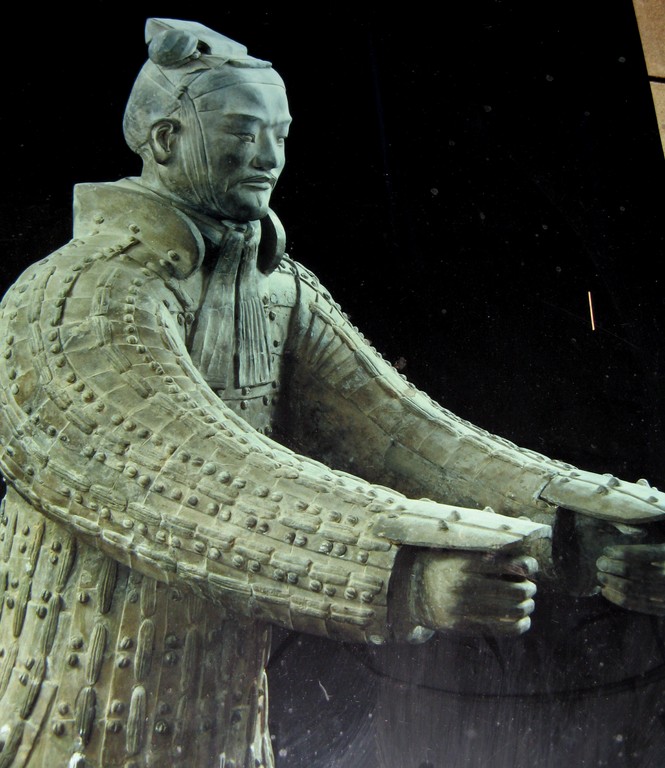
And
this chariot driver. The detail in the clothing, the hands, the
faces...truly awesome. All of these figures were modeled after real
people. They were fired in kilns and then painted.

The horse to me has a wary expression as though aware of a stranger's approach.

I was surprised at how little from the pits was in the museum. Hopefully that will change as they rebuild and restore.

One
of the best things about the museum was their noodle lunch. A guy on
each end of a long counter holds a hunk of noodle dough like this. This
cook was quickly shaving off a piece of dough into hot broth that made
wide noodles. Xian is a hard wheat growing region. It used to be that for birthday celebrations, long noodles were made to fit around a child's waist. Now they want cake.

The
guy on the other end of the system, had the same size hunk of dough
that he stretched, and stretched and stretched until it spontaneously
separated into this long strand of fine noodles. It was a real show to
watch. I tasted both soups and they were both delicious. I guess it
doesn't take much to impress Westerners. I loved it. Is it any wonder
Marco Polo decided to bring this wonderful food back to Italy?

I fell in love with the exquisite pottery in the museum. This piece is a pillow, believe it or not.

My second favorite was a depiction of what an ancient Chinese home would look like, with animals encased in the same abode.

Notice the precisely rendered hooves on this horse. This artist loved horses, you can tell.

And the musicians on a camel. Whimsical.
For more pottery, click the link below:
https://picasaweb.google.com/106530979158681190260/TerraCottaWarriors