Showing posts with label construction. Show all posts

Saturday, September 7, 2013

GHOST TOWN WITH A GHOST.

DSC09644 (Copy)
Our travel goal yesterday was to avoid the boom-town of Williston and seek out the little town of Baineville, just on the border of N.D. and Montana. Jim found a website for Buffalo Trails Museum at Epping, which was closed, but we decided to have a look at the area anyway. It was about 10 miles out of our way. The turn-off required us to cross two lanes, a meridian and another two lanes of oncoming traffic and whoops!  The road is gravel? Oh, well, we're committed. We bumped miserably along popping rivets and screws and bolts, we are sure,  for about ten miles.
DSC09655 (Copy)
we pulled into town and parked next to this ramshackle old building.
DSC09766 (Copy)
There wasn't a car or a person anywhere in sight. With a one block main street we just walked along taking pictures of this "ghost" town and peeked in the windows.
DSC09657 (Copy)
After a few minutes of poking around, Heather appeared out of nowhere and began watering plants in front of the school.
DSC09683 (Copy)
She took us to the Museum office and introduced us to Shelly. These two women are the only two people who have keys to the buildings we were looking into and even though the museum was closed, they opened up  the buildings and allowed us to tour the complex.
DSC09660 (Copy)
In the front part of the office was a dental exhibit, all items here have been donated by locals. I don't know the population of the town in 1905 when Epping was founded adjacent to the Northern Pacific Railroad, but in 2010 the population was 100 people according to the census. DSC09676 (Copy)
In every building, the human figures were made out of papier mache  by a guy named Elmer. DSC09667 (Copy)
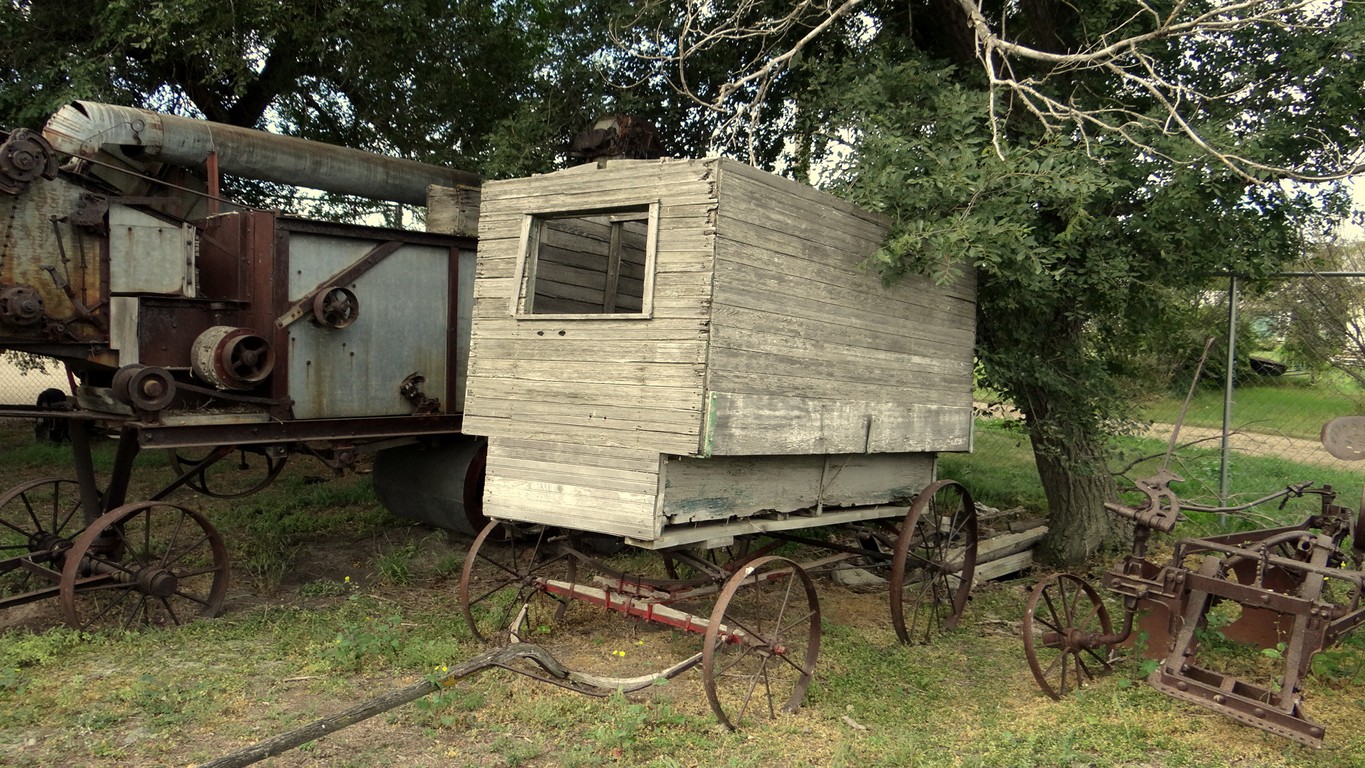
Behind the office was some rolling stock. Kind of reminded me of  a Bonnie and Clyde affair.
DSC09670 (Copy)
My quest for something I've never seen before was soon answered. This little wooden horse-drawn wagon is a school bus.
DSC09689 (Copy)
Elmer did a lot of work here. A life sized diorama of his family, with Elmer in bed getting medicine from the doctor, his little brother crying.
DSC09694 (Copy)
This gentleman reading the paper in an exhibit looks just like pictures of Elmer.  In fact, almost all of the gentlemen in the exhibits look like Elmer.
DSC09686 (Copy)
Elmer put together several very authentic box dioramas in which he went to the hill where this Indian village was located, he studied the topography, even picked the grass from the site to make this scene.  He must have been an interesting character.
DSC09684 (Copy)
One building has a unique cement floor.
DSC09737 (Copy)
The one room school house classroom is in beautiful condition.
DSC09701 (Copy)
North Dakota winters require a mighty stove and this one is a beauty.
DSC09719 (Copy)
You'll notice in this kitchen exhibit the wall paper is made from newspaper, not uncommon in the early 1900's.
DSC09729 (Copy)
Another item I'd never seen, a painted story hide.
DSC09745 (Copy)
And from the General Store, a marshmallow beater. I can't quite fathom how I've managed my life without one.
DSC09678 (Copy)
The cafe building is historic as is the tavern. Both are open businesses. The tavern was closed but the cafe was open. We didn't see any activity around the cafe for the hour we wandered the street until lunchtime. Then out of nowhere a few trucks and cars pulled up for the daily special, a cheeseburger and tomato soup. DSC09757 (Copy)
We practically sat under this buffalo head for our lunch. But, I'm digressing. This is a ghost story.
DSC09690 (Copy)
This exhibit is one the ghost likes to fool with. There is a big space between the two shelving units in this building. Heather and Shelly never enter this room alone because it gives them the willies and they have the only keys. The board was replaced, by a carpenter, screwed in, and, when they returned, it went missing. After three tries, they gave up.
DSC09693 (Copy)
A glass stopper collection was removed for dusting. The girls placed them on top of the case in rows. When they returned, they were disheveled and moved around. Twice. Lights that have been turned out, go on. They think they know who the ghost is.
DSC09651 (Copy)
The man who owned this hardware store hung himself in the open window above so everyone returning from church could see him hanging there. They replaced the window. And the next day it was broken out. They replaced it again. The same thing happened. Now, they just leave it open.
We left Epping glad we braved the bad road and got direction from the girls to a short gravel road to a paved highway that took us right into Williston. We breezed on through.DSC09784 (Copy)
Everywhere, we see mobile homes in clusters, temporary housing for oil workers. Billboards advertise for house builders needed, jobs, jobs, jobs. It is a boom phenomena. People rent out space in their yards to two or three mobiles.
DSC09788 (Copy)
Road workers needed.
DSC09774 (Copy)
Every half mile or so, we see another well going in.
DSC09791 (Copy)
Bainville was another gravel road town without even a mom and pop store or gas pump. A post office and a church with a few houses. We pushed on 14 miles west to Culbertson, Montana and spent the night in a delightful city park.

Wednesday, June 27, 2012

THE GREAT WALL OF CHINA.


We take a bus to visit one of the seven wonders of the world, the Great Wall of China. I’m so excited, I can hardly believe I’m going to actually walk on the Great Wall of China. On the way, Vicki gives us a history while we look at the passing scene out the windows. We see the Beijing Romance Club, a matchmaking club, which seemed strange in 2006. Now, don’t we all know about on-line matchmaking?  We see farms, fruit orchards, vendors along the highway lay out their produce on blankets. Highway workers in droves sweep the edges of the roads with straw brooms. I mean straw brooms that look like “witches” brooms. China doesn’t buy machinery to do a task that can be accomplished by human labor, though, that is changing. But what then do you do with a huge population of workers without work asks Vicki?  People don’t drive as fast here and the highway is teeming with people on foot.

The walk up to one of the Great Wall’s entrance places is lined with vendors, since the Great Wall is the biggest tourist attraction in all of Asia.

I took a picture of this camel and was shushed away by the owner. Vicki explained that this man makes his living by charging for pictures taken of his camel, usually with mom and the kids standing near it. I felt bad for my “sin”, but I couldn’t read the sign nor undo the picture. Vicki explained that most of these vendors have been licensed to sell here because they were once farmers displaced by the flooding of the Yangtze River.

We enter near one of the towers built to house the soldiers and their families who lived  there and manned the towers all day and night.  I was stunned to learn that. It isn’t as though the Great wall could be driven to from a nearby city during the 1200′s. Somehow, I thought the wall was its own defense, a deterrent. Vicki took us to an entrance that is the farthest from Beijing and not as busy as others. Notice the dip on the right to take rain water away from the steps.

This gives you an idea of the height of the walls at the top, just over five feet tall.  From magazine pictures and travel ads I’d seen, I  thought of the wall as this smooth brick roadway for miles. It is smooth here.  This section has been restored and looks quite new.

I guess I expected an even structure built in a ring at the Chinese borders, never giving much thought to the undulating terrain of the mountain passes it guarded. It is mind-boggling just trying to see in the distance as it traces the tops of the mountains in every direction you look.

It’s uphill, jagged, stairs both straight and crooked; weathered and broken.

You can hike the wall for days, or weeks. We met a family that backpacked in for miles and found vistas, and wild animals, and broken, crumbling sections of the wall where they could climb down and explore the woods and meadows.

When you look over the edge, you realize that the wall is much taller than it looks on the “inside”.  Here Vicki pointed out the remnants of an old fruit orchard the soldiers and their families depended on when they guarded the border. They had to grow their own food and carry or pipe water to farm on the Chinese side of the wall.  On the opposite side, it was part of their job to cut away all vegetation within 30 feet of the enemy side of the wall. Ascending and descending the wall many times a day, to toilet, haul water, tend gardens, and other tasks,  tests the sense of believability.

This is a spot where soldiers could get out to their work detail off the wall.

In inclement weather, you can imagine how treacherous it would be to patrol this wall. It drains one way and then another. Like castle walls, cut outs were built for the soldiers to fire their arrows.  The towers and exits are located I’m guessing about every 300 to 400 feet, or so. Inside those towers, all open to the air above, the families kept warm by body heat and a charcoal brazier, also used for cooking. The feat of building the wall is hard to put your mind around. It at one time stretched 13,171 miles. And, while we were in China, news came that archeologists had uncovered another 400 kilometer section of earthen and stone wall from ancient times. The original wall was started in 200 B.C.  Each section has a distinct character, an individuality, as one worker differed slightly in his method than another. Hauling and mixing the cement in a remote area, hauling the water, again, it tests the sense of believability. I expect they used horses and donkeys to help with the work. Even so, a monumental achievement.

You can see this section of the wall is  shorter, warmer and sunnier.

This was an emotional experience for me. I felt it was worth the whole trip’s expense just to see the wall. I cast one last look at this impossible place, straining my eyes through the mist to see, as far as I could, this amazing wall etched like a painting  on the mountain tops. I hated to leave.
The website below gives some history, facts and pictures of this one of seven of the greatest world wonders.
http://www.chinahighlights.com/greatwall/fact/