Showing posts with label soldiers. Show all posts

Saturday, September 22, 2012

FROM A WRONG NUMBER.

Some days are fast-moving and adventurous. My daughter, Kris and Son Ken share a family plan for their phones since they live in the same city. While driving to work, Kris got a phone call meant for her brother’s family. The caller was asking her if she could take on an exchange student from Italy. She stopped the car and said, Yes!  Her brother had done it the year before. Why not? The woman asking explained that she had to place two boys in 24 hours or they would lose their right to exchange. Zoom, Kris had a mountain of paperwork to fill out, proof of employment. She had to take pictures of her house and family and the dogs. Fax it to Italy. They approved her and asked if she knew anyone who would take the other boy.
“My brother and his wife,” of course.   Ken said yes before he could consult with Laurie. And, just as fast, they were approved.
For Kris, as it turned out, it was her son’s birthday and they would be celebrating his birthday that day and picking up their student that night at midnight. When I get pictures, I’ll give an update.
We had an exchange student from Indonesia in 1986, that turned into a wonderful learning and exciting experience for all of us. We still keep in touch with Linda and her family. I visited them for the first time in 2004.

This is Linda with her daughter and son.
My youngest daughter was an exchange student to France in 1987. The son of one of her French sisters visited us last year.  Now she is hosting a graduate student from Brazil. I will get to meet him at Thanksgiving.
Hosting students from all over the world is such an enriching experience. Understanding other cultures is an advance toward peace between nations, which is what got the initial public exchange program going after WWII. It was named AFS, which stands for American Field Service,  an idea from soldiers who, like today, find people wonderful and endearing in  an “enemy” country. I’m sorry to say, it hasn’t stopped wars. But, I’m pleased to say, there are many, many student exchange organizations still making inroads to peace.
I’m glad my kids are spreading the tradition to their families. If you ever feel you have time to have a temporary addition to your family, having an exchange student is a wonderfully rewarding experience. In fact students report that their exchanges have been life changing events when they learn how others live.

Sunday, July 1, 2012

BEIJING OPERA AND THE TERRACOTTA ARMY OF XIAN.


Before leaving Beijing, we attended the traditional Opera that is no longer performed anywhere in China but Beijing. It is considered old-fashioned, an old art. There were no pictures allowed of the opera, nor the beautiful costumes on display in the lobby.  Cast members  entertained us at our tables while we enjoyed refreshments. A teapot with a three-foot long spout was used to dramatically pour our tea into tiny cups without splashing or spilling a drop, much to our delight. On stage,  one very acrobatic act performed in slow motion, with every muscle in coordination, had us holding our breath. The performers painted faces were allowed to show no emotions;  their lips could not move, not even to take a breath. You could see their nostrils flare as they took in air during extremely strenuous moves. It put us on the edge of our seats.  The opera is part singing, part acrobatics and part storytelling. One story (all printed in English on screens at the side of the stage) involved a hateful government edict presented to the people. They conspire to steal the key and change the offensive edict. This is important because in old China, it was the only form of protest the people had, through their art. One act was a about a Shogan who falls in love with his concubine. Another "social issue."  It was wonderful. Viki told us most people skip the Opera, but, I would certainly recommend it if you have a chance to see it.

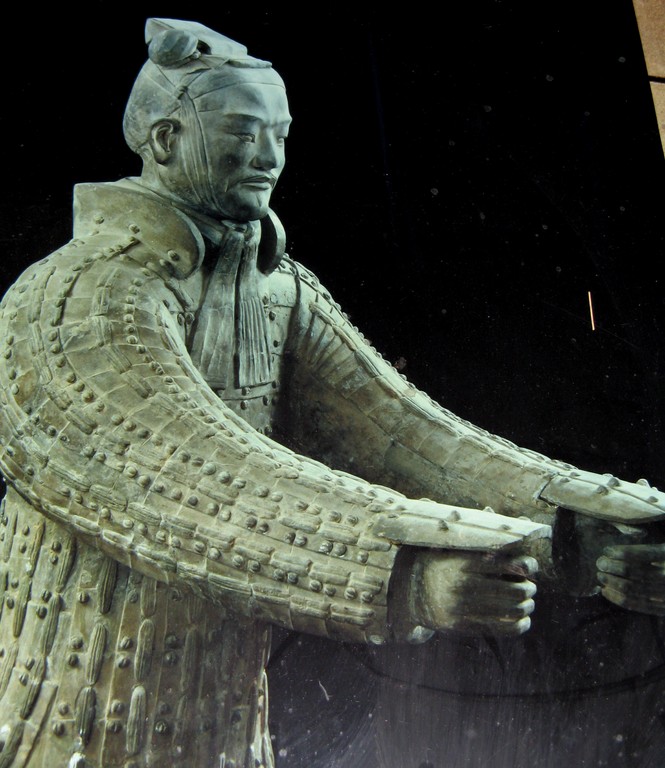
The next morning, we flew to Xian, pronounced shy-ann. Realize that the soldiers were discovered in 1974 and they have been designated the 8th wonder of the world. Xian was once the capital of China during the first of thirteen dynasties, the Ching Dynasty. Here, underground, lay the roots of the dynasty, for over 2000 years. The photo of a  photo taken by  the archaeologists shows what the soldiers looked like as they began to uncover this phenomenal treasure.

The soldiers are displayed  in the pits from which they came and covered over by a roof. This photo shows the immensity of this pit. They carried weapons because  the soldiers were ready to do battle for their emperor when he died.   The soldiers were destroyed by the incoming faction of government after the Emperor who ordered the armies built,  died,  while inspecting the army.  The soldiers weapons were removed, then the figures were broken up and covered over.

This photo shows the depth of  one of the pits.  There is six  pits open to the public if I remember correctly. There is 8,000 soldiers, over three hundred chariots, wagons, and horses, jade armor, animals, dancer,  acrobats plus other people, statesmen or persons important to the Emperor.

A flash only carries so far and it is difficult to get  really good pictures of the soldiers. But the immensity of the task and the visible definition of the clothing, the hands, the features overwhelms. I find myself continually amazed at the wonders people crafted when given inspiration, and that I should have the privilege of seeing them.

The soldiers, when first removed had color in their faces and clothing. The Chinese government is building a new museum for the soldiers because they've lost their color from exposure to light and air. The roof leaks in places and since the discovery, they've found 73 more mounds, 16 of which they've opened up and reburied until they have perfected a technology to preserve the color and prevent deterioration of the figures. The rest will not be opened until they have the financial reserves and technology to care for this enormous treasure. The Terracotta Army is also a UNESCO site. UNESCO means this is a world treasure, to be preserved for all mankind and funded and preserved by shared funds. That designation carries a lot of responsibility and cooperation between countries around the world and benefits all of us.

Some of the best views of the warriors are replicas from the museum store.

You can buy one of these and have it shipped back to the United States. The replicas are a treasure as well as the man who discovered the  soldiers and had to turn his farm over to the government. He was given the official job as book signer. He is a small man, very quiet, doesn't say much.  He is no longer allowed to have his picture taken because his eyes were damaged by so many flashes. A cute story about him:  He was told President Clinton would be visiting and he was taught a bit of English to greet the President. He learned to say "How are you?" He was coached that the Clintons would likely say, fine, thank you and he should answer, I'm fine too. But, Clinton said "Hello".  And the farmer, who was nervous said, "Who are you?" And Clinton said, "I'm Hillary Clinton's husband." And the farmer said "Me too!"

The Provincial Shaanxi History Museum, adjacent to the pits,  holds this team of horses. All under glass, tough to get a decent photo of them.

And this chariot driver.  The detail in the clothing, the hands, the faces...truly awesome. All of these figures were modeled after real people. They were fired in kilns and then painted.

The horse to me has a wary expression as though aware of a stranger's approach.

I was surprised at how little from the pits was  in the museum. Hopefully that will change as they rebuild and restore.

One of the best things about the museum was their noodle lunch. A guy on each end of a long counter holds a hunk of noodle dough like this. This cook was quickly shaving off a piece of dough into hot broth that made wide noodles. Xian is a hard wheat growing region. It used to be that for birthday celebrations, long noodles were made to fit around a child's waist. Now they want cake.

The guy on the other end of the system, had the same size hunk of dough that he stretched, and stretched and stretched until it spontaneously separated into this long strand of fine noodles. It was a real show to watch. I tasted both soups and they were both delicious. I guess it doesn't take much to impress Westerners. I loved it. Is it any wonder Marco Polo decided to bring this wonderful food back to Italy?

I fell in love with the exquisite pottery in the museum. This piece is a pillow, believe it or not.

My second favorite was a depiction of what an ancient Chinese home would look like, with animals encased in the same abode.

Notice the precisely rendered  hooves on this horse. This artist loved horses, you can tell.

And the musicians on a camel. Whimsical.
For more pottery, click the link below:
https://picasaweb.google.com/106530979158681190260/TerraCottaWarriors

Wednesday, June 27, 2012

THE GREAT WALL OF CHINA.


We take a bus to visit one of the seven wonders of the world, the Great Wall of China. I’m so excited, I can hardly believe I’m going to actually walk on the Great Wall of China. On the way, Vicki gives us a history while we look at the passing scene out the windows. We see the Beijing Romance Club, a matchmaking club, which seemed strange in 2006. Now, don’t we all know about on-line matchmaking?  We see farms, fruit orchards, vendors along the highway lay out their produce on blankets. Highway workers in droves sweep the edges of the roads with straw brooms. I mean straw brooms that look like “witches” brooms. China doesn’t buy machinery to do a task that can be accomplished by human labor, though, that is changing. But what then do you do with a huge population of workers without work asks Vicki?  People don’t drive as fast here and the highway is teeming with people on foot.

The walk up to one of the Great Wall’s entrance places is lined with vendors, since the Great Wall is the biggest tourist attraction in all of Asia.

I took a picture of this camel and was shushed away by the owner. Vicki explained that this man makes his living by charging for pictures taken of his camel, usually with mom and the kids standing near it. I felt bad for my “sin”, but I couldn’t read the sign nor undo the picture. Vicki explained that most of these vendors have been licensed to sell here because they were once farmers displaced by the flooding of the Yangtze River.

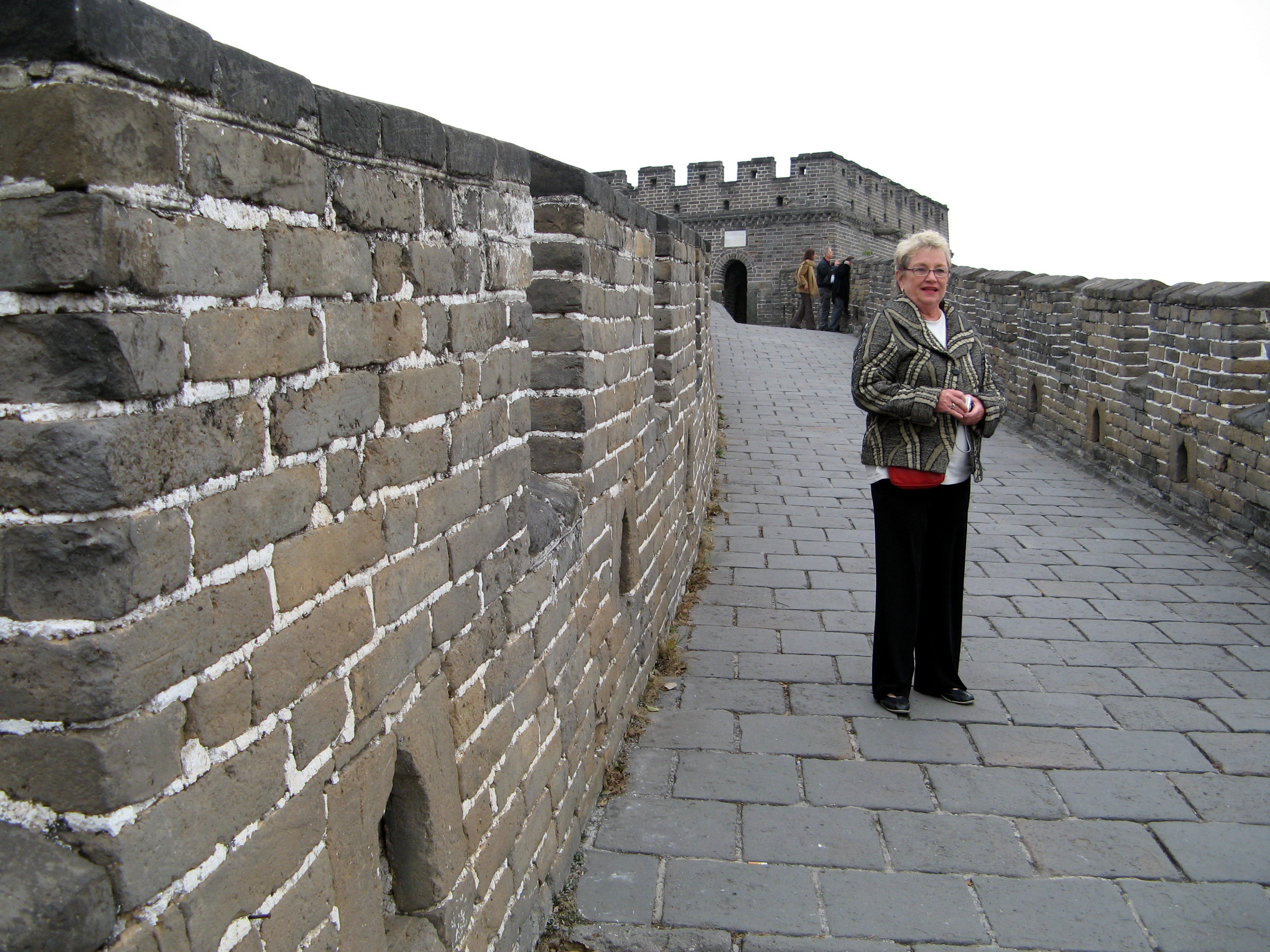
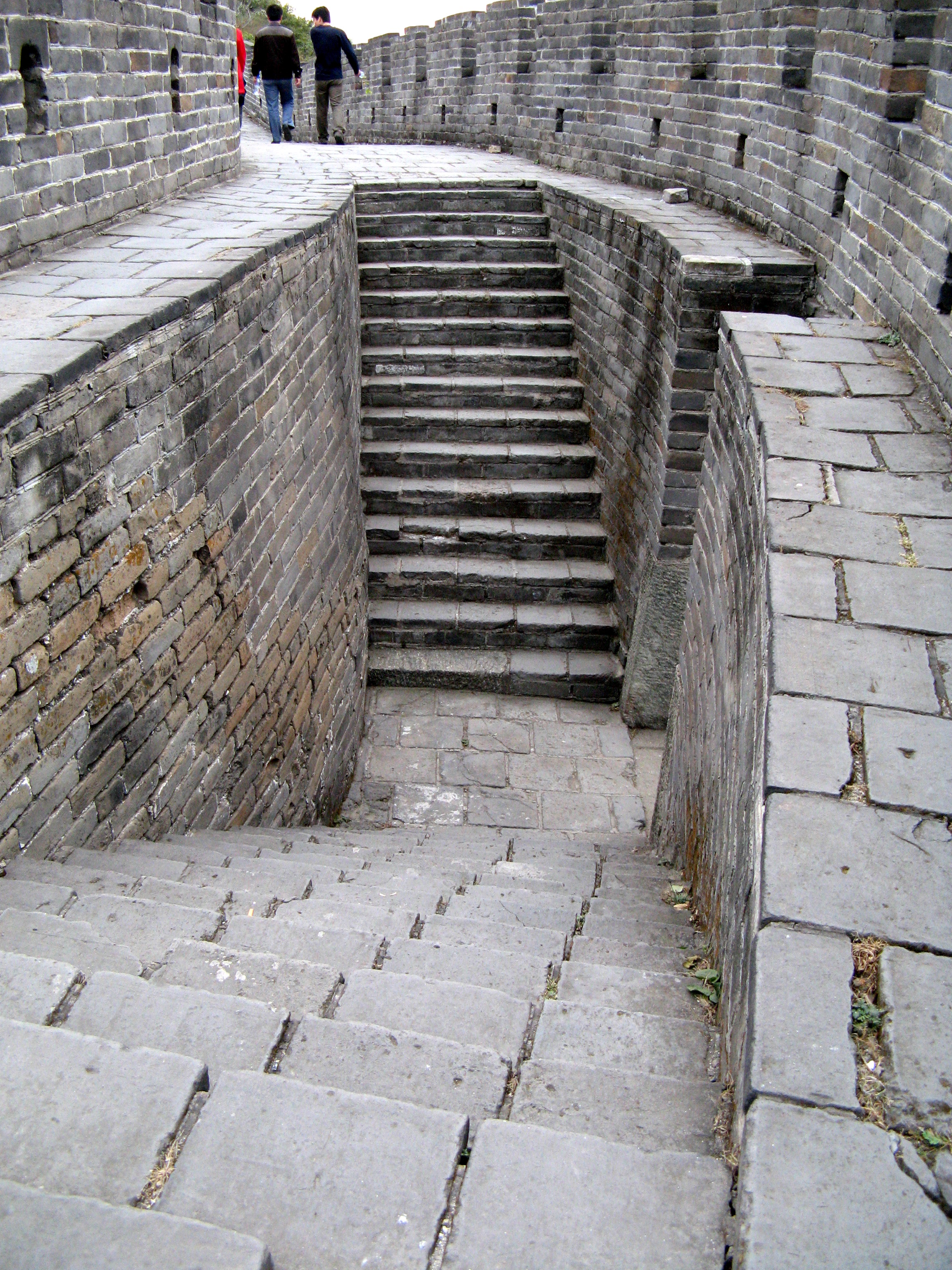
We enter near one of the towers built to house the soldiers and their families who lived  there and manned the towers all day and night.  I was stunned to learn that. It isn’t as though the Great wall could be driven to from a nearby city during the 1200′s. Somehow, I thought the wall was its own defense, a deterrent. Vicki took us to an entrance that is the farthest from Beijing and not as busy as others. Notice the dip on the right to take rain water away from the steps.

This gives you an idea of the height of the walls at the top, just over five feet tall.  From magazine pictures and travel ads I’d seen, I  thought of the wall as this smooth brick roadway for miles. It is smooth here.  This section has been restored and looks quite new.

I guess I expected an even structure built in a ring at the Chinese borders, never giving much thought to the undulating terrain of the mountain passes it guarded. It is mind-boggling just trying to see in the distance as it traces the tops of the mountains in every direction you look.

It’s uphill, jagged, stairs both straight and crooked; weathered and broken.

You can hike the wall for days, or weeks. We met a family that backpacked in for miles and found vistas, and wild animals, and broken, crumbling sections of the wall where they could climb down and explore the woods and meadows.

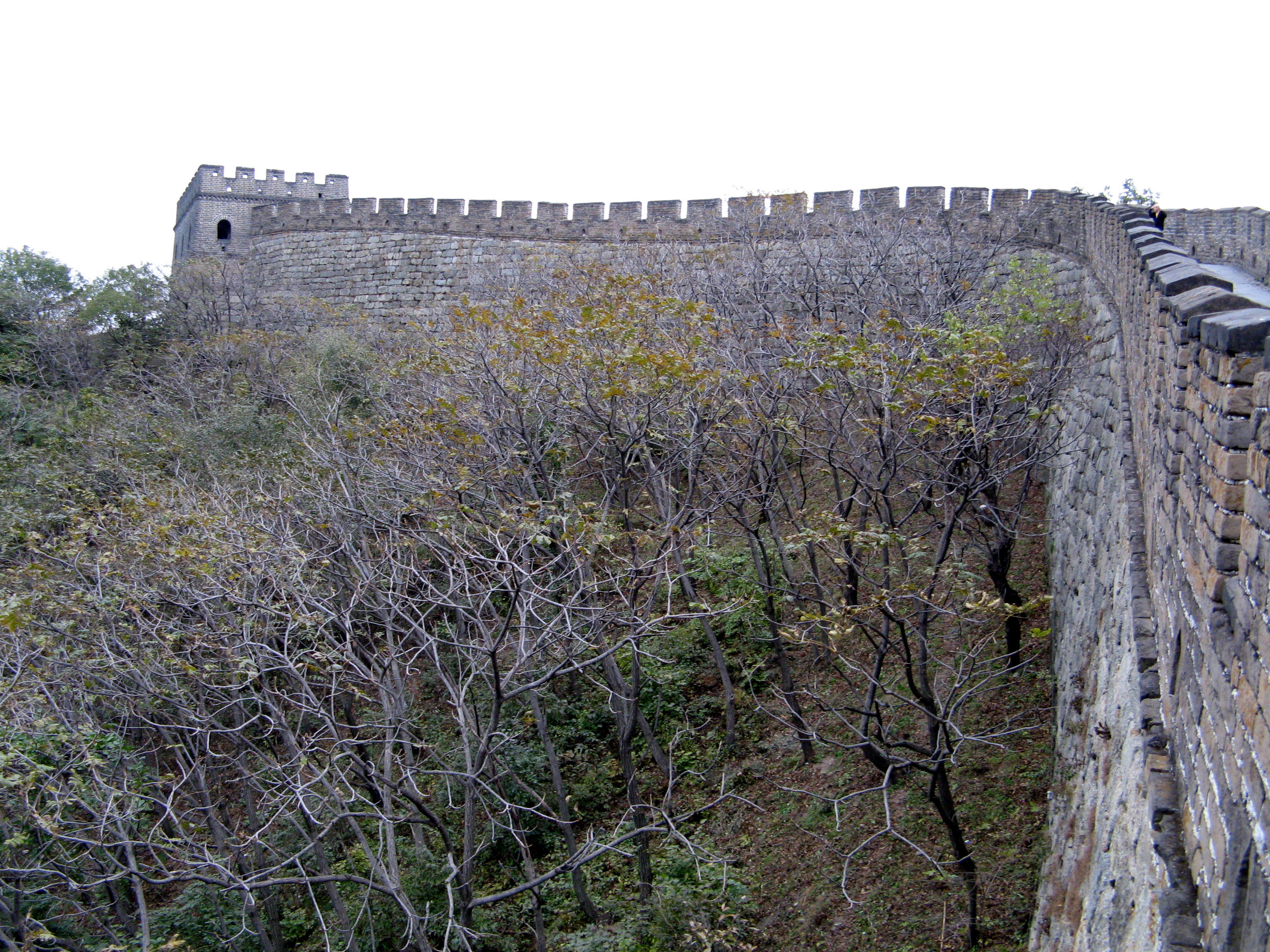
When you look over the edge, you realize that the wall is much taller than it looks on the “inside”.  Here Vicki pointed out the remnants of an old fruit orchard the soldiers and their families depended on when they guarded the border. They had to grow their own food and carry or pipe water to farm on the Chinese side of the wall.  On the opposite side, it was part of their job to cut away all vegetation within 30 feet of the enemy side of the wall. Ascending and descending the wall many times a day, to toilet, haul water, tend gardens, and other tasks,  tests the sense of believability.

This is a spot where soldiers could get out to their work detail off the wall.

In inclement weather, you can imagine how treacherous it would be to patrol this wall. It drains one way and then another. Like castle walls, cut outs were built for the soldiers to fire their arrows.  The towers and exits are located I’m guessing about every 300 to 400 feet, or so. Inside those towers, all open to the air above, the families kept warm by body heat and a charcoal brazier, also used for cooking. The feat of building the wall is hard to put your mind around. It at one time stretched 13,171 miles. And, while we were in China, news came that archeologists had uncovered another 400 kilometer section of earthen and stone wall from ancient times. The original wall was started in 200 B.C.  Each section has a distinct character, an individuality, as one worker differed slightly in his method than another. Hauling and mixing the cement in a remote area, hauling the water, again, it tests the sense of believability. I expect they used horses and donkeys to help with the work. Even so, a monumental achievement.

You can see this section of the wall is  shorter, warmer and sunnier.

This was an emotional experience for me. I felt it was worth the whole trip’s expense just to see the wall. I cast one last look at this impossible place, straining my eyes through the mist to see, as far as I could, this amazing wall etched like a painting  on the mountain tops. I hated to leave.
The website below gives some history, facts and pictures of this one of seven of the greatest world wonders.
http://www.chinahighlights.com/greatwall/fact/

Tuesday, August 16, 2011

THE GREAT WALL OF CHINA

Yesterday, our goal was to move to Leavenworth on the east side of the Cascades. A change of plans came as Jim studied the book and called Ford dealerships to learn all he could about transmissions. He settled on one of two transmission shops. The fix has waylaid us until we can get the Bronco repaired.  I’m returning to my China Journal and pictures.

We left the restaurant and enjoyed the street scenes as we walked to our bus. This cute family was mobbed by we tourists.  The wooden stroller is unusual to us and the boy in the middle with a bamboo backpack as well. Remember that you can click on any of these pictures to make them larger and see better detail.

This set of orange bonnets is a public phone booth;  I expect, like ours, soon to be obsolete.
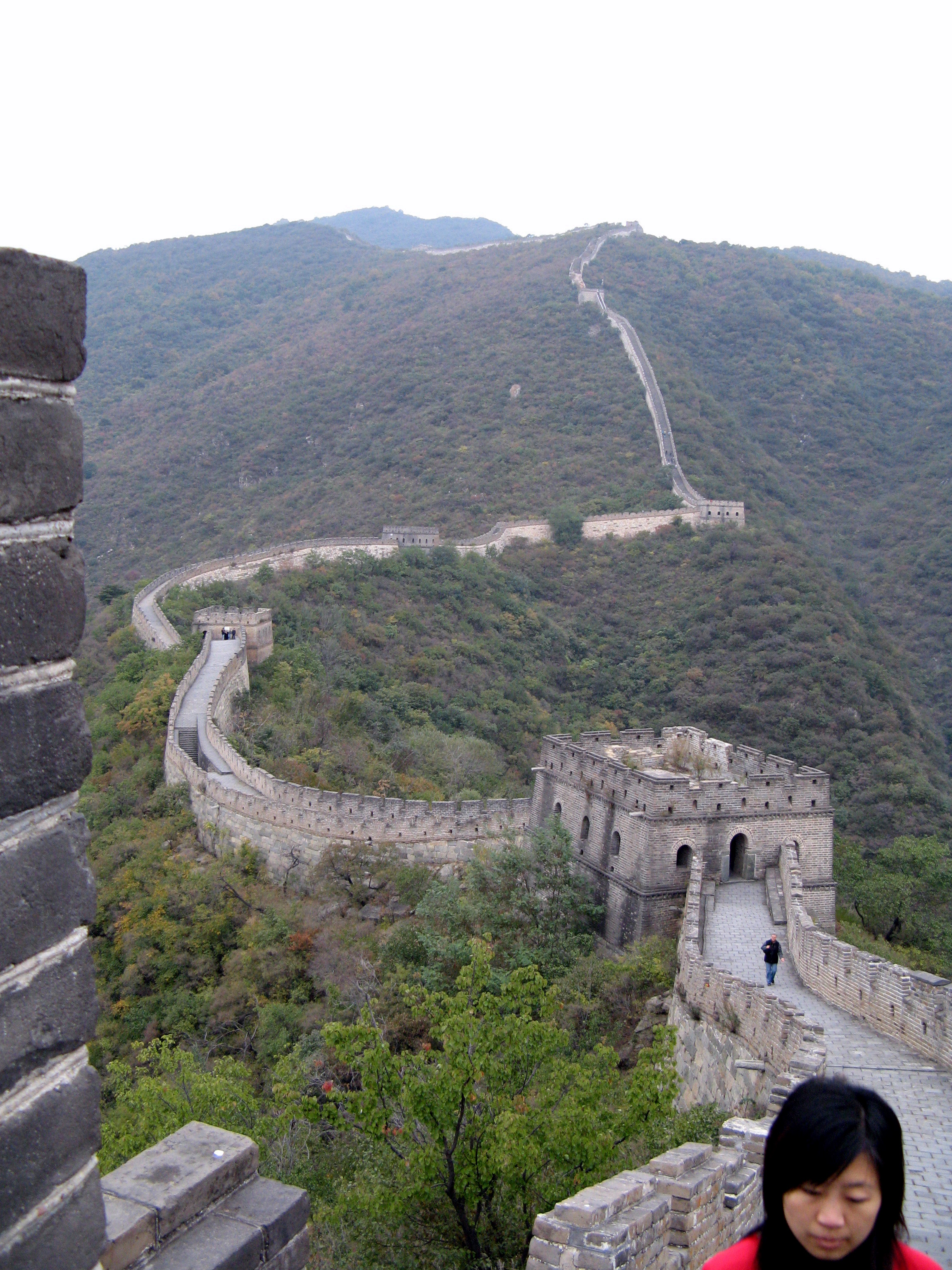
I’ve seen pictures of the Great Wall and thought of it as a smooth brick-like roadway.  Up close, it is anything but smooth. Rugged, overpowering, stupendous, jagged, uneven, crooked, weathered. The section we visited is from 1400 A.D. The wall was started in 200 B.C. We are told the Chinese archeologists just discovered 500 kilometers more of rammed earth wall base previously unknown.
The soldiers/laborers who built it had varying  skill.  This rough,crooked stairway leads to one of the “guardhouses” that were built at regular intervals along the miles of wall. I had no idea the wall was manned. I thought just the height and steepness of it kept out intruders. The wall in various forms stretches over 5,000 miles.

The camera cannot take in the unbelievable reality of this wall undulating up and down the surrounding mountains for as far as the eye can see. It graces every mountain crest on China’s Mongolian border.

Numerous gates and exits allowed the soldiers and their families to go for water, tend their gardens, and hunt for food and gather wood.  The guardhouses where they lived had very little privacy, no toilet or washing facilities, no doors and no windows, only openings that allowed the cold air to enter.  Life in the guardhouses  only sheltered them from rain and snow. In many places they were miles and miles from civilization.

Only some sections of the wall are maintained. In places, the bricks have fallen, have heaved and cracked or become overgrown with vegetation. The cost of maintaining the wall is enormous and thus neglected. Here we see the drainage system that carries  water away from the walkway.

Each section has an individuality about it as you can see where one worker differentiated his placement slightly from another worker just 30 feet away.

On the Chinese side of the wall are remnants of fruit trees and gardens. The fruit trees have self seeded. On the enemy side of the wall,  soldiers kept all vegetation cleared for 30 feet out from the wall so no enemy could approach unseen.

Seeing the Great Wall was  worth the whole trip. We walked about a mile from one station to another and another. We met a couple  with two children, all  burdened with  backpacks. They camped and walked the great wall for two weeks and saw many exciting sections that we on tours cannot see during our limited visit.  I had no idea that camping on the great wall was an option.

Visiting the Great Wall was an emotional and unforgettable experience for me. Wikipedia has more precise information about the great wall.
http://en.wikipedia.org/wiki/Great_Wall_of_China