Friday, August 17, 2012

DON'T BUY FISH ON A HOT DAY.

I’m used to  good mileage in my Prius and filling up the tank of my old 1994 Ford Ranger put a good-sized dent in the wallet. I made it to the Bay Area with nary a hint of a leak and it was certainly worth it to drive my truck and let it know I still cared about it. It responded by purring  all the way to the Bay.  I expect a lot from this truck when I need it.

I founded the Alameda County Sheriff’s Department Archive Association and worked hard over the intervening years to get it up and running, along with a lot of volunteer help, of course.  When I turned it over to Bill Rhodes, top left, it was the right decision. He has made so many positive changes that every time I do attend a meeting, I hardly recognize the place. He has expanded our buildings, is having a new one built and is rebuilding our old  guard tower. Next to him is Vic Agapalo and attending with a broken foot is Rich Barlow.

Al Ianarelli checked in as did Bud Harlan, not pictured.)  New is a case made for this missing child’s bust  that came out of evidence.  The new building will hold a mock cell with old style jail doors we have stored, along with other heavy equipment.

We will go from three large rooms and three storage rooms to one-third more space and we have enough stuff to fill it.  It is a great project and my contribution since being on the road with Jim is to interview deputies about the history of the department. I spent my time interviewing Rich Barlow, yesterday.

A recent donation to the archive was business cards and a shield that once belonged to  Hell’s Angel Berdoo. The Angels have changed their image from the old days.  When my husband was a detective, he arrested Sonny Barger and confiscated his stolen motorcycle and put it into evidence at the County Garage Impound Yard. The way it worked, when someone came to pick up their vehicle, he  took the elevator down to the garage, the civilian clerk  would ask for their  release order, then he would open the locked  gates to drive the vehicle out. Sonny, out on bail, with a friend, went to pick up his vehicle. He had no release. The friend distracted the clerk and Sonny got  into the yard rolled his motorcycle into the elevator and went out with it through the building. My husband couldn’t make his case without the evidence and Sonny went free.  The clerk, of course, was not a cop.
On the way home I stopped at a Costco to buy some batteries and refill on cheaper gas, at $3.93.  Murphys price is $4.29. I found some beautiful U.S. wild caught cod and bought it, figuring my air conditioning would keep it cool enough to get home. Well, long story short, my newly cleaned truck smells like fish; I had to poach the whole package when I crawled through the door at about 6:30 p.m. I can’t possibly eat all that fish.  I’ll have to be creative and invite company over. I had six messages on my phone. One an emergency call from a friend who was in an accident. It took me two hours to locate him. He was so drugged he was practically incoherent, one arm in a sling, and a whip-lash collar. His car totaled.  Another cold beer night.

Thursday, August 16, 2012

A BEER SWILLING DERELICT.

I have a tree hanging dead in another tree. Six trees with heavy over-story hanging above my roof, upstairs deck and guest-house. My tree guy called and said he couldn’t make it on Thursday. Aha! A free day. I quickly decided to attend a meeting in the Bay Area, roughly 120 miles away. So down to the service station I go to have my tires checked.
Ray, from Nash’s Chevron in Angels Camp, drew two circles around spots on my tire where the steel is showing through.  “I wouldn’t drive this car to the Bay Area”,  he told me. Shoot! Couldn’t get new tires to match until Friday. I return home. Oh, well, I can take the truck to the Bay.  I don’t drive it very much. I struggled to open the hood, it is old and tight. Yikes!  I found chewed acorn debris inside the engine- not a good sign.   Couldn’t get the lid off to check the coolant. Left front tire practically flat. Checked my tag, yipes!  I’m over-do for service. Luckily Ethan at Nash’s can get me in at 4:00.

I slowly drive to Pinacle therapy with my soft tire, late for my appointment and apologizing. I hate it when I’m late, I’m frazzled. But,Theresa Locke is the greatest. She get’s to know you and your habits, and can define intricate muscle movements. Its about caring and time and evaluating. I can’t say enough good things about  Theresa. I have such confidence in her as does everyone who meets her.


And her staff is great too. Dulcie, Lea and Jessie, allowed me to take their picture. Lea hammed it up and gave me some good advice. You know how guys go to the barbershop and discuss the game or their car problems with the barber?  Well, Lea gave me some good advice as I told her my woes. “People on the prairies, where they have problems with prairie dogs, leave their hoods open and the rodents won’t chew up wires and stuff on the engine.”  What a team.

This is what Lea really looks like.

Back to Nash’s. Jeff has the station on a new computer system and he gets me entered into it. Nash has been taking care of my vehicles  for 30 years.   It is nice to have someone you trust to do good work and always take care of your needs.

The good news is the tire is fine. It  just needed air from sitting too long.  Bad news is the oil pan plug has been replaced so many times with a bigger and bigger plug to prevent leaks, it is going to need replacement next time. And, “I wouldn’t drive this car to the Bay Area with that plug. Better test it on a short trip,”  Ethan told me.  He drove it around town about five miles. It was dry and without a leak.  I promised I’d watch the gage and pull over at the first hint of a problem.

I’m a bit red-faced. This is the rat’s nest Ethan found sitting on top of my air conditioning filter. Red faced also because my truck was so dirty. It sits under trees with leaves and twigs and bird droppings and rats…arrgh!  Ethan told me, you just put a bar of Irish Spring in your engine well and the rats won’t bother it again.

The full service car wash in Angels Camp had just closed.  I settled for the car wash in Murphys where you have to get out in the heat and vacuum the inside yourself and wipe down everything.  Some days are like that!
I went home and couldn’t wait to get in the door and swill down a nice cool brew. I shuddered at how dirty and neglected I’d let my trusty truck get. It needs some tender loving care instead of being owned by a beer swilling, neglectful derelict.

Wednesday, August 15, 2012

PEACE, CULTURE AND HIP HOP.


It is our last morning in China. We are up early. Business people all over town line up in their suits and ties at street steamers to buy buns and dumplings for breakfast.  (Picture by Nicolas Delerue) China is vast but it’s cities are huge and crowded. The Chinese seek peace in their gardens.

In the center of this snarling city is the UR Garden. The designers took great pains and cost to turn this former government employees home into a centerpiece of Chinese garden architecture. A walled garden shuts out the troubles of life and brings peace and quiet to the soul. It allows you to contemplate a higher plane and renew the spirit.

The Chinese people strive for perfection in everything they do. A perfect garden must have a hill, water, rock, plants, bamboo, a building and trees. The plants placement and position in the garden, and shapes of everything  have special meanings. A rock must not overshadow water. All gates, walkways, windows and doors must suggest nurture, peace and serenity to soothe the soul. A tea house provides refreshment and joy.

A cut out in the wall has pleasing lines and picturesquely  frames and enhances a particular view of the garden.
A beautifully designed window does the same.

Each rock, each plant is chosen for its sense of balance and rest. Lotus for purity. Bamboo for strength and resilience.  Flowering plum represents rebirth. If you plant a pine tree, you must have both a male and female tree. If one dies, the partner tree is removed.

Proper dragons guard the roof and walls.

The roof is enhanced with bamboo at the top to make music as the wind passes over the hollow tubes.  The poetic aspects of a garden are taken very seriously.

When a contingent of Chinese Garden Architects from Vancouver came to see the garden, they politely said it was beautiful. Not perfect?  They judged it imperfect because modern condominium visible in a little corner of the garden.  Tsk, tsk!

We leave the garden to visit Shanghai Cultural Museum.  On the freeway we see a huge cement column  about 12 feet in diameter  supporting an over crossing. It was beautifully decorated with writhing dragons. I asked why the need for such a heavy support column? Our city guide explained that it allows the dragons to get out. When they were building, the workmen had trouble in that spot. They insisted there was a dragon there and it would be bad luck to cover it up. The government architects came up with a solution. It is partially hollow and has an exit window.  Now knowing what we do of Chinese culture and centuries of superstition embedded in their character, we understand.

The museum too, is a quiet place that gives a sense of peace…


and beauty.
Late in the afternoon we have free time and several of us take tea at a lovely tea house and then off to the Hip Hop Market to pick up any last minute souvenirs. This is not a souvenir market.  We gawk at ultra modern merchandise. Shoes like I’ve never seen in my life with price tags to match.  Baby items and clothing  for the children or grandchildren of the very wealthy. Teens swarm the place with their phones and wrist band radios. They buy see-through blouses, painted skirts and bathing suits that would fit in a cigarette box. We are running from store to store like unruly kids were we see every kind of goods,  rich leathers, golden threaded bags and scarves; canes, sunglasses, jewelry to dazzle an empress, plastic neon bracelets, fancy suits and ballgowns, jeans and top branded merchandise from all over the world.  A city of such contrasts is Shanghai.
We enjoy a fabulous farewell dinner with a flaming dish of some sort. We  fondly embrace our new friends and  trade addresses and know we’ll probably never see them again. Unforgettable China.

Monday, August 13, 2012

SHANGAI II


Shangai is an impressive city for its ultra-modern skyscrapers, shopping, culture,  night life. You can easily think you are in a Western city with a grand Chinatown.  With  camera/disk problems I have  few pictures to show you. The night scene photo above has no attribution but it came from a tourism website. Our first night in Shangai, after our daytime city tour, we have dinner at the gorgeous Hilton Hotel and ate bland food. It was decent, but by comparison with the rest of China, we decided it was our worst meal so far.  On balance, we had our first real alcoholic drink. Good scotch.
It has been a long day but that night,  we are taken to visit the tallest building in the world with 88 floors. (Since eclipsed by the 105 story Japanese building with-in sight of it.) We don’t go up an elevator, we ascend, seamlessly, all 88 floors in 45 seconds,  with no sensation of being on an elevator whatever. An endless line of tourists paid $7 for the ride. It goes without saying the views are spectacular. It is a Saturday, and the waterfront is alight with skyscrapers projecting ads 20 stories tall on the sides of their buildings. We see a video of men who illegally parachuted from the building. We drink it in, reluctant to leave. The waterfront buildings are alight on Saturdays and Sundays. During the week, the lights are turned off as a cost saving measure. Smart!

The next morning, we visit the Children’s Palace, very aptly named since Mau took over  mansions from the decadent rich ministers and government employees and devoted them to boarding schools for gifted students. The education is free and only those identified by their teachers with special talent may attend. Children  move to cities all over China where other “palaces” are located. Some concentrate on art, or music, science, dance, sports, martial arts, gymnastics, etc.  We were impressed with the pictures these young kids drew and painted.  The walls going into the school are  filled with exceptional artwork.
Another room held  a music class with students age four to sixteen learning the violin. First they tap out the music, then hum the notes, then  strum the notes. The teacher strikes her stick loudly when a mistake is made and scolds. We cannot understand her words, but we understand her tone.
Next we watch as  five girls play for us on a zither-like ancient instrument, similar to a harp in sound. It may be admirable to help children achieve  their special potential, but we found the fierce discipline offensive. Not a smile  from any student and we can’t help but wonder where goes their childhood? Talented and unhappy is not  a good goal. The parents are honored that their child is chosen and wouldn’t think of turning down this opportunity.

After lunch, we visit a silk factory. Employees stand. Again, we see poor working conditions. The cocoons are drowned and the larvae removed. The fine fibers are twisted into a fine yarn size, then dyed in special batches of color to be woven into shirts, scarves, ties and rugs.  Hard work. Bats of coarser silk, are used to make comforters with a reputation for being very warm compared to their light weight.

The process of making a comforter was fascinating. Each bat of silk is stretched and stretched and fit on a form like a fitted sheet fits a mattress. After several bats are stretched, it becomes a comforter and is fitted into a case for size, queen, king or double. I bought two, at $10 each. Of course, a fancy cover to make them beautiful, costs twice as much. One woman from our group opted to make her own cover. A machine squeezes them so tightly, they fit into a small purse sized case with a handle.  Cool!

After dinner we attend a show that is the highpoint of Shanghai and all tickets have been sold out for months. Chinese acrobats are famous for their extraordinary muscle control and balance as they do difficult feats in slow motion. A girl balances a tray of glasses in her mouth while doing carefully modulated trapeze acts. Another balances on one hand while doing contortions with her body, forming a butterfly, frog, cricket, then she jumps to the opposite hand and becomes her own twin. Breathtaking twists, falls, jumps from unbelievable positions. High jumping, hoops, tumbling comic acts…we hold our breath and gaze entranced at such talent.  On the way back to our hotel, we catch our last look at the fabulous lighted Yangtze River boats and skyscrapers and know we are looking at a burgeoning new capitalistic economy that is rocketing skyward to awe the world.

Sunday, August 12, 2012

SHANGAI


As we get ready to disembark from the Li River (cruise highway of 10,000 tourists), we see more civilization, bigger villages, and more activity.

Close to the village, we notice bamboo boats with cormorants and while Vicki  describes the treasures of the Li, a 1500 year old banyan tree, a Phoenix Tail Bamboo, (an evergreen), and a blind mandarin fish that lives inside of a rock cave, I’m excited about seeing a cormorant fisherman in action.

The port is  busy with many boats docking at the same place.

From our boat, we can see the fishermen on shore with their birds.

The fishermen have a daytime occupation, getting paid to have their picture taken. They fish at night. Vicky angrily tells us, “do not pay them”. I get a good picture of this fellow because another tourist has paid him and he is posing for her.

If you try to photograph them without paying, they turn their backs to you.

I managed to sneak another shot. At this village, where many  tour boats disembark, vendors of all types swarmed us and Vicki asks us to wait until we get to the Yangtze Market  in Shanghai .  We plow through the throng to our waiting bus.

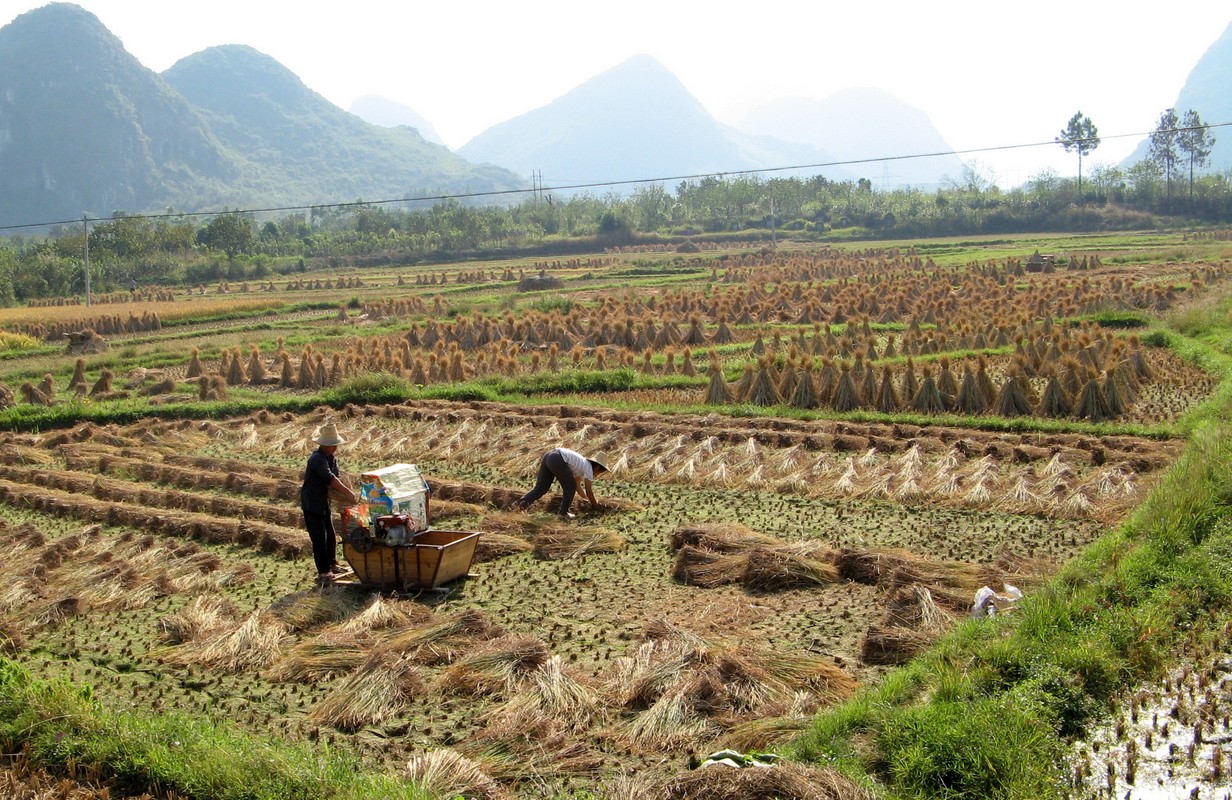
The next morning, we bus to the airport for our next stop at Shanghai. On the way, we see farmers working the fields. They harvest two crops per year, one in March and another from July to November. They still hand cut rice with a sickle. We ask to see a rice paddy. Vicki stops the bus. It is harvest time, but you can see new plants growing in the right hand corner of the picture.

In America, it would all me mechanized. Here people work with rudimentary equipment, hand threshing  hulls from the rice.

Rice plants look like grass; how the people farm is more interesting than the plant itself, and we move on.

Shanghai looks like a futuristic city. It is regarded as a baby city since it is only 200 years old. This is the place where able-bodied men were kidnapped and brought down to the river and put to sea. They were  forced to work on an ocean-going vessel. What was once an opium shipping port in the 1840′s to the 1930′s, with only 100,000 population, and a wild and tawdry reputation,  has become the biggest container shipping port in the world. Now 21,000,000 people live here in an extremely modern city where the Hang Po river and the Yangtze flow through the city of  huge ships and sprightly boats sporting lighted billboards facing the city at night.
We take a city tour by bus. Michele, our city guide,  points out the biggest skyscraper in the world, yet in 1964, no Shanghai building was over ten stories high. They have more skyscrapers than New York City and Hong Kong. Chinese people want to be the biggest, the tallest, the fastest and the best, yet we see business people riding what seems like a million bikes. Some people are licensed to drive cars on Mondays and Wednesdays, others on Tuesday and Thursdays. We see one man carrying a full sized bed on just an ordinary bike. The loads people carry here are legendary. My disk is full and I have no more pictures  until I can buy another disk. So many photo ops of  Shanghai I missed.  The Wedding Cake building, a Soviet building from 1952,  looks like a wedding cake.
Michele takes us to the BUND, Shanghai’s financial district with multiple banks and financial institutions with a sprinkling of old buildings mixed in. China’s  Wall Street. She explains that Shanghai is the business center of China, like New York is the business center of  America. One member of our group visited Shanghai twenty years ago. She said they found one hotel that would take foreigners and no restaurants. People were still wearing black sack cloth peasant clothing and you had to eat from a stand. In China, people over 80 and children under 20 speak English.
Vendors swarm the tourist spots wherever we stop. They sell rip off watches, hand bags, shoes, you name it. Michelle warned us not to buy from them but one member of our group bought a Mickey Mouse watch and before the bus pulled away, it fell apart. She laughed the hardest at her own folly.  The universities here are considered excellent. Michele sang a folk song for us before departing.
I finally get to a photo shop  after lunch to buy a disk, but the city tour is over. The food is bland compared to the marvelous spicy and different tasting specialties we tasted on the road.

And, I finally got a picture of a mother with her child in the split pants, defying the governments directives. Not many years ago, this woman would have had no choice but to obey.
More tomorrow.

Saturday, August 11, 2012

OLD CHINA ON THE RIVER LI.


We board our boat, that looks much like this one, for an 83 kilometer trip up the River Li. Ten thousand people a day tour this river to see mystical rock formations. The river bank is thick with blooming acacia; its fragrance fills the air. I would point out that both of these boats are in motion.

The vendor has hooked his boat to the tour boat and hands off  fresh vegetables and fish to the kitchen. The kitchens on these tour vessels are at the back of the boat in the open air.  We watch fascinated. The vendor is precariously balanced as he hands off his product.

The cook can be seen cutting up a chicken or duck.

The much vaunted rock formations everyone comes here to see are smooth, rounded hills and spears treasured for their mystical appearance and ever shrouded in mist.  I’ve seen professional aerial pictures of them that are beautiful, but I find my photos disappointing. They just don’t seem to have that same mystical effect. It doesn’t matter anyway, life along the Li is a glimpse of Old China and fascinates me.

The Dong people are known for their bamboo boats, houses and flutes. It looks like this boatman is offering a ferry service to get a bicycler and his package to the opposite bank. You can click on these photos to make them larger.

People live on their boats. The house boats we see are put together from whatever scrap can be  garnered.

Cows appear to be free ranging, but if you look closely, you will see their tether rope.

People carry heavy bundles. There is little mechanization.

They hand carry water up from the river the old way.

Water buffalo enjoy cooling off in the river. Notice the one with its head underwater; he is grazing.

Up he comes with a green morsel to eat.

These men have harvested and are preparing some type of green to sell. In China, everyone eats multiple types of greens.

A floating garden held up with oil cans. The bamboo fence and net protects the garden from ducks and flying birds.

People from the villages come down to the river to wash their clothes.

So many make their living from the river and work from their boats.

This fancy ferry boat has a motor. The boatman uses his petrol sparingly and prefers to paddle whenever possible.

We are passing a popular Chinese tourist area.

Everyone walks along the river.

The big draw here is an abandoned Yau village with beautiful 200-year-old buildings. People left here 120 years ago because they were persecuted and moved higher up the mountains.

Maybe the lucky ones are those who live on the river. We see villages of children watching and watering their water buffalo; dogs and pigs roam freely. Whole families living on sampans and all around the storybook shapes of the mystical hills.