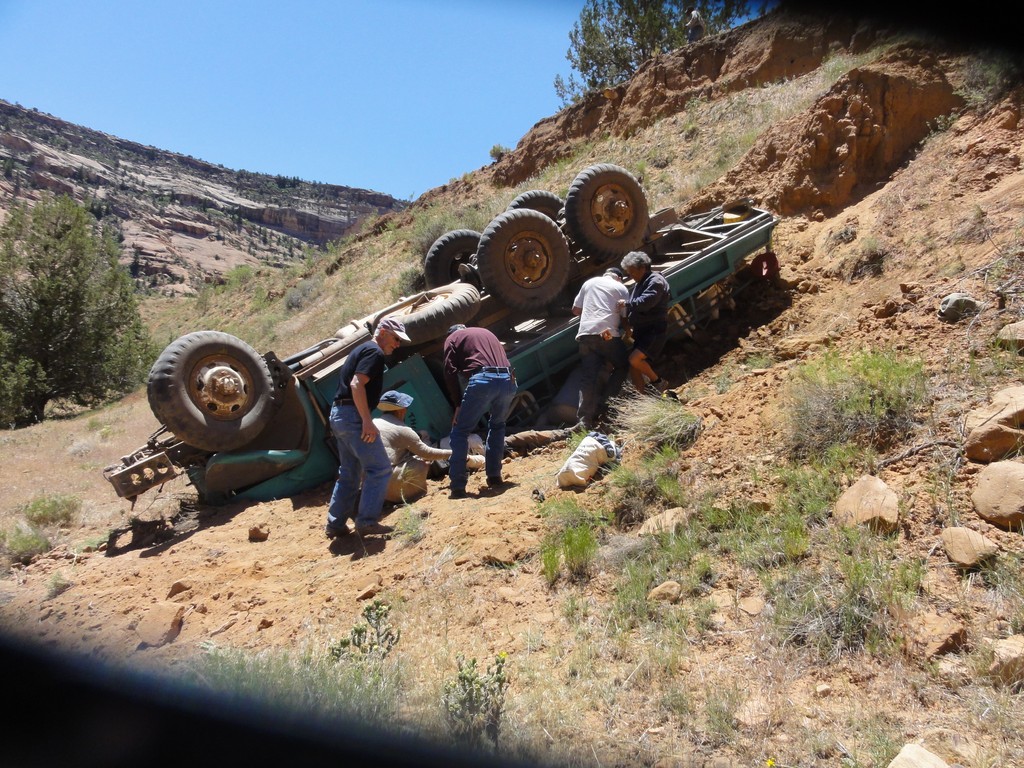
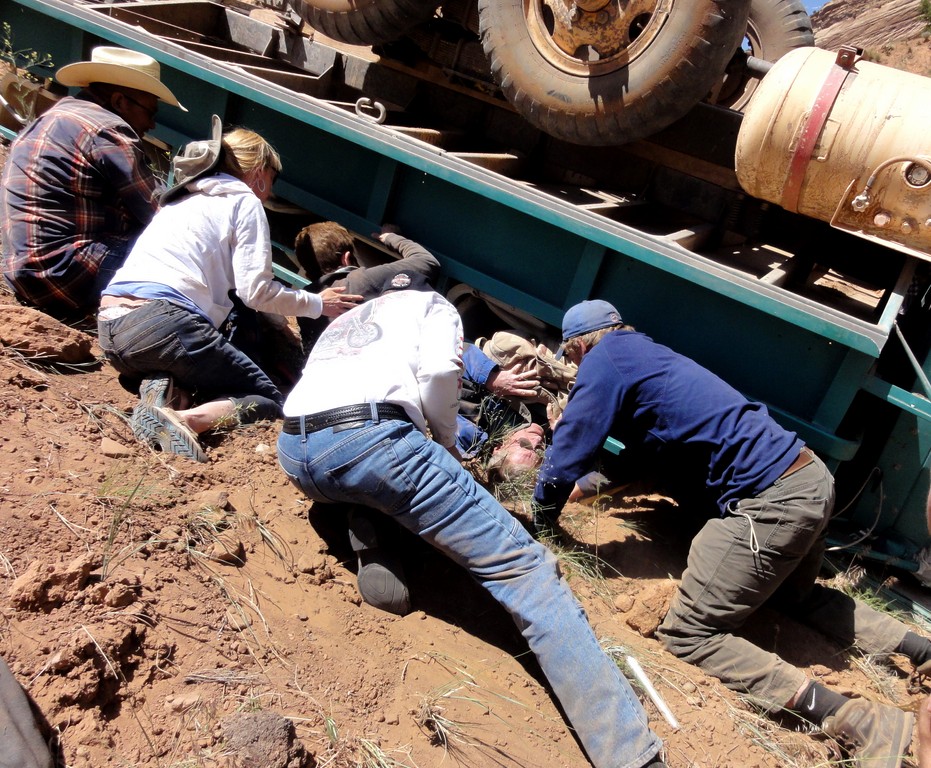
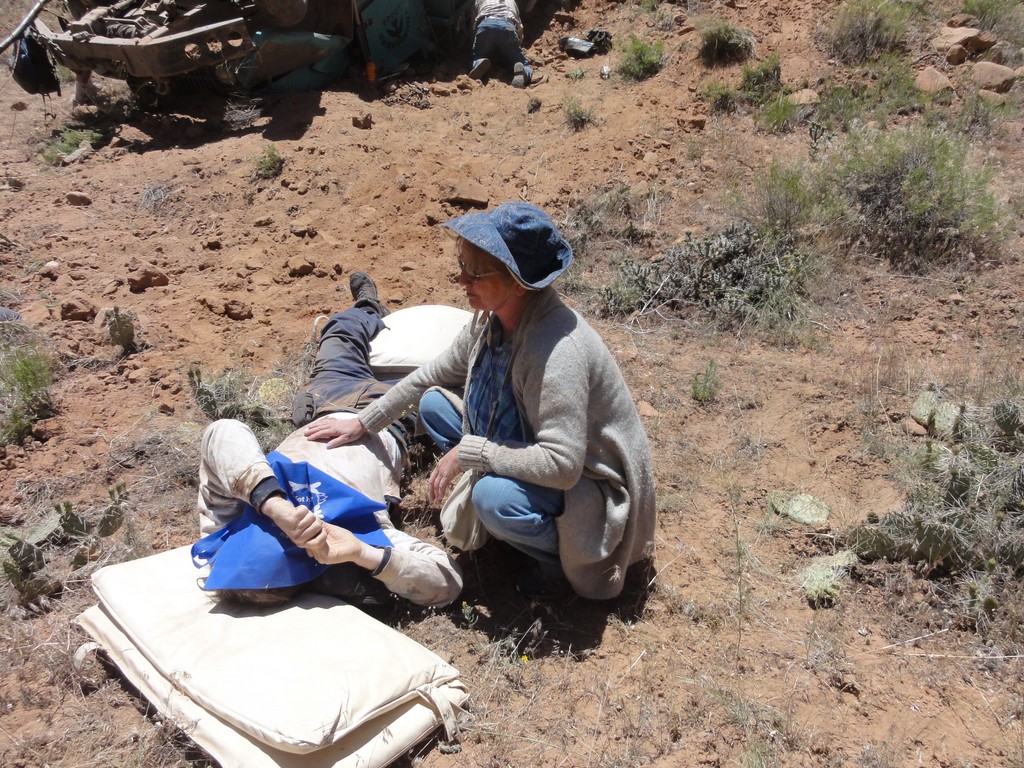
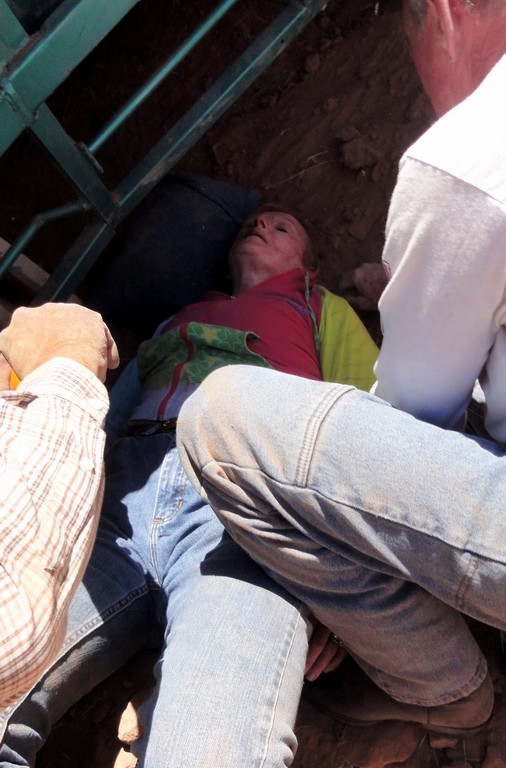
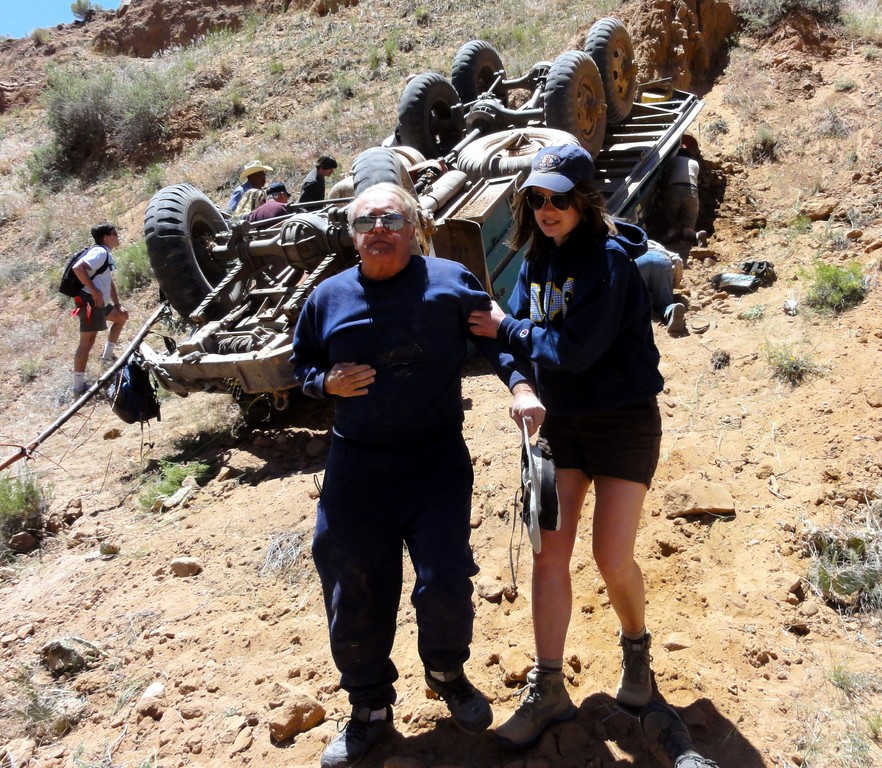
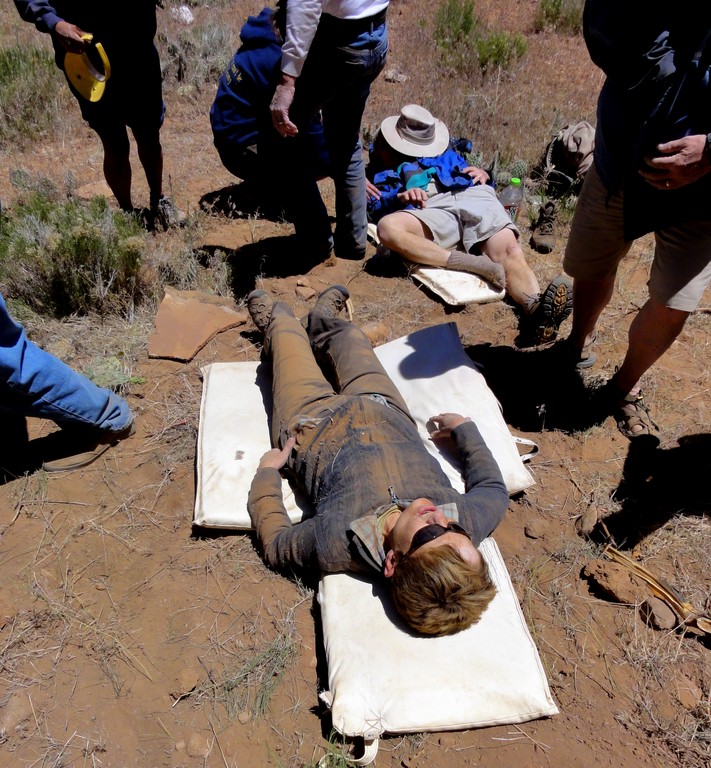
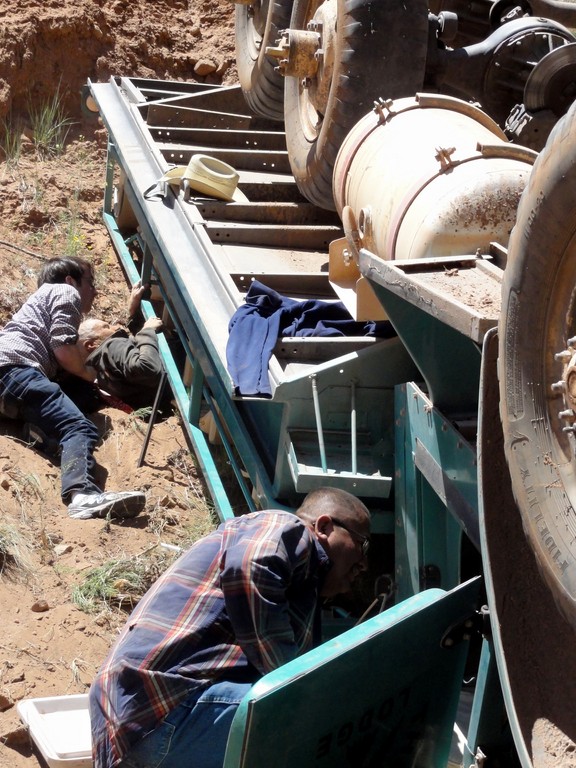
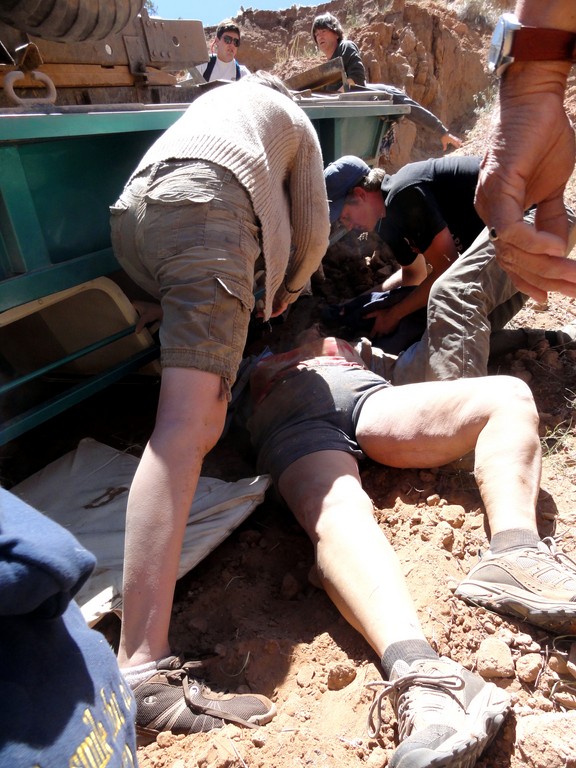
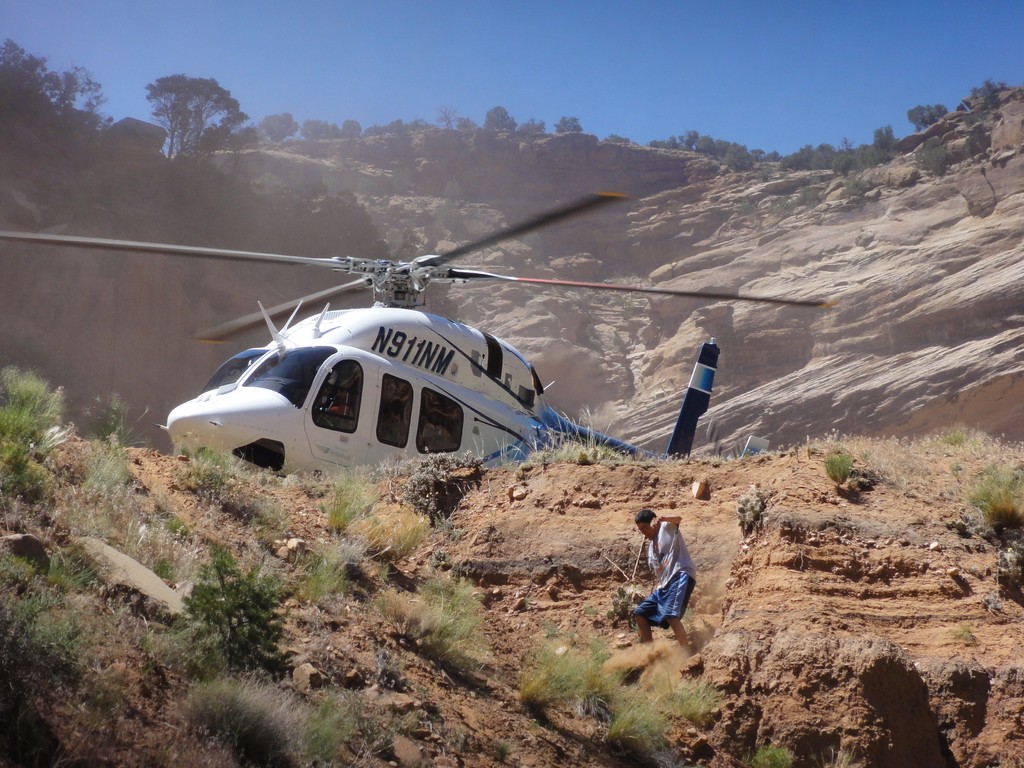
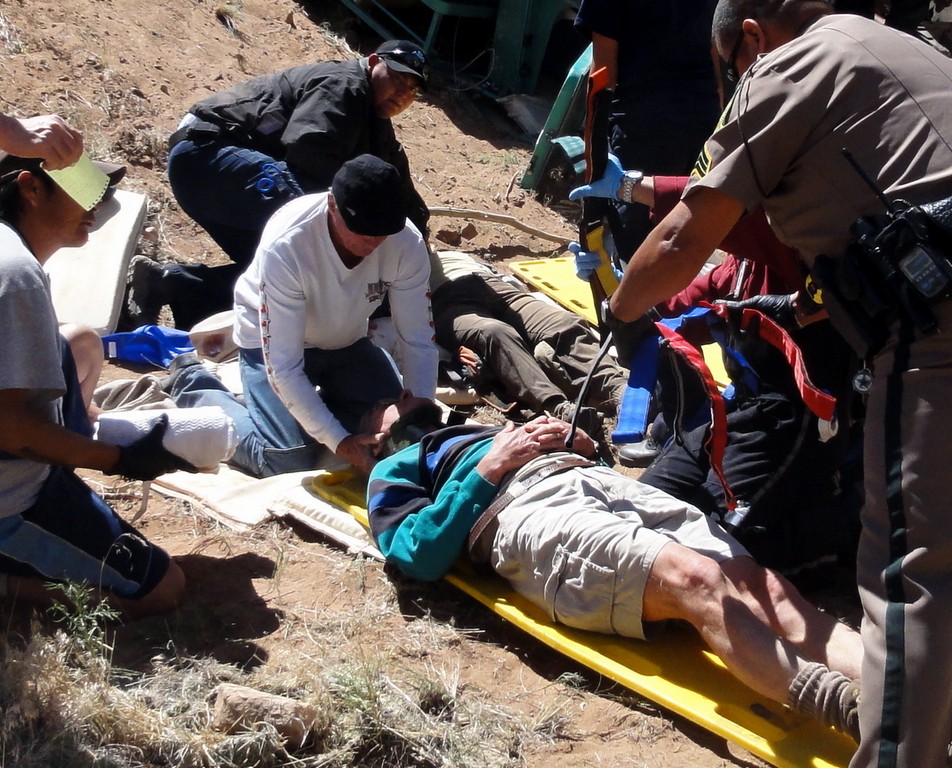
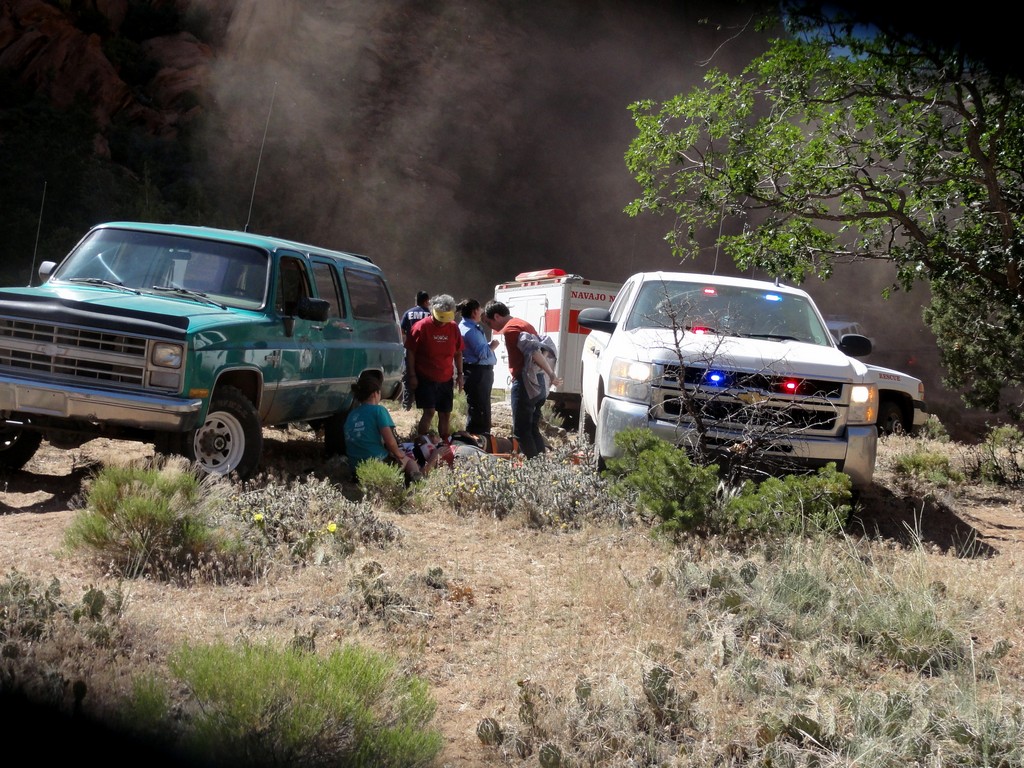
Once the officials took over the canyon accident, and the severely
injured were on their way to help, the rest of us gave a collective sigh
of relief, and finally felt like we could sit down, except,there was no
place to sit without encountering cactus thorns.

The last person to be removed from the ravine was Richard Crowe. The
crew bowed their heads in prayer before placing him in the helicopter.

I slowly made my way to the road and found it jammed with vehicles.
Everything seemed chaotic and I wondered how I was going to get out of
the canyon?

Jim had been helped to the top and lay on a rock waiting for the
helicopter to return and move he and Bill Repshur to an ambulance
waiting on the overlook. From there, the ambulance took them to the
Chinle Medical Center.
Jean, Chris, myself and Anita, the walking wounded, were asked if we
wanted to ride out with a volunteer family from the canyon. The Bia
family had come into the canyon that day to water their squash and corn
plants with their children. When they saw many emergency vehicles
driving by, and heard the helicopters, they knew something terrible had
happened and drove over to offer help. The kids gave up their back seat
in the truck and stayed at the site with friends, (I assume), so Jean,
Chris and I took their place in the back of the pick-up. We met Albert
and Cecilia Bia, and Virginia (Bia) Lee, a brother and two sisters.
This wonderful family turned to us after introductions and asked if we
would like to pray with them. We all clasped hands on the back of their
bench seat and the family prayed for us, and for all of those in
trouble, in Navajo. A very touching gesture I will never forget.
Albert drove as quickly as he could, navigating the rough, bumpy
road. He told us the canyon had been closed to traffic so we would meet
very little traffic on the way out on the narrow roads.
As we bumped along, I realized something was wrong with my back.
Sitting against the back seat, made my back burn. I was able to hook my
toes under the front seat and sit upright enough so my back wouldn’t
touch. It was wonderfully distracting to have Albert, Cecilia and
Virginia tell us about their lives.
Families from their clan, who farm in the canyon, where there is no
electricity or running water and sewer, live “on top”. It would be more
difficult to get their children to school each day, and take care of
daily life, than to haul water down into the canyon to water their
plants. He had driven in with the children. He pointed out their farm
lands as we passed. And his cattle we met on the road.

(My second camera is now not working properly. And, it was bumpy and difficult to take pictures out the window, though I tried.)
Later in the day, Virginia and Cecilia climbed down into the canyon on the one of the Twin Trails.

(This is a very skewed picture of Twin Trails visible in the far
right of the picture where Cecilia and Virginia walked down from the
ridge.)
They are three of 12 siblings. Navajo families work together on the
land, and benefit together. Ned Bia, their grandfather, knew enough
English to translate paperwork when the government Bureau of Indian
Affairs was parceling out their ancestral lands back to the families.
Navajo families are divided into clans and traditionally have no last
name. He became known as Ned Bia, for Bureau of Indian Affairs. The
government wanted them to take last names and they often took the names
of what they were doing. Like one man hauled wood. His name became
Hollawood. (Not sure of spelling.)
When meeting other Navajo, they always ask, “What’s your clan”,
because they cannot inter-marry within their own clan. The clans have
very descriptive names like Two Walking People, Or Salt By The River
Clan. (These may not be accurate.)
The Bias, like all families, are concerned about the next
generation. Will their children love the land? Will they appreciate the
simple life and the ability to lead a self-sustaining lifestyle as
they do? The Bias have cattle and gardens. Horses run wild in the
canyon and do a lot of damage besides over-grazing. A currently unsolved
problem. Some Navajo are opposed fencing them. Others feel each family
should be responsible for their horses and keep them contained. The
families hunt deer in the canyon, as well.
Whenever we passed a place of interest, the Bias would explain it to
us and answer our questions. They pointed out Baby Trail. It was a
narrow, vertical crevice in a huge rock edifice. Baby trail looked
anything but baby trail to us. Named for a woman with a baby on her
back who was being chased by the Spanish. She managed to get up into a
crevice to hide and she squeezed her way up and out to escape the
Spaniards. From then on, it was called Baby Trail. No one could
understand how she made it up the crevice, including us.
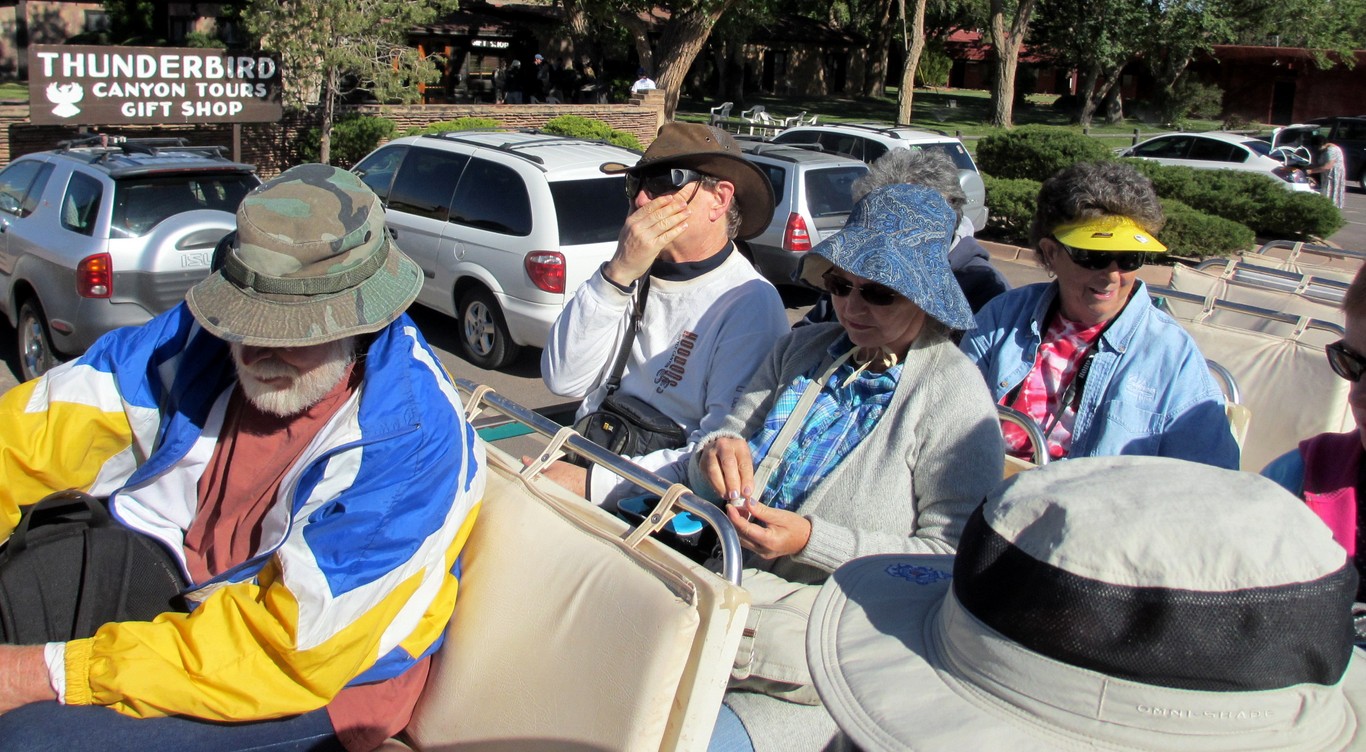
When we arrived in Chinle, the Bias took Jean and Chris to the
Thunderbird Hotel. Jim and I had our packs and took no money with us.
The Bias refused gas money from Jean and Chris, then drove us on to the
medical center. We can’t thank the Bias enough for their timely
assistance and prayers.

I was examined and released to wait with Jim while they got the
results of his chest scan. I had several abrasions, possible broken
ribs, a huge lump on my head, a bruised eye and jaw, and a painfully
bruised breast. He had a massive bruise on his rib cage, no internal
injuries. His severe pain was due to gas bubbles in his intestines that
would put him right down on the floor. The nurse offered to take our
picture and I look at it and think how could I look so normal? I was
tired, hungry, feeling dizzy and disoriented and exhausted. I wanted a
hot bath, a bowl of soup and my bed. It was 9:00 p.m. by the time we
returned to the motor home. Inexplicably, my camera worked for this
picture, only to fail again later.
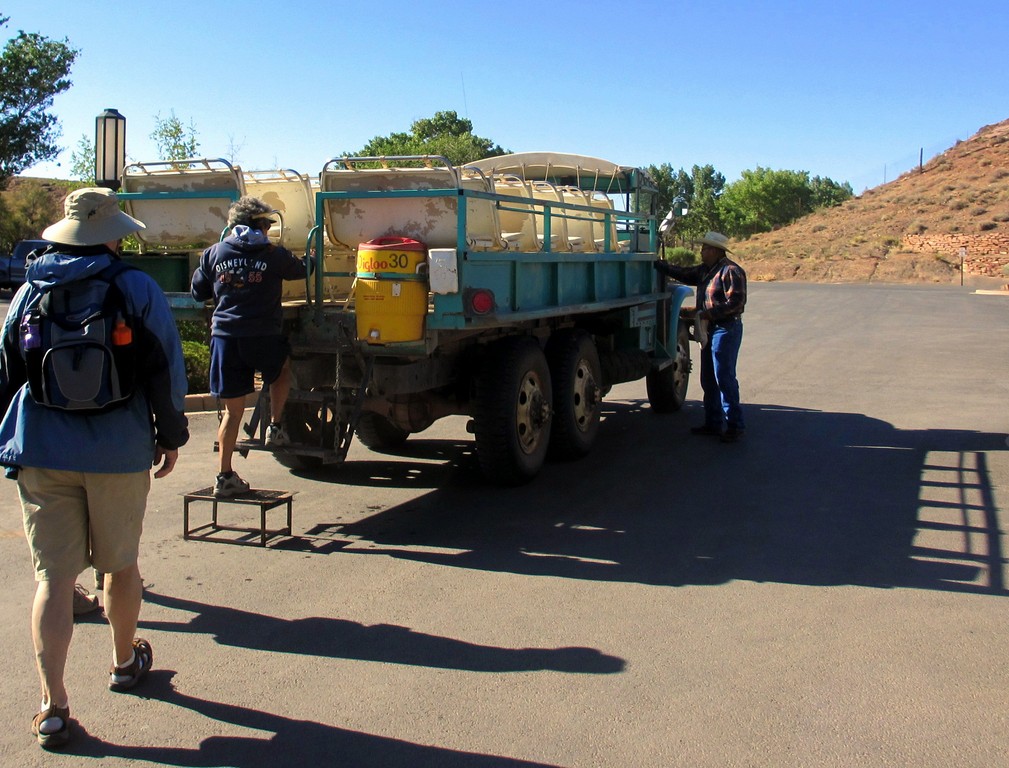
I want to say, that given all that happened, I would gladly take
another trip in the other six wheel drive truck like the one we rode
in, open to the wide and glorious views of this beautiful, spiritual
place. The beauty remains and the spirits keep watch. Jim and I hope to
feel well enough by Saturday to continue the rim overlooks. In the
last two days we’ve been visited by several officials from the park, the
hotel, and the Sheriff’s Department. We gave our statements and
pictures to the Sheriff’s Department for their investigation. Tanya, a
canyon family member, stopped in for a visit. Jean and Chris had
purchased a painted rock from a young boy in the canyon from Tanya’s
family. During our drive out of the canyon, Jean over and over said,
please,please tell that young boy that we are uninjured and we saved his
beautiful rock from the wreckage to take back to Wisconsin with us.