Wednesday, June 27, 2012

THE GREAT WALL OF CHINA.


We take a bus to visit one of the seven wonders of the world, the Great Wall of China. I’m so excited, I can hardly believe I’m going to actually walk on the Great Wall of China. On the way, Vicki gives us a history while we look at the passing scene out the windows. We see the Beijing Romance Club, a matchmaking club, which seemed strange in 2006. Now, don’t we all know about on-line matchmaking?  We see farms, fruit orchards, vendors along the highway lay out their produce on blankets. Highway workers in droves sweep the edges of the roads with straw brooms. I mean straw brooms that look like “witches” brooms. China doesn’t buy machinery to do a task that can be accomplished by human labor, though, that is changing. But what then do you do with a huge population of workers without work asks Vicki?  People don’t drive as fast here and the highway is teeming with people on foot.

The walk up to one of the Great Wall’s entrance places is lined with vendors, since the Great Wall is the biggest tourist attraction in all of Asia.

I took a picture of this camel and was shushed away by the owner. Vicki explained that this man makes his living by charging for pictures taken of his camel, usually with mom and the kids standing near it. I felt bad for my “sin”, but I couldn’t read the sign nor undo the picture. Vicki explained that most of these vendors have been licensed to sell here because they were once farmers displaced by the flooding of the Yangtze River.

We enter near one of the towers built to house the soldiers and their families who lived  there and manned the towers all day and night.  I was stunned to learn that. It isn’t as though the Great wall could be driven to from a nearby city during the 1200′s. Somehow, I thought the wall was its own defense, a deterrent. Vicki took us to an entrance that is the farthest from Beijing and not as busy as others. Notice the dip on the right to take rain water away from the steps.

This gives you an idea of the height of the walls at the top, just over five feet tall.  From magazine pictures and travel ads I’d seen, I  thought of the wall as this smooth brick roadway for miles. It is smooth here.  This section has been restored and looks quite new.

I guess I expected an even structure built in a ring at the Chinese borders, never giving much thought to the undulating terrain of the mountain passes it guarded. It is mind-boggling just trying to see in the distance as it traces the tops of the mountains in every direction you look.

It’s uphill, jagged, stairs both straight and crooked; weathered and broken.

You can hike the wall for days, or weeks. We met a family that backpacked in for miles and found vistas, and wild animals, and broken, crumbling sections of the wall where they could climb down and explore the woods and meadows.

When you look over the edge, you realize that the wall is much taller than it looks on the “inside”.  Here Vicki pointed out the remnants of an old fruit orchard the soldiers and their families depended on when they guarded the border. They had to grow their own food and carry or pipe water to farm on the Chinese side of the wall.  On the opposite side, it was part of their job to cut away all vegetation within 30 feet of the enemy side of the wall. Ascending and descending the wall many times a day, to toilet, haul water, tend gardens, and other tasks,  tests the sense of believability.

This is a spot where soldiers could get out to their work detail off the wall.

In inclement weather, you can imagine how treacherous it would be to patrol this wall. It drains one way and then another. Like castle walls, cut outs were built for the soldiers to fire their arrows.  The towers and exits are located I’m guessing about every 300 to 400 feet, or so. Inside those towers, all open to the air above, the families kept warm by body heat and a charcoal brazier, also used for cooking. The feat of building the wall is hard to put your mind around. It at one time stretched 13,171 miles. And, while we were in China, news came that archeologists had uncovered another 400 kilometer section of earthen and stone wall from ancient times. The original wall was started in 200 B.C.  Each section has a distinct character, an individuality, as one worker differed slightly in his method than another. Hauling and mixing the cement in a remote area, hauling the water, again, it tests the sense of believability. I expect they used horses and donkeys to help with the work. Even so, a monumental achievement.

You can see this section of the wall is  shorter, warmer and sunnier.

This was an emotional experience for me. I felt it was worth the whole trip’s expense just to see the wall. I cast one last look at this impossible place, straining my eyes through the mist to see, as far as I could, this amazing wall etched like a painting  on the mountain tops. I hated to leave.
The website below gives some history, facts and pictures of this one of seven of the greatest world wonders.
http://www.chinahighlights.com/greatwall/fact/

Tuesday, June 26, 2012

THE TEMPLE OF HEAVEN.


It is an early October  morning and our tour bus takes us to the Temple of Heaven, another UNESCO site. We see buses with people on their way to work, like these women catching a cat nap. Vicki, our guide,  tells us Chinese laborers put in long hours for low pay.

This orange hooded stand is a telephone booth, simple, protected from the weather, low-cost.  You have to respect the design. Although, like the US, cell phones are seen  all over China,  more than in my neighborhood.  (Remember this is 2006.)  The street scenes are so interesting here but  I was using a new digital and still taking pictures as though each picture would be developed and being very conservative, not knowing how many pictures would fit on the sandisk. At that time I hadn’t heard of a cyber album where I now keep my pictures.

We entered the complex through a park with many squares. Our first encounter was a group of people doing ball room dancing. We watched for a while.  A single man asked me and another woman from our group to dance. This is very common in China, morning exercise with a huge group.

The next square held a group of people line dancing.  Wanning Determan, in red and my partner Michal joined them. What an enjoyable way to start the day.

This group was performing a kind of fast clapping exercise designed for mental alertness. In between the clapping they make foot figures and turn around and start again, sometimes hands raised above their heads.  Quite tricky and challenging. Like line dancing, they follow a leader in this exercise that also has music to it.

This group, at a distant square,  practices a graceful flag dance.

This group is doing Tai Chi. I’ve tried it since my China visit, and it is harder than it looks. Great for balance and coordination.

This group was doing a type of  Tai Chi with paddles and balls, very difficult Vicki informed us. I was quite taken by the vast amount of people who exercise. It is easy to see why you rarely encounter an overweight  person in China.

We finally arrive at the entrance gate to the Temple of Heaven.

Before passing through the gate,  I grabbed a picture of the ornate decoration under the eaves and you can see the parade of  protective lions on the roof.

The Temple sits on vast square all the way around it.  It is the tallest round building in the world.  At one time animal sacrifices were done here and the meat cooked and eaten  in a great kitchen/dining room.

You enter by way of this huge marble staircase.

Each newel post is carved, each one different.  The rails have decorative carvings. This stairway was meant to last forever.

The unique building is highly decorated with the typical colors of the day. The Chinese people love the color red and you see it in their special places.

Inside, the building is held up by a series of beautifully decorated columns. They all have gold leaf. Magnificent and irreplaceable.

A close-up of the dragon on the roof.  It is no surprise the temple is a UNESCO treasure.

On the way out we passed through the Long Hall which is really long. Without the measurements, I would guess it is the length of a city block.

It is kind of fun to observe the Chinese people.  We are curious about them and they are open and friendly and curious about us, as well though we can’t speak their language, this mother was obviously enjoying all the fuss over her cute little girl. The wooden stroller is unique.

Instead of a cloth sling, this woman carries her baby in a bamboo slat basket.

As we left, a lone woman was practicing her banner exercise.

As we left the temple, we passed the last remaining gate from Mongolian times hovering above the Ring Road that replaced the feudal walls and surrounds the city. Mau was smart enough to preserve it for posterity. It was through this gate the people, dignitaries, and the privileged few passed to have access to their leaders and protection from enemies.

Monday, June 25, 2012

MODERN CHINA-2006

With my first digital camera, I visited China in 2006 , when China was in the middle of changing from a Socialist/market economy to a capitalistic economy. As a child, I watched a neighbor dig a deep hole in his lawn. Every few minutes, he’d say, “Look at this?  He’d hand me a penny he’d supposedly found, and tell me “We must be getting close to China.”  He regaled me with fantastic stories about dragons and castles and magic, all happening on the other side of the earth.  Simple things that fostered a dream.

We whizzed through Beijing with 300,000 vehicles in a city of 13 million people. Fifteen percent of families now own cars that intersperse with weird motor driven carts piled high with goods,  and 8 million bikes, motor cycles carrying whole families  and buses and pedestrians all mingling  in a way that you are sure someone is going to get killed at any minute.  I saw a man carrying a baby high above his head as he squeezed between two moving buses. You just have to turn your head away. We stop at Tiananman Square, so huge it defies the camera’s ability to capture it. A flag pole so tall the flag can be seen all over the city.

Just like us, Chinese tourists, something new for China, have their picture taken at their seat of government,  much like us having our picture taken outside of the White House. Sixty per cent of the citizens of Beijing work for the government just like the greatest percent of people in D.C. are under some kind of government employ.

The grounds around the building are beautiful where once there was a forbidding wall around the buildings and the whole city. Chairman Mau tore down the old city walls and built what they call ring roads to replace the  feudal walls of China’s  cities.

This is “modern” China. We were very quickly dispelled of the notion that we would see Chinese men and women in black sack pants and shirts wearing straw hats. This is the infamous square that led to student deaths in 1989, forever giving China a black eye over their aggressive policies. We are mobbed by vendors selling post cards. Capitalism is grasped very quickly.

We move on to the Forbidden City which was built, or finished anyway, in 1420. Eleven Emperors  have lived  in this multiple complex of buildings between 1419 to 1911. It has 9,999 half rooms in the palace. Nine is the supreme number. Nine gates, each gate measures nine x nine. Our guide tells us that the Last Emperor,  the movie, is very accurate about what happened to their last Emperor.

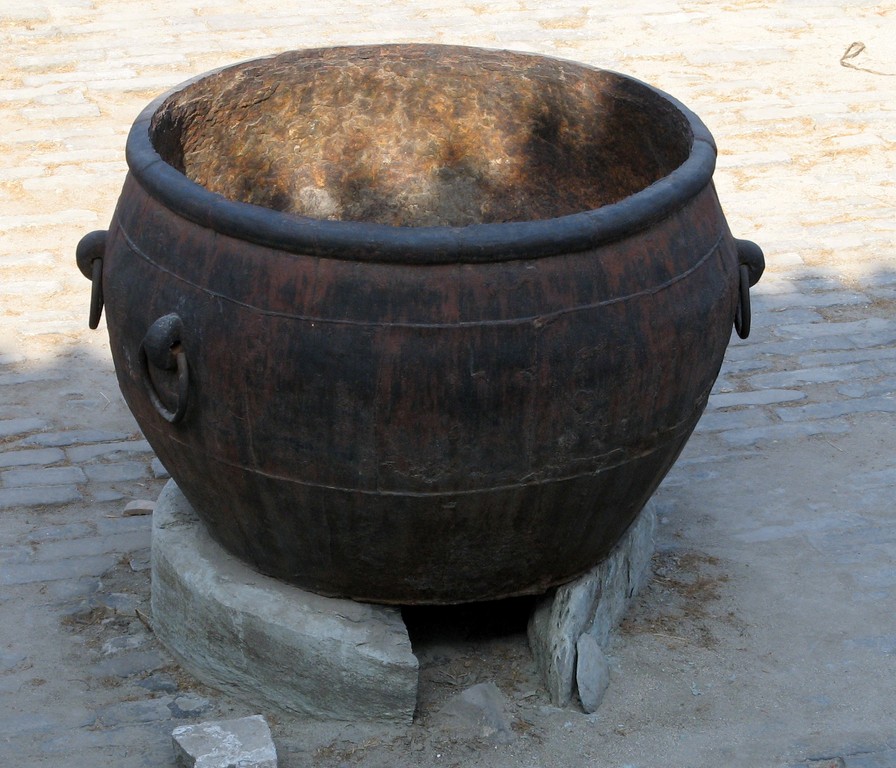
This is one of 18 water pots around the square, (a multiple of nine). They represent the 18 provinces. All must be in harmony.

Soldiers still guard the palace and live here. Notice their boots and shoes  lined up next to their “barracks”. The living quarters of the Emperor  is approached by a series of stairs and nine gates to pass through.  Each gate is a building with marvelous gold, jade carvings, incredibly fancy decoration as part of the building, with real gold leaf.   The rooms that store antiquities are  not lighted, tall columnar rooms, no windows. Pictures don’t reflect  the glorious treasures inside.

It seems as though every inch of the building is exquisitely decorated like this mantel above a doorway.

My traveling companion, Michal Houston and I posed before this Chinese guard lion. His left foot is crushing some small creature, I think.

His right foot is balanced on this ball. I’ve forgotten the significance of this stance, and its meaning, but it is the same wherever these lions are seen. And, the dog-like face of Chinese lions was rendered by artists who had never seen a lion. They only had a description of lions from explorers/travelers  who passed through China.  I always wondered about that. Now I know and so do you.

The roof of the palaces are  protected, as you can see. It seems a bit strange to us that the superstitions of old are still, if not believed, at least respected and revered. Visiting China  helps to understand many mysteries about the Chinese people’s beliefs that hang on.

This little boy knows nothing of the Ming Dynasty, 1420 to 1644 or the Ching Dynasty, 1644 to 1911, or the turbulent  history of  the gate he is crawling through. Notice you step over the deep thresh hold as you move from one gate, which brings you to another palace, and on to the next.

And I got to see many dragons. This gives you an idea of the size and scope of these carved wall panels.
Aren’t they gorgeous?  There are nine of them at the Palace of Tranquil Longevity.

We see so much, it is difficult to take it all in and remember it all.

More tomorrow.