Sunday, September 11, 2011

AN IMPERFECT GARDEN


We are up early to visit the UR Garden. The designers took great pains and cost to turn this  beautiful,  former government employee’s home, into a centerpiece of Chinese garden architecture.  Walled gardens are meant to shut out the troubles of everyday life. To do that, a garden must have balance, and elements that instill peace and serenity.

A perfect garden will have  a hill, water, rock, plants, a building and trees,  the major components.
The plants and shapes and positions of everything in the garden have special meanings. If you plant a pine tree for strength, you must have two, a female and a male pine tree. If one dies, you must remove the partner tree and replant two new ones to replace them with their relativity in size maintained for “balance”.

The rock and hill must be a  size to complement its surroundings, not overshadow it.   Gates, bridge rails and doors are smooth and pleasurable to touch. Walkways flow.  Windows and doorways have form and interest to please the eyes.

Bamboo represents strength and resilience and music as the wind passes over its hollowed stems in a gate or a structure.  Each plant is chosen for its symbolic meaning. A flowering plum represents rebirth and renewal when it blooms on bare wood in the spring.   A lotus is purity. Peonies symbolize wealth.

A carved historical event.

A  requisite lion.

A protective dragon.

After this painstaking cultivated garden was matured, a contingent of Chinese garden experts came from Vancouver, Canada to see it. They commented on how “beautiful”the garden was. Not perfect?  When asked why it didn’t meet expectations, it was  because above the wall, in a small corner,  could be seen, a modern condominium in the distance. The cure will be heighten the wall or move the condominium if necessary. They take the poetic aspects of their peaceful garden very seriously.
In the afternoon we cross the river to the Yangtze market to pick up last-minute souvenirs. Several of us take tea at a lovely tea house. We are let loose in the market place within walking distance of our hotel. Three of us go to the Hip Hop Market and gawk at merchandise for teens, babies, grandchildren, ourselves. Very expensive stuff.  Shoes like we’ve never seen in our lives before. Stiletto heels six inches high. See through blouses and bathing suits. This is China?  It was a gas. We dashed from store to store like unruly kids to take it all in.

That night, at our  farewell dinner, we  traded  email addresses with our new friends and said our goodbyes.  I don’t remember  our  farewell dinner  but, I’ll never forget  China.

Saturday, September 10, 2011

THE CHILDRENS PALACE AND ACROBATS.

The next morning, on our way to the Childrens Palace, business people all over town line up in their suits and ties at street steamers to buy buns and dumplings for breakfast. No congee (gruel) for this group.

The Children’s Palace is simply a mansion converted to an accelerated school. Only the best students in every discipline need apply.  All who show potential, as identified by their teachers  from anywhere in China, come to the “palaces” to live and learn under very strict rules. They MUST perform. And they want to succeed. But, the rules and discipline are very strict, and expectations high. (Picture from Creative Commons Attribute, Wikipedia.)

Art on view in an adjacent gallery, the best pieces from these classes (competition)  on simple paper,  from eight to eleven year old students was  unbelievably good. The students never looked at the fourteen of us invading their classroom. Eyes stayed on teacher.
In a music class for violin, we saw six students from four years old to sixteen learning together. First they tap out the music, then hum the notes, then they strum the notes. The teacher strikes her stick loudly on a music stand when a mistake is made and scolds. We cannot understand her words, but we understand her tone.
Parents are so honored to have their children accepted into a Childrens Palace, they do not complain about the fierce discipline.
We listened in on a musical number in one gallery by five girls on ancient zither-like instruments and stringed instruments that compare to a  harp. The teacher expressed pleasure.
There are Palaces like this all over China, old mansions of the very rich, decadent ministers and government employees that Mau banished. Concentrated learning  in art and music, others are for science, dance, sports, martial arts, gymnastics, etc.  There is something very admirable about guiding children to their special potential, but we found the fierce discipline a bit dehumanizing. We saw no smiles among the students and wonder if they are going to come out of this very talented but unhappy?
We had a free afternoon to roam around town.  Michal and I had  drinks and dinner at the hotel before the evening’s performance of  renowned Chinese acrobats.
The acrobats were stunning.  High jumping from one pole to another.  Flying nimbly through hoops imitating a bird.  Speed tumbling, comic plate spinning, extraordinary feats of strength  and balance as only the Chinese seem to know how to do,  in slow motion. A girl balances a tray of glasses in her mouth while doing carefully modulated trapeze work. In another act, a girl balances on one hand while performing minutes worth of contortions, forming a butterfly, frog, cricket, then she switches to the opposite hand without resting and repeats the moves,  becoming her own twin. These talented acrobats do all manner of beautiful splits, twists and breath holding balance positions you can only believe are impossible. This show is considered the highpoint of Shanghai and all tickets were sold out for months. Of course, you cannot take pictures. This youtube link is not the show we saw, but it is entertaining.
http://www.youtube.com/watch?v=uY85Gb4Yj5M

On the way back to our hotel, we catch our last look at the fabulous lighted Yangtze River boats and skyscrapers.  The boats carry huge billboards as they float past. Skyscrapers have what appears to be television screens on the windows of their buildings that advertise continually. It speaks of wealth, and a burgeoning new capitalistic economy that is rocketing skyward, figuratively and actually. We get back to our hotel late.  (Picture Creative Commons Attribution, Wikipedia)

Friday, September 9, 2011

SHANGHAI

Saturday morning, we bus to the airport and fly to Shanghai. Shanghai is the business center of China and Beijing is the government center, much like New York and Washington D.C.  We notice the air here is awfully polluted.
We tour the city by bus and  important buildings are pointed out to us by our City Guide, Michelle. A Soviet building from 1952 called the Wedding Cake. All the important banks and financial institutions of the Bund. The Bund is China’s Wall Street, the financial center of China, in the old days,  and now. My one gigabyte sandisk , as it filled to the end, had blank spots during the unloading, and burning process and many of my pictures were lost. The best way to see The Bund is at the following website.
http://en.wikipedia.org/wiki/The_Bund

My one surviving picture of the modern skyline of Shanghai from across the Yangtze. Our City Guide, Michele tells us Shanghai means to the sea. We think of Shanghai as kidnapping and that is part of  Shanghai’s reputation when able-bodied men were taken against their will and brought down the river and put to sea on an ocean-going vessel. Shanghai is regarded as a baby city since it is only 200 years old. What was once an opium shipping port in the 1840’s to the 1930’s, with only 100,000 populations has become one of the biggest container shipping ports in the world. Their biggest exports are silk and tea. Now an astonishing  21,000,000 people live here.   They have the highest building in the world and more  skyscrapers than New York City and Hong Kong. Yet in 1964, no building was over ten stories high. . Chinese people want to be the biggest, the tallest, the fastest and the best.
The city is so modern, yet we still see people driving on different types of  slow-moving motors, and a zillion bikes. Here and in Beijing  people are licensed to drive on Mondays and Wednesdays, others on Tuesdays and Thursdays and so on.  We see one man carrying a full size bed on just an ordinary bike. The loads people in China carry on bikes are legendary. There are many beggars swarming us at bus stops and anywhere tourists congregate selling rip off watches, hand bags, shoes, you name it. One member of our group, though warned, bought a Micky Mouse watch and before the bus had pulled away, it fell apart. She laughed the hardest at her own folly.

Traditionally, Chinese babies and toddlers do not wear diapers. They wear split pants. I tried many times to get a picture of them and finally caught one. The problem is, the children squat in the street and the parents pick up after them;  part of  old China where nothing, including human fertilizer was wasted. The government discourages this practice but notice  resistance from young mothers like this one.

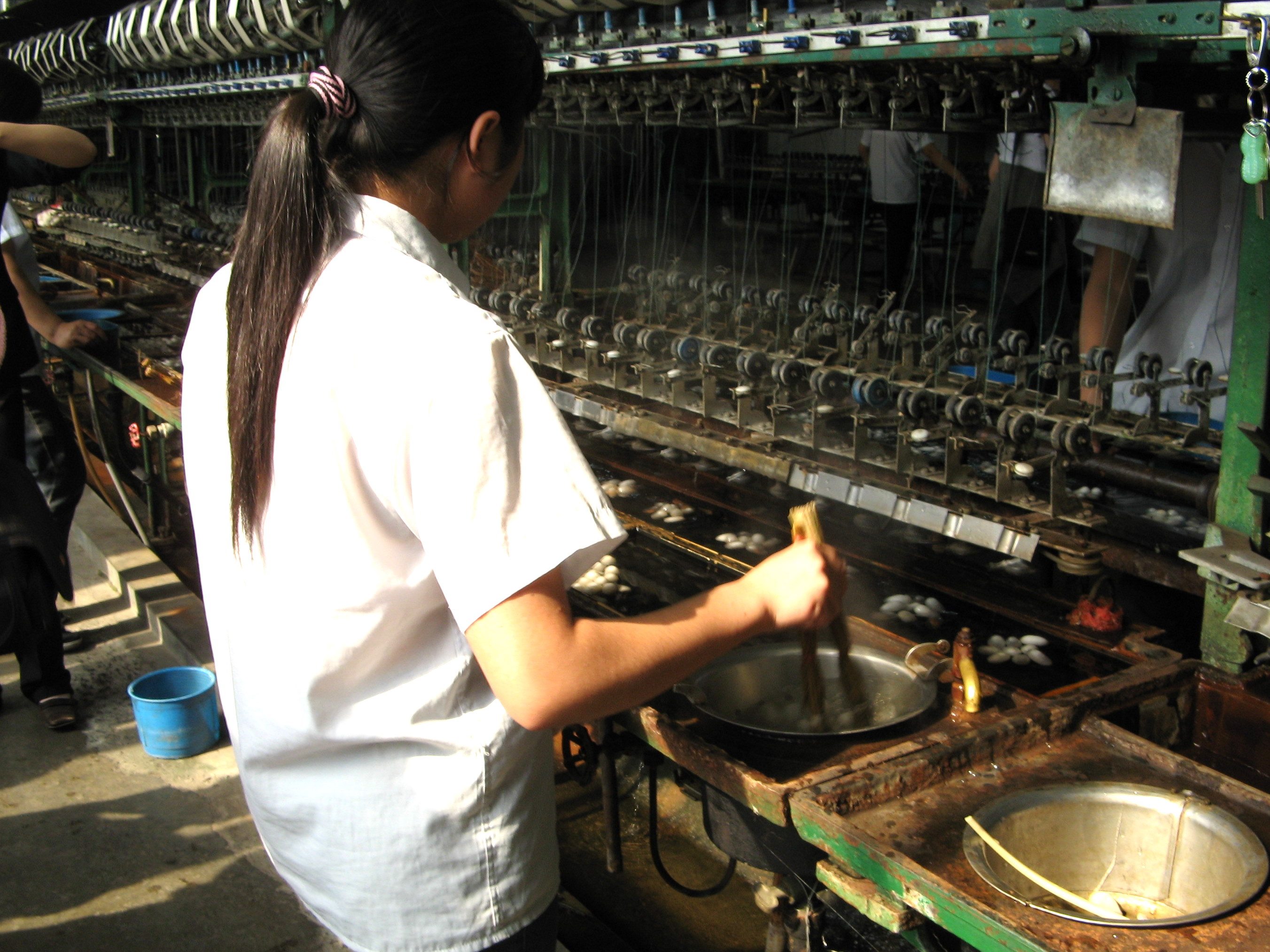
In the afternoon, we visit a silk factory. They harvest these small cocoons, boil them to kill the worm, then dye the silk various colors and spin the silk into large batts.  They sell silk “quilts” and we had a hard time understanding how you could have a quilt made of silk until we watched them take a silk batt and stretch, stretch, and stretch it until it was bed size.

In reality, the silk quilt is a comforter not a  quilt. Silk quilts are reputed to be  very warm for their weight. You do not wash them, we are told.  You air them out twice a year and only wash the outer cover in shampoo. They machine squeeze them so small, you can carry a queen sized quilt like a medium-sized purse.  These factory visits are sales pitches, all tours have them.  They can be educational and worth going to. The whole silk making process was interesting.
We passed a section of freeway where a cement column supporting an over crossing was approximately twelve  feet in diameter?  It was beautifully decorated with writhing dragons. I asked why the need for such a heavy support column. Our city guide explained that it allows the dragons to escape. The road worker found trouble in that spot. They insisted there was a dragon there  and it would be bad luck to cover it up. The government architects came up with a solution. The column is partly hollow and has an exit window. Now, knowing what we do of Chinese culture,  and their superstitions of centuries embedded in  their character, we understand.
We stayed at the Gorgeous Hilton Hotel and ate out our first night. Food here tastes bland compared to the spicy Szechuan food we enjoyed and prefer. The hotel rooms sell condoms and you can buy a large bottle of water for $28. Expensive in this city. To buy a small condo here costs about $200,000. Seems high when they pay workers so little. It was nice to have a good scotch at the bar instead of the tasteless Chinese beer and wine.
That night, we are taken to visit the tallest building in the world, a brand new building with 88 floors.  It costs us $7 to ride the elevator to the top in 45 seconds. Amazingly, you feel no stomach churning lift, it is a seamless ride. The lines to get on the elevators are never-ending. We suspect the building will be paid for by tourism. From the top, we look at a new building being built right next to it by the Japanese which will be even higher at 105 stories. The view from the top is stupendous.

It is a Saturday and all the city lights are lit on the weekends, but not during the week;  a cost saving measure. At the top we see a video of men parachuting from the building. It is against the law, but they did it anyway. What an amazing technology. We have no doubt that China will some day replace the U.S. as the pre-eminent super power. There are, by the way, 20 million Christians in China.
(The photo above  is copyrighted by the Creative Commons Attribution given to wikipedia.)

Thursday, September 8, 2011

TWELVE BRIDGES AND OLD CHINA

The Li and Peach Blossom rivers merge together at Guilin  and form four city lakes before they move on down the mountain. The lakes are joined by locks and we take a night boat tour to see  the twelve bridges  joining the mainland to an island in the center of the lakes.

Picture taking is difficult as the boat chugs along.  The twelve bridges  are small imitations of world-famous bridges with frescoes and decorations of great beauty and interest. It‘s ooo and aahh time. They imitate the Brooklyn Bridge, Cambridge Math Class Bridge, The Golden Gate, the Glass Bridge… I didn’t recognize all of them or get them into my journal. The Cambridge Math Class Bridge is so-called because students at Cambridge supposedly took it apart to understand how it was built and then put it back together again.  In the dark, night fishing with their cormorants, the boatman uses a cane to keep them moving. He smacks and scolds when a bird circles behind him and  tries to steal a fish out of the basket and pretend  it was newly caught. He calls to them, “Ai, ai, ai”!  The birds work quickly,  fly out,  dive,  and return. It was musical;  his voice echoing  over the water as the boat moved away.

The famous Sun and Moon pagodas are beautifully lit up at night.  One leads to another under water. We saw a charming tea house on an island with a replica of the Empress’s Stone Boat we recognize from the Summer Palace.
The  trees, on shore and on the islands, the bridges, are all  lit up with specialized lighting.  Bands play from the shore as we pass by.  Built to entertain, More realistic  than  Disneyland, we floated along, mesmerized by the sights,  thinking, how lucky we are to take this magical boat ride

The next morning, we load onto a boat like this one for an 83 kilometer trip up the Li to view unique karst rock formations. The osmanthus, a type of purple acacia,   is in bloom. It  reflects its color on the water and fills the air with a fragrance like orange blossoms. It is used for tea, medicine and perfume in China.

Ten thousand boats a day cruise the Li. Sampans furnish them with fresh fish and greens for the meals they prepare. Chinese people do not eat  “dead” fish. Restaurants in China have aquariums full of fish and only kill it when you sit down and order. The boat kitchens are always at the back of the boat.

Uniquely shaped hills of the Li are often clouded with a fine mist giving them a mystical quality.

The formations are world-famous and many artists and photographers come to see one of China’s great  “pearls”.

I find myself more interested in a glimpse of “old China” revealed on the banks and water of the River Li, like this boatman ferrying a man and his bike across the river. We see many of these flat bamboo boats that seem barely able to float without swamping.

A house boat.

The age-old manner of carrying a heavy burden.

Washing clothes.

If you don’t have running water you must carry it up from the river in buckets.

While some farmers depend solely on water buffalo, others have a modern motor.

We  see kids bathing their water buffalo. Buffalo, pigs, and dogs roam quite freely, sometimes invading a golf course near Guilin.  Vicki tells us that on another tour she saw a farmer drive a herd of buffalo across the lanes of the freeway. People drive slowly here, and they stopped and none were harmed.

A crude fish trap.

A fancier ferry. The boatman chooses to paddle even though his ferry has a motor. Vicki says he saves gas.

A fisherman’s hut.

Vicki tells us that the minority people from this village were persecuted 120 years ago and moved up higher in the mountains. The buildings still stand. Some tours take you into various villages along the Li.

When our boat docks, the cormorant fishermen are waiting for the tourists.

If they see you are trying to take their picture, they turn their backs to you.  They want you to pay. Vicki gets angry and says don’t pay them. We try our best to sneak a few shots.

Wednesday, September 7, 2011

THEATER OF TEA AND A CHINESE PHARMACY

After our visit to the Suni Yi village, we load back in the bus headed for Guilin (guay-leen). Our guide finds a pit stop for us at a tea factory and a  tea tasting.

Tea has been the drink of choice for China before Christ and it has recently found renewed popularity in the U.S. as well. At this tea factory it was theater. The tea mistress gave us a tiny little cup.  We tasted about eight to ten different teas out of about sixty choices. The interesting wooden hot plate with a happy Buddha, and a burner was central to the event. Now, the tea tasting rules:
First, you smell the cup.
Then you sniff the tea and chew a bit of the leaves to make sure it is good and strong.
Hot water is poured in the cup to warm it. Then while the tea is brewing, (not boiling) you hold the cup in your hands to warm them. You dump the water (or drink it) before the tea is poured.
The tea is poured and you sip once and swirl it around your mouth and savor its smell and tongue feel.
Then you slurp it noisily, considered  polite and the best way to enjoy your tea.

We are paraded by open containers of loose tea to smell. Also on parade are beautiful tea pots  that  filter out leaves. Most Chinese don’t know what a tea bag is. We are given samples of our choice and sent home with a bright pink bag.  And we are entertained by two tea pots. One is a fat baby. When the hot water goes into the pot, the baby pisses into your cup. The other is a green dragon pot that turns red when the hot water fills it up.

Big and small rounds of compressed tea leaves, some beribboned, is the way tea is presented in tea shops. And, suddenly the light dawns. We had seen big wheels of tea, larger than these, at a shop in Jiliang and wondered what they were?  Now, we know.  Almond, and citrus smells and other earthy fragrances pleasantly invade our senses. Some teas in China are aged, like fine wines.  The twenty-eight year old Puer tea (not to be mixed up with Pu’erh tea) is  said to reduce blood pressure, cure diabetes and clean your liver. Does it work? It is expensive to buy but our tea mistress explains that  you can use the same leaves nine times before the leaves are depleted of flavor. I bought some to bring home.

From our bus window, we see the city surrounded by rice paddies. They are so beautiful and at one point in our journey we wanted to see a rice paddy up close. Vicki had our driver stop by the side of the road so we could see rice growing, but it was disappointing.  It  looks like grass. The paddies are in several stages of growth which give that patchwork look. Vicki gives us background on Guilin and its minorities as we ride on the bus.
The town was destroyed during WWII and  rebuilt. University students go to coffee shops like western students do. She warns us to watch out for pick-pockets when walking around town. None of the buildings are allowed to be over twenty floors so that no one’s view to the mountains is blocked.  The hills around have 3,000 caves made of limestone,  many of them open to tourists. Some have colorful names like Waiting Husband Rock Cave,  Crown Cave, Elephant Rock Cave to name three.
Guilin has 13 different nationalities. The Yau and Dow are the major nationalities in this small city of 640,000 people.
We look aghast at Vicki’s definition of a small city. Every year they hold a folk song festival in Guilin. The Dau people sing a beautiful courtship ritual. A woman throws a bouquet at the man she wants and if he catches it, that is his acceptance and they are one.
The Dong people are known for their bamboo houses and other wood work. They make bamboo and  reed flutes.
In the Miao minority families, six and seven-year olds begin to learn the crafts of their parents. They make silver hats and hairpins, combs and hair decorations. They wear very heavy head dresses.
Yau people practice the Oman Religion, a form of Islam. Notable about them is their practice to cut long hair only once when they reach 16 years of age, and then the second time when a daughter marries.  The mother cuts her hair with her daughter. Thus the women are separated by who is single from who is married by the length of their hair. Vicki told us she knew a woman who was 101 years old and had hair to her ankles.  They use oil to wash hair, not water. The Yau are known for their longevity. They also use reflexology, and are very educated herbalists.

We unload at our hotel and walk around the city to see what we can see.  We find a place for our “own”  lunch. The city is very Westernized and busy. We happen upon a pharmacy. We wouldn’t have known if it hadn’t had a second sign in English.

Unlike any pharmacy we’ve ever seen, the pharmacist here is lighting the burner on a huge infusers.

The medicines look more like dried fish, because they are.

Unable to identify the various herbs and plants that go into Chinese medicines we hear and read about, makes this picture more compelling. Professionally laid out in a modern pharmacy we now understand the seriousness of herbal medicine in the Chinese culture.  They have but few “pills”.  Syrups, bottled infusions, and ointments make up the better part of the medical menu. At this point, I decide to take the Puer tea I bought seriously.

Tuesday, September 6, 2011

VISIT TO A CHINESE CEMETERY

We leave Kunming on the bus headed for Guilin. On the way we stop at a poor Suni Yi village that  still functions much like it has for hundreds of years. It has been insulated from tourists until recently when the village and its cemetery were designated a UNESCO site.
Most of the houses are ramshackle. Some have tin roofs, some have straw. Some keep pigs next to their houses.

Raw sewage runs into a ditch down the street; garbage is strewn on the ground everywhere.  You understand very quickly what life was like, and still is,  for some ethnic minorities in China.

The Suni Yi believe spider webs are good luck and they don’t remove them from doorways, alleys or houses.

The women work together to remove corn from the cobs. The crop is shared among the families. It appears to be the major crop in this area. Front right is the village adobe mixer.

They have many uses for the fibrous husks and don’t throw them out.

Clearly visible on this building, the many layers of time. On the right, is a slap dash repair. The center is from an earlier time. Above and on the left are different materials.

Here, too, you can see the different style of adobe bricks and stucco that went into repairs over the years.

Like all Chinese, they adore their children. During the enforced one child per family policy ethnic minority people are allowed two children per family. The Chinese government enforces this with ostracism. An unregistered child is shunned by neighbors; he cannot get work as an adult, no one is allowed to hire him.  His parents also suffer; they lose jobs and get punished in many, small ways. Farm people didn’t exactly have “jobs” like city people before collective farming. And now, collective farming  has been discontinued.   At one time they gave out free condoms and demonstrated them by showing how to use them by slipping  them on their fingers. So the farmers put the condoms on fence posts, tree branches and anything but their privates thinking they would work.

The people here are not used to big noses parading through their village and they are a bit shy. Vicki asked us not to give them money and turn them into beggars. But, you can see the dollar bill in this little boys hand. One of our group “forgot”.  It won’t be long before tourism will negatively and positively affect their  lives.

We barely give the above ground  cemetery a passing glance. It is unkempt and overgrown with weeds.

From past experience,  UNESCO sites usually have some great beauty, but this site was chosen for its historical significance and rarity. Above ground cemeteries have not been allowed in China for several centuries. By law,  bodies must be cremated.

As we leave the village, this woman is headed for the fields with her child on her back. You can tell the dog has had recent puppies and we wonder…

Happy children play on the street. They don’t know they are poor when they get enough to eat, have loving parents, and adequate shelter.