Showing posts with label survival. Show all posts

Thursday, October 29, 2015

A NATURALIST IN THE NEIGHBORHOOD.

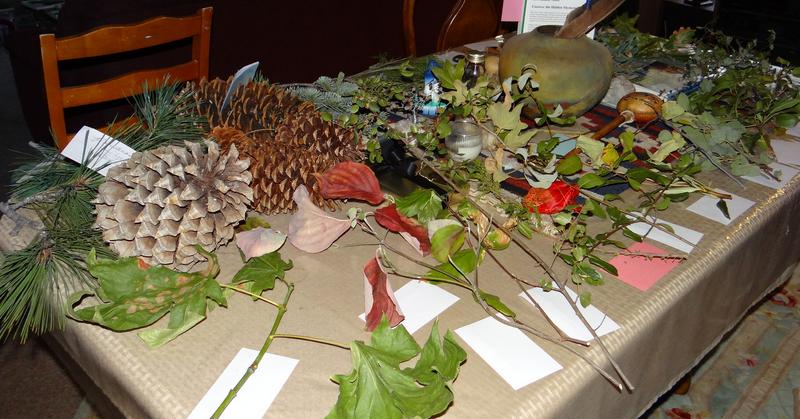
DSC06919 (Copy)
Naturalist John Randell gave a slide presentation about trees and under-story plants in our neighborhood and then on up the hill to the top of the Sierra Nevadas. He lives on the same road as I and my neighbors live on, so it was journey through our own neighborhood.
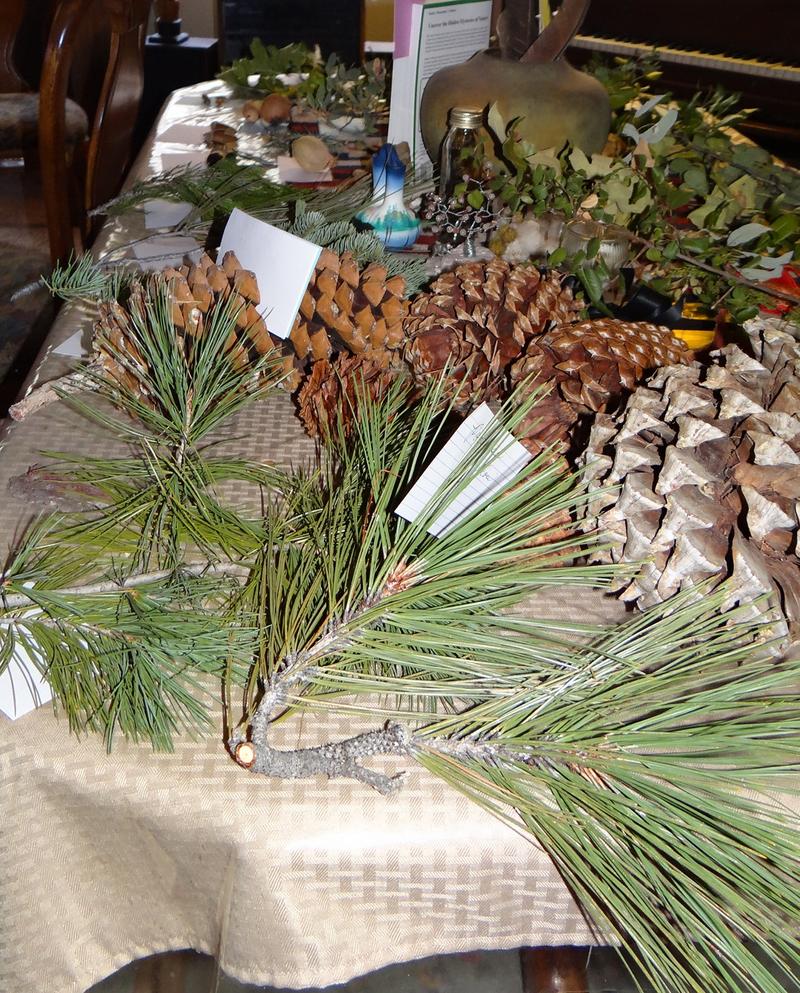
DSC06922 (Copy)
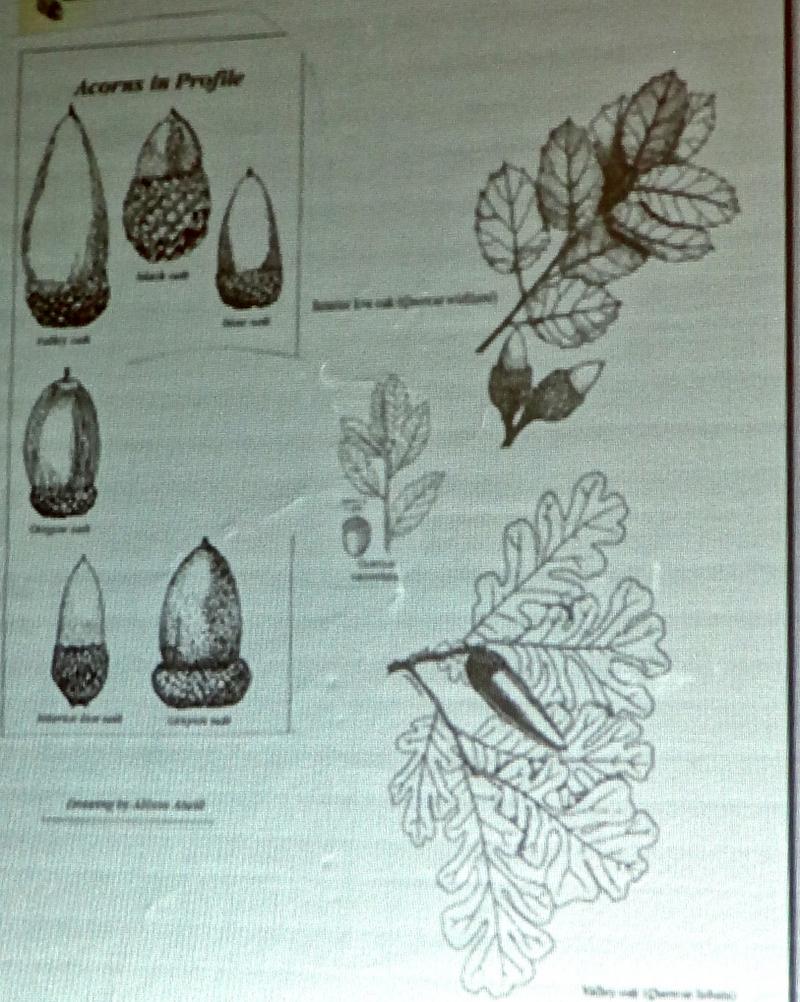
Everything on this table came from nearby and it was a revelation. I tend to think we have two different type of Oak trees, the live oaks from my yard and the huge, magnificent blue oaks that line the road and fill up the hillsides. He showed us cones, and needles from valley oaks, white oaks, red oaks, black oaks. Our journey continued on up the mountain. We looked at and discussed sugar pines, ponderosa,  lodgepole and Jeffry pines that smell like butterscotch or vanilla. Huggable trees and what naturalists and scientists have learned from their adaptability. A good thing to think about during our present drought.
DSC06923 (Copy)
In our neighborhood we have vine maples, big leaf maples, the invasive poisonous black locust, alder, Oregon scrub, huckleberries, canyon oak, and a host of plants all managed and used by the local Indians.
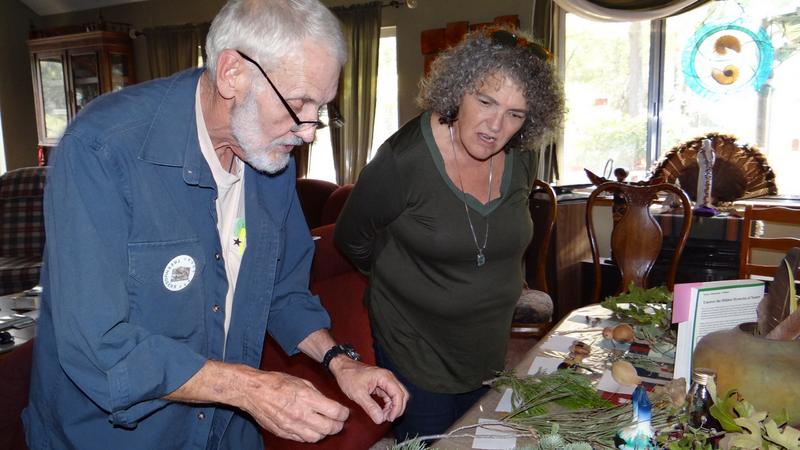
 DSC06926 (Copy)
What John did was place cards under the plant samples and asked us to guess what they were, from what we had learned in the slide show. The answers are on the cards. We got to roll needles between our fingers, and smell and pinch everything. What a delightful presentation.

Even more interesting, Dixie (whose last name I didn't get) prepared a wild dinner. We drank pine needle tea, ate pine needle cookies; there was edible seeds, shredded wild plant salsa, along with a rice based enchilada. A complete meal. On display were plant based medicines from Indian recipes.

Native Americans thanked the spirits for whatever they took from the land. They never used too much nor did they despoil the land.  (More tomorrow along with the kitchen sink.)

Friday, September 21, 2012

THE BEST FOODS IN THE WORLD.

The best foods in the world are herbs, as it turns out. If you are interested they are turmeric, sage, marjoram,cinnamon, oregano, pepper,cloves and then a mixture of Jamaican spices and a mixture of Italian spices, under what name and brand, I’ve promptly forgotten. Then following the herbs are ginger root, and honey. Maybe they should be the best foods in the world for your health. I’m not sure who decided these things but they make for a god-awful breakfast.
I shouldn’t complain, since I’ve  eaten grubs, ants, grasshoppers, snake, rat and other weird fare. The difference is, I don’t eat them as a steady diet.
The foods on this best foods list are purported to have healing qualities, and are  therefore recommended as a preventive. Despite my upcoming carotid surgery, even my surgeon agrees I have a healthy diet and have exceptionally good health. But, it isn’t the grasshoppers, or grubs. I do faithfully eat five to seven fruits and vegetables each day. I enjoy unsalted brown rice with sea weed and whole grain breads and cereals.
And, according to some of my friends, I have bizarre taste. I happen to love parsley in my unsweetened, whole grain cereal every morning. I clip it with a scissors and I l\enjoy the texture and the taste. I know, everyone thinks it is strange.
My sister and I were discussing bizarre eating habits in our family. She claims she loves pickle relish with potatoes and gravy. She also likes sliced cooked potatoes with raw onion and baloney in a sandwich with plenty of  mayo.  We normally don’t tell anyone what strange stuff we eat. One of my brothers eats pickled pigs feet every day and happily devours the cartilage around the ends of chicken bones. Whose to say what foods are right or wrong? A friend of mine eats sweet pickle and peanut butter sandwiches. And, my brother who lived many years in Alaska, developed a taste for whale blubber.

But, this guy, Andrew Zimmern, roams the earth to taste things like dung beetles, tarantulas, scorpions, and rooster testicle soup. He is the host of the travel channels Bizarre Foods.

Here he is shown with withered frogs. He reminds people that most of his programs are devoted to all the wonderful foods you see only in other cultures, many of them poor countries, where absolutely nothing goes to waste. Like in Bolivia where an old women with nothing but an oil can for a kiosk, serves thinly sliced calves liver that barely touches a hot grill. She adds a homemade sauce with peanuts, chili, garlic and vinegar. People stand in line for it because it is ridiculously good. He thinks Americans are squeamish and afraid to eat little fish with the heads on them, and chickens feet. It bugs him that the hot dog and hamburger are king. (Information and pictures taken from Sierra Magazine.)

We are so fortunate to have great food, wholesome and clean. And, we can enjoy the health benefits of herbs and spices as well and make lovely dishes if we just step up to diversity.

I’m appreciative that my parents never introduced us to fast food nor soft drinks. We ate close to the garden, what was in season, whatever was available. I cringe when I see a cooking show and the participants leave half the tomato sauce in the can, they don’t scrape or rinse every bit out. We didn’t waste.  My father was a survivalist and I like to think I’m a survivor, no matter what happens in this economy. I could live off what I can find in my yard. Thinly, but I could do it with a couple of chickens and a goat.

Sunday, June 10, 2012

THE LONG HOUSE AT MESA VERDE

Mesa Verde means green table. And, for desert, this high mountain place is green.  The drive  Mesa Verde National Park at  7,500 feet was a challenging pull. The drive to the various ancient dwellings on a twisty hilly road provides you beautiful views of the valley below.
It takes 45 minutes to drive the 25 miles to the Long House. We stood in line to get tickets for our guided tour.  The tickets are only $3, affordable and young children can climb the ladders. No water or food in the canyon. When  you go, read all the rules before you start.

A panoramic view of this ancient  cluster of dwellings, set into a stone mountain suggests to me why it is called the Long House since it sits in a long crevice in the stone. ( Click on pictures to make them larger.)

The tour starts here, with these two ladders. They are easy to climb. The guide allows 90 minutes for the tour from start to finish. Plenty of time to look around and rest if you need to.

The first building we looked into was quite intact.  The Puebloan People crawled into their dwellings through a small door. Windows were often smaller than this one, and gave very little light.

This is what it looks like inside. Jim teased a little girl on the tram ride back and asked her if she would like to live here if they would install a television set.  Of course,  she said no. The climate gets very cold and very hot here.  Archeologists believe the ancient ones  spent as little time inside as possible. Mostly to store goods, sleep and cook in winter months. 
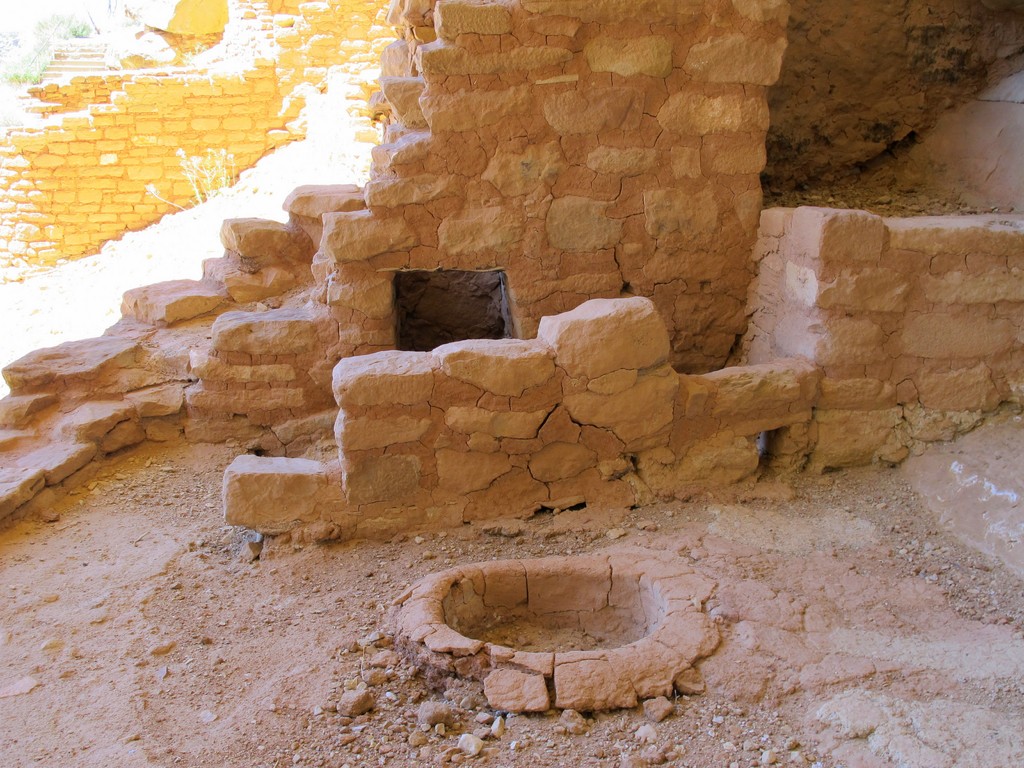
Looking down into one of the dwellings shows a fire pit with a deflector in front of it.  The chimney that brought in fresh air is behind the deflector, so not to blow embers or smoke around. Smoke went up through a hole in the roof.  It is amazing to think these people lived her around 568 BC.  Archeologists  know the dwellings were continually occupied for 200 years. Then abandoned and then lived in a second time.

No one knows how many people lived in this cluster of dwellings, but their middens show they hunted elk and the bones in the midden got smaller and smaller as the years passed, suggesting they had over hunted and game became scarce.  Knowledge had to be passed down to younger generations, and the average lifespan was 32 years for men and 36 for women. They were good architects; survivors; capable of eking out a living in a sparse environment.

Building here was no easy task, picking the stones, carrying them in, making the mud. This rock shelf had a small spring at the back wall that now grows moss and mosquitoes. Life giving to the Puebloans.

In the floor were grinding holes next to the water visible as a thin layer on the right.

And on the  floor, a moccasin footprint .

.

It is easy to romanticize and imagine the congenial families, children cavorting, enjoying story telling around a fire at night, women weaving, looking out over the beautiful canyon. But, the lifespan, the sparse living, suggest more work than play.

We hiked back up to our tram and got off at the Pit Houses. These ancient dwellings are covered for protection and precede the cliff dwellings.

This community of ancient peoples dug homes into the ground. We visited four covered sites  within easy walking distance of each other.

A large Kiva, where ceremonies and religious rituals  were held suggest a large community.  A drawing of what these dwellings looked like with a roof over is at one of the sites.

Why did they dig homes to live underground?  Why did they cease their formerly nomadic life style to live in “permanent” dwellings? One pit house had evidence of a fenced enclosure around it. Was it for protection?  To hold livestock, like turkeys?  No one knows. Archeologists suggest the planting of corn, changed their lives from nomads to farmers. They used practically every plant in the canyon for food and medicine.
I thoroughly enjoyed seeing how they lived and imagining being set down in this hostile climate and  being able to survive. For us, not possible.
Sunday, February 22, 2009

WATER, WATER EVERYWHERE BUT MAYBE NOT FREE TO DRINK

There has never been a time in my life when water wasn’t significant to my deepest feelings about life. I was born and lived near or on the Great Lakes. With our young family, we chose to lease camping space on the Stanislaus River where the kids could fish, learn to swim, hunt crawdads, watch salmon spawn, pick berries and cattails. I bought river property for vacationing and retirement. Its life sustaining properties seduce my back-to-earth fantasies and genuine survival instincts. Land, water, growing your own food… America, where access to clean, safe drinking water is a basic right.
That is, it used to be. Our government is turning over public water systems to private corporations. And why not? They can make a great profit…just think. Coca-Cola sold $346 million dollars in Dasani bottled water in one year. Nestle sold $200 million in Poland Spring that same year. So, now we have EXPENSIVE water, sold in plastic that leaches chemicals into our water. Its not cleaner nor safer. The plastic is trashing our environment. In the past three years the Federal Government has slashed funds for clean water in half. Multinational corporations are swooping in to buy up our public water systems. It takes 47 million gallons of oil to produce those plastic bottles.
HELP!! Pledge NOT to buy bottled water. Tap water is better for your health, your checkbook and the environment. Also, check out www.foodandwaterwatch.org


Align Center