Showing posts with label legend. Show all posts

Sunday, January 15, 2012

THE LEGENDARY MOUNTAIN MAN, MONTE WOLFE.

It is unusual to find someone who has a  link to Monte Wolfe, the legendary mountain man who disappeared over sixty years ago.  Mark Bonar, who moved here in the 1950′s is that man.
In college, he met his wife, Barbara La Teer, who was a native of West Point, Calaveras County. They had three children, Mark Richard, Lynne Alison and Lauren Ann. Mark became close to his Father-in-law and through him, the larger than life character of Monte Wolfe with whom Paul La Teer had crossed paths.

“I hadn’t fished since I was a kid in Idaho,”  said Mark.  “Paul invited me fishing. I went out and bought a primitive fishing pole and reel, and as we began hiking, I heard the first of many stories of Monte Wolfe. Our fishing expeditions became regular, enjoyable occasions. Paul hiked all over the rough and wild back country and was in terrific shape.  And, that is how he encountered Monte’s one room, “first” cabin, which became known as the Upper Cabin,  in the mid 1930′s. It was situated in plain sight along the Mokelumne River and right along Paul’s fishing site. Monte had left a foot- high stack of canning jars piled next to the cabin.

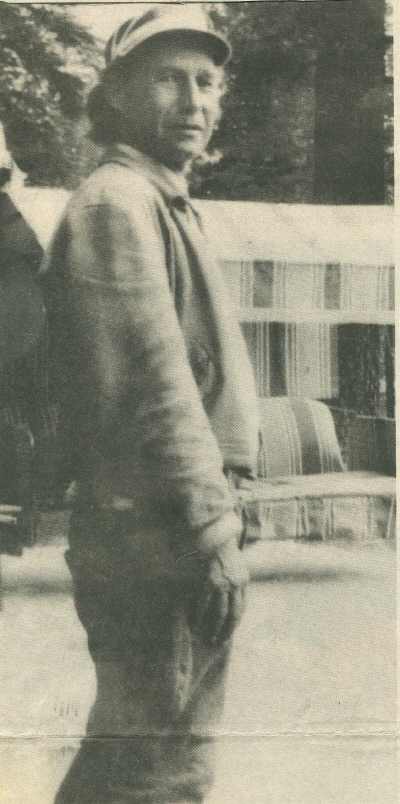
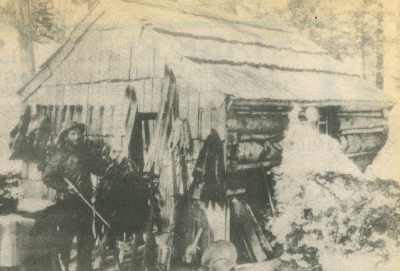
(These two reproduced pictures of Monte and the first cabin were copied from my newspaper article on Monte in the 1980′s and were taken by Harry Schimke.)
"Paul had heard rumors of a newer cabin and as he prowled the high country, he spent the late 1930′s  trying to find it. When he did find it, he was met with a 30-30 deer rifle by an unfriendly Monte Wolfe.  During that encounter, Monte had visitors, presumably the Linfords, who had befriended Monte and who claimed to be guarding his privacy. Monte was a social person but could be unpredictable and not someone to mess with, so Paul never became a friend of his.”

Veda Linford wrote a book about Monte and once cared for him when he broke his leg. The Linford’s probably knew him best. Monte divulged little about himself and seemed to like being a bit mysterious, for good reason. He was arrested and tried for stealing in Tuolumne County as Ed Mc Grath, not something the locals were likely to forget.

He lived totally off the land on fish, deer, and  whatever game he could trap for food and pelts. Some of it was legal and some of it was not. He had many a run-in with the Calaveras County game warden and the law.
“He would routinely break into local cabins and take food, mostly canned food which was standard fare at the time. He’d usually leave something to replace it, or leave a note of thanks signed Monte The Wolf.”   He would attempt give something in payment at a later date, perhaps a mess of fresh trout.
Paul recollected a story of one of Monte’s encounters with a game warden who walked up to Monte’s camp to find a lot of grouse feathers around it. The warden questioned him. Monte steadfastly claimed that he had seen no grouse and that the feathers must have blown in. Another time, a rifle that went missing from Sonora, out of someone’s car, was spotted hidden in a hollow sugar pine near his camp.
There were many incidents of things gone missing that irked people and the authorities. He was so adept in the woods and a dead shot with a rifle, people were not inclined to challenge him in his own territory, which encompassed three counties, Calaveras, Tuolumne and Amador.
(To be continued tomorrow.)

Friday, January 13, 2012

MONTE WOLFE REVISITED


Last night, a friend of mine offered to share some information he has worked on about Monte Wolfe.  I’ve known Mark for some time, but what I didn’t know about  Mark Bonar was his  long history of interest in the reclusive Hermit, Monte Wolfe.  Since I’d written about Wolfe in the 1980′s,  Mark  came by with materials and we enjoyed an evening of ruminating about Wolfe. Mark had the good fortune of living in Calaveras County in the 1950′s.  His then father-in-law, Paul LaTeer had met Monte and later wrote stories about Monte and influenced Mark and his family to engage the vast, mountainous arenas and rivers that Monte called home. I promised Mark I wouldn’t write anything from our interview until I passed it by him, first.

For those who don’t know the legendary Monte Wolfe story,  I’ve provided two  links  to my  blogs of 2009 as an introduction to Monte Wolfe.
http://marysramblins.blogspot.com/2009/03/disappearance-of-monte-wolf.html

http://marysramblins.blogspot.com/2009/03/monte-wolf-legend.html

Wolfe spelled his names two ways, sometimes as Wolf and sometimes as Wolfe. Mark uses Wolf with an e and thus this blog is consistent with that spelling.
Wolfe lived like an Indian, surviving completely in the wild with no services. He didn’t have a totem, that I know of, but on a recent walk, I took a picture of a neighbor’s totem that I’d like to share today. I’m always looking for ways to display my amazing pile of junk and this totem  inspired me to build the bottle fence I’ve promised myself.  I only save bottles and jars that are embossed with writing or insignias of some kind, or that have unusual shapes. Anyway, here goes. Don’t tell me. My kids have already informed me that I’m weird.  And, they ought to know.

You  might note that the top of this totem is made of  carved wooden feathers.

What else can you do with rusty tools and broken pieces of tile?

A true totem has a face.

Two faces, optional.

Since I’m part Indian, and I approve, three and four faces are also appropriate.

I also took a picture of a chicken coop.

My brother, Norman, told me he will come back in the spring and build me a chicken coop. (But, what I really want is a totem.)

Monday, March 9, 2009

MONTE WOLFE, THE LEGEND


After Monte's disappearance, the stories began to flow. His exploits as a hunter; his quirky ways; his feats of strength. They came from so many sources, they are collectively a picture of the real Monte Wolfe regardless of his origins or what his real name may have been.
He spelled his name Wolfe with the English e on the end. He used expressions like thar and by gar, and made some "Canuck" bunk beds for friends of his. He served some time in jail as Ed Mc Graff for relieving Constable Billy Schmidt of his gun while trying to arrest him for stealing a gun from Alexander Chauncey. He was prosecuted as Ed Mc Graff in Tuolumne County and sent to State Prison. He also supposedly served in War War I as Ed Mc Graff, but he once corrected someone and told them his name was Monte Rice, and another time Ed Wright? He wanted to be unfound and his inconsistencies made everyone more curious. For instance, he had a barely accessible cabin on the Ned McGrath ranch on Little Humbug Creek. Ned McGrath, Ed McGraff? The names so similar? He claimed to be Catholic and his mother had a proper upbringing. He canned venison, never dried fish or meat as the Indian's did. His cabin building skills and handiness with an ax suggest a Canadian background. No one knows for sure who he was, but his feats of strength were legendary and indisputable. He would easily ski to Nevada to get his mail since the rangers took his mailbox away in Calaveras County. He'd pack people into the woods and carry their stuff plus his own. He'd catch fish for them if they didn't get their limit. His main cabin was two rooms, 14 by 20 with a loft. It had guest beds made of metal with real mattresses. He had a cement mixer, a wheel barrow and a heavy cast iron cook stove that he carried into the canyons by himself along with a victrola, steel cookware and other heavy items.
One man recalls meeting Monte carrying a keg of heavy nails on his shoulder. He stopped to talk for several minutes and never set his burden down, but continued on as though it was nothing.
He made a log ramp and hoisted 600 to 800 pound logs up the ramp he made while building his main cabin. After working all day on his "new" cabin, he still had energy enough to hike five hours out to escort people to their cars as the day dwindled, making it back alone at night.
The Lewis family recall that he offered to build them a cabin on the Moke River if they would supply the windows. He showed them a couple catfish lakes so full of fish they'd practically jump in the pan. "His legs were like fence posts and we couldn't keep up with him. Monte explained that he wore several pairs of stockings to protect himself from rattlesnakes," said Earl Lewis.
Monte loved to be social and readily sought company on his terms. Yet, he gave the impression that he was hiding from justice.
All the little contacts people had with him through the years verify his unusual personality, his strength, his sense of fun. He would ski into Tamarack and chase the giggling cook around the bar (a skit they planned for the entertainment of patrons) and through the kitchen, jump up on the bar and emote with relish. He loved talking about his encounters with cougars and bears.
Slim Hinton remembers he started a forest fire once and was embarrassed by it. He burned around his cabin every year and it got away from him. The burn exposed a cast iron stove he had tried to move to his lower cabin. It even defeated Monte. Hinton said he couldn't even budge a corner of the thing. Another time he used his shoulder to lift and nudge a cabin into position that he helped another guy build. He liked women and had a number of women visitors. He worked for others when he could find work, but he always left himself an out. He had many a cache stored around a four county area to give him a wide range and an "out" if he needed it.
The above pictures show Monte's smaller cabin, one of the log bridges and a cache wired into a hollow of an oak tree. He kept his food in water tight, vermin proof containers. He grew 500 pounds of potatoes a year and kept them buried in oak leaves near his cabin.He would have enjoyed knowing people are still talking and reading about him today.

Saturday, March 7, 2009

THE DISAPPEARANCE OF MONTE WOLF


Mountain man Monte Wolfe chose the rugged canyons of the Sierra Nevadas as his home where he could range unhindered over several hundred square miles, hunting, trapping and fishing. He prided himself on his ability to live off the land and turned himself into a legend in the process. He loved the grandeur of the mountains and the quiet, privacy it offered. He liked people,too, on his terms. Some swore he was a wanted man, and were afraid of him. Others loved him for his unique lore of the woods and his willingness to share it. Monte disappeared in 1940. Those who knew him speculate that he would have enjoyed the controversy and mystery his disappearance caused.
Harry Schimke of Sonora was the last person to see him alive. He and his brother Art had a cabin in the Stanislaus range where they wintered and knew Monte from 1936 to 1940. Monte visited them whenever they were in camp.
"When I first met Monte," said Harry, "he was hiring out as a mountain guide from a tent at Tamarack. He'd take hunters and fishermen into the remote canyons. When he wasn't on a trip, he'd put on a campfire for the summer people. He was quite a showman and he'd tell great stories of his hunts with a lot of flourish. It was obvious he liked to entertain. Near Tamarack was a guy and his wife, Retha and Louis Bauer. They were good friends for years but not long after I met him, they had a falling out and Monte avoided their place. Louie would sit all day with a jug and lace his wine with pepper to spice it up a bit. Louie had it in for Monte and spoke viciously about "getting" Monte someday and I believe he was capable of doing Monte in. It was rumored Monte had an affair with Retha and Louis hated him for it. Louis was such a drunk and M0nte was so normal, and a virile man. I believed it. Besides, Retha was half Indian like Monte.
"Anyway, he gave up his GUIDE operation and continued to sell furs, hunt, fish, garden and live off the land. He'd have a drink with us at the cabin, or if someone else was buying, he'd drink at the bar, but he didn't buy drink, nor smokes. I never saw him inebriated.
"Monte turned into a superman after he disappeared, but he wasn't a superman really. He was a small guy about 165 pounds, but he was tough. He could hike miles up and down hill through rough country with a 100 pound pack on his back like it was nothing. He had huge calf muscles from all that hiking and he wasn't young. I remember him talking about being in WWI, but he was in such good shape he looked like he was in his forties. He had a habit of disappearing for months and then he's just pop in on you. I think he liked the idea of being a little mysterious and not telling anybody too much about his past.
"I liked Monte but he wasn't well liked by everyone. For one thing, he tended to take things that didn't belong to him. If something was left unused, he'd take it an use it. It was his way, but it caused resentments. Then there was his problem with Louis Bauer. He had a few scrapes with the law but the constable considered him harmless and didn'[t act on them. Some people said he was an ex-con running from the law. People were a little afraid of him. He had a temper if you got him riled up. And, no one knew for sure what his real name was. Veda Linford knew him well and wrote a book on Monte called Monte, The Lone Wolf of the Mokelumne. Its pretty accurate.
He stayed with us one night at Alpine. He took off the next morning on his skis. It was January, 1940. I saw his tracks up around Wheeler Lake on April 1st. That was the last sign of Monte Wolf. In June, the Linfords went to his cabins and found no sign of Monte. The last date marked off his calendar was April 20th.
To be continued.