Showing posts with label Politics. Show all posts

Saturday, February 25, 2017

INDIA'S RAJ GHAT

dsc09400-copy
The name of this complex is Raj Ghat and is the place where Mahatma Ghandi was cremated. It is a beautiful walled garden where people come from all over India to pay their respects. The park is next to the Yamona River which runs through Dehli, though we never saw it.
dsc09403-copy
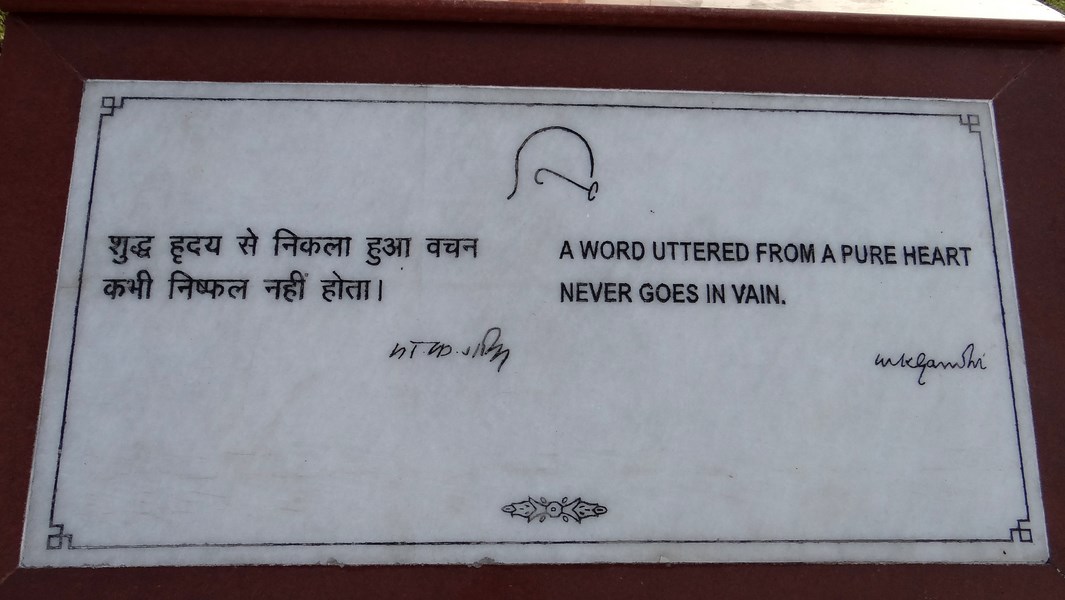
The gardens are beautiful and mats surround the area for celebrations and prayer on special days, always the anniversary of his death. The grounds are well attended and people sometimes throw flowers on top of the existing bed of flowers.
dsc09406-copy
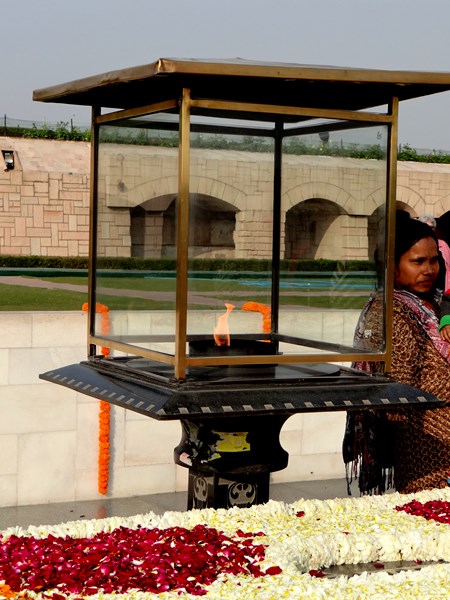
An eternal flame burns at the head of his tomb where his ashes are buried.
dsc09407-copy
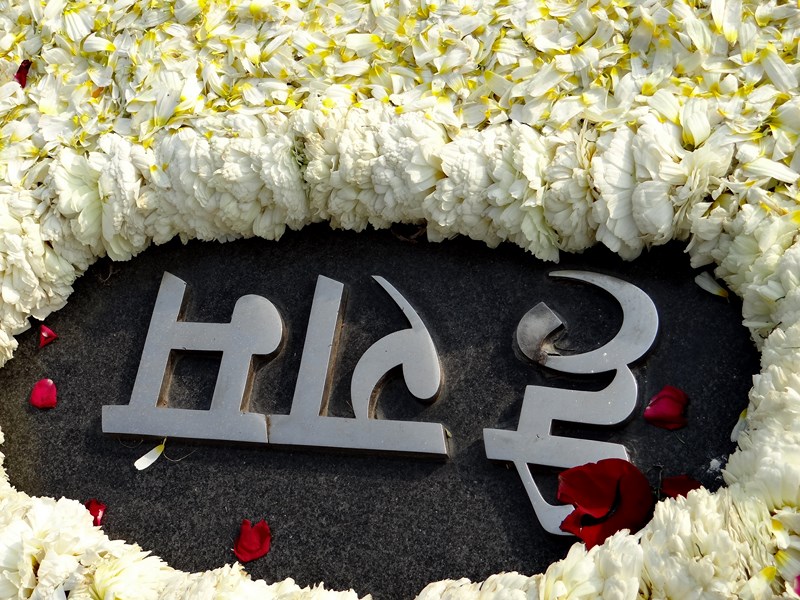
In script are the last words he spoke. "Oh God!" Our guide told us the man who assassinated Ghandi  touched his feet out of respect before shooting him. He claimed he did it for India. There was much anger about Partition. Ghandi preached that Pakistan was free to go or free to stay. Others felt that Pakistan must commit to Islam. His position on Pakistan cost him his life.
dsc09411-copy
When I was a kid, he was a folk hero to me. My dad talked politics at the table. After visiting the memorial, the bus took us to the tree lined, wide avenues the British set up when they governed India.
dsc09414-copy
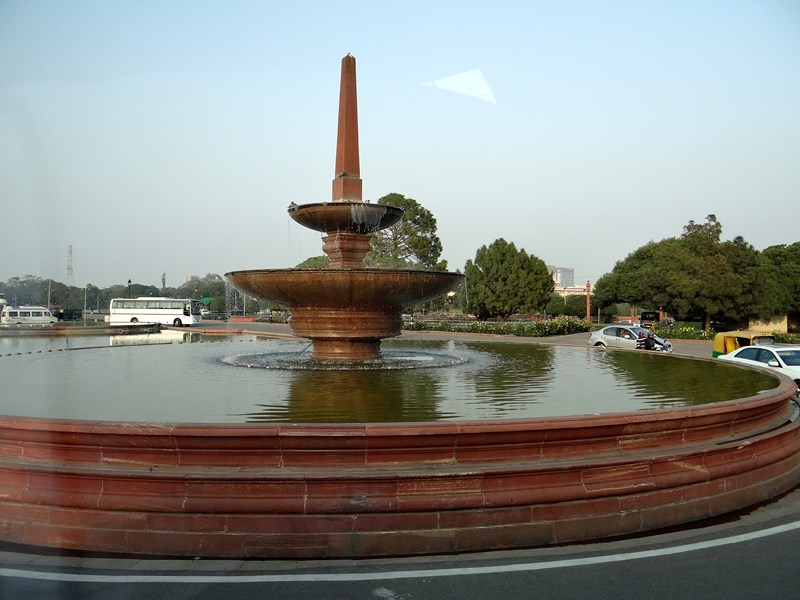
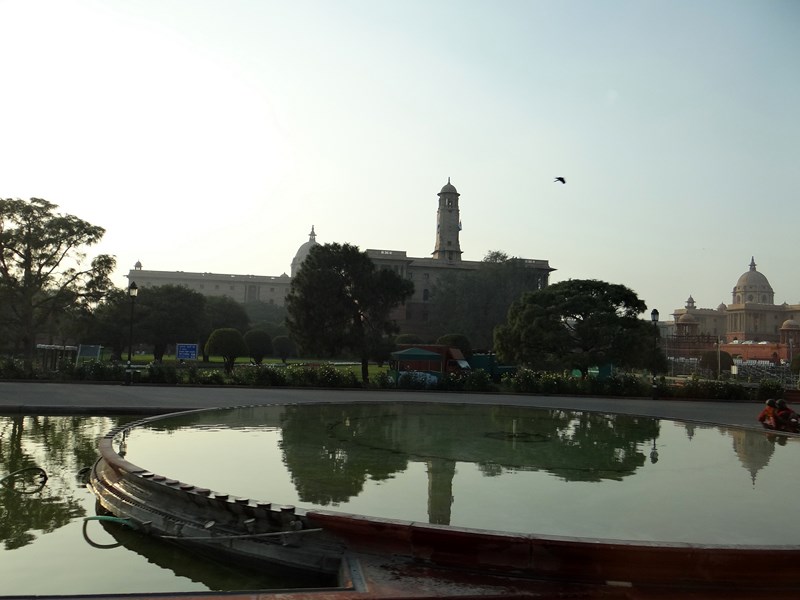
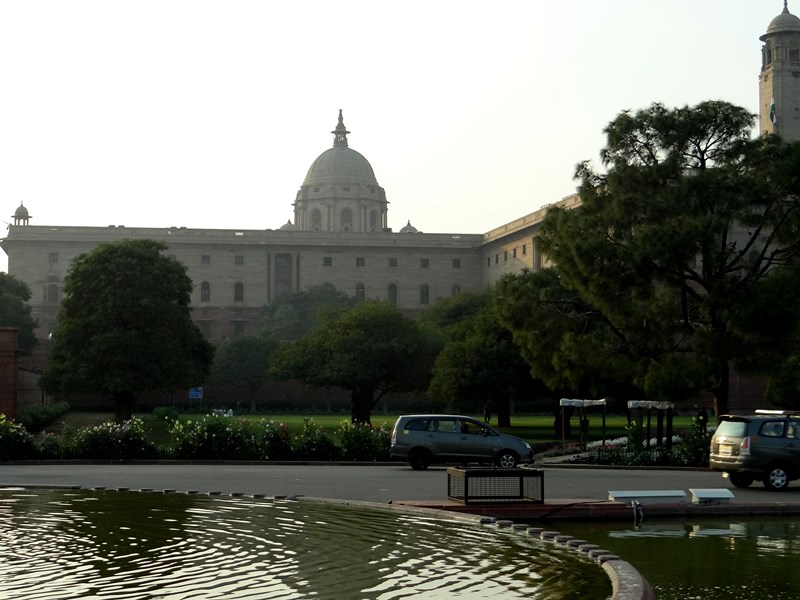
Considered one of the seven cities of Dehli, a fountain in a roundabout sits near the government complex. No one is allowed to stop so our bus drove very slowly around and around so we could take pictures.dsc09416-copy
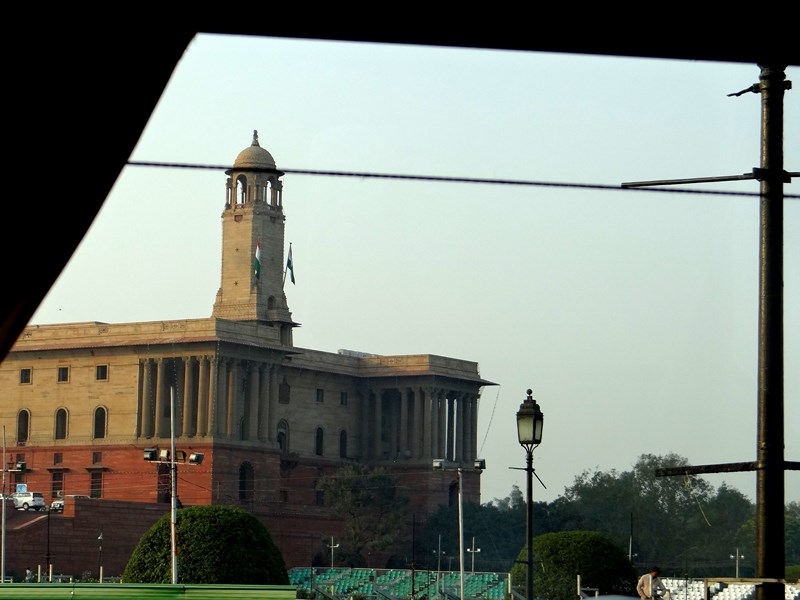
This is the seat of power for the largest Democratic Country in the world. The Presidential palace called Rashtrapati Bhavan.
dsc09417-copy
I was able to get the reflection of the building in the pond. dsc09418-copy
The ministries all have offices in this building, the Minister of Culture, Of Agriculture, Of Tourism, of Textiles, Health, and so on. Their parliamentary building.
dsc09425-copy
Modern paved streets contrast with the narrow lanes of Old Dehli. Next to this bridge, a tube can be used to get from one side of the freeway to the other. Very modern. (They don't use the word freeway.) You can barely see it under the walking overpass.
dsc09420-copy
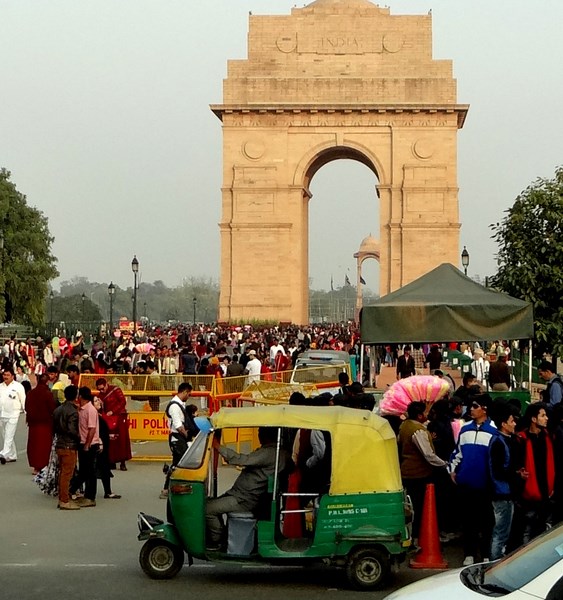
We pass by the India Gate, dedicated to those who died in the 19th Century war with Afghanistan and those who served with  Great Britain during WWI. It has an eternal flame and a huge park.  Other buildings not photographed, National Gallery of the Arts, The Supreme Court, The National Stadium and some very modern Bungalows where the Brits lived in the days before granting India her Independence.
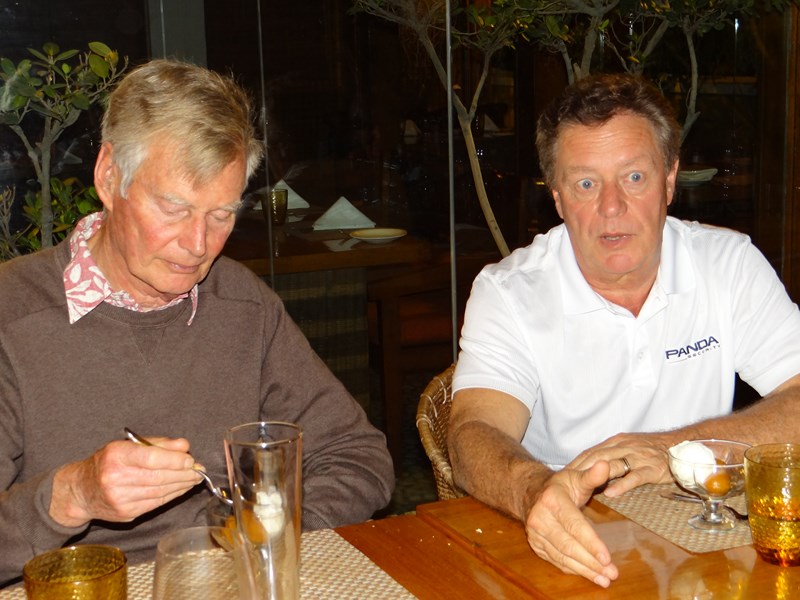
dsc09442-copy We stopped for lunch, Adam and Hugo are finishing dessert.
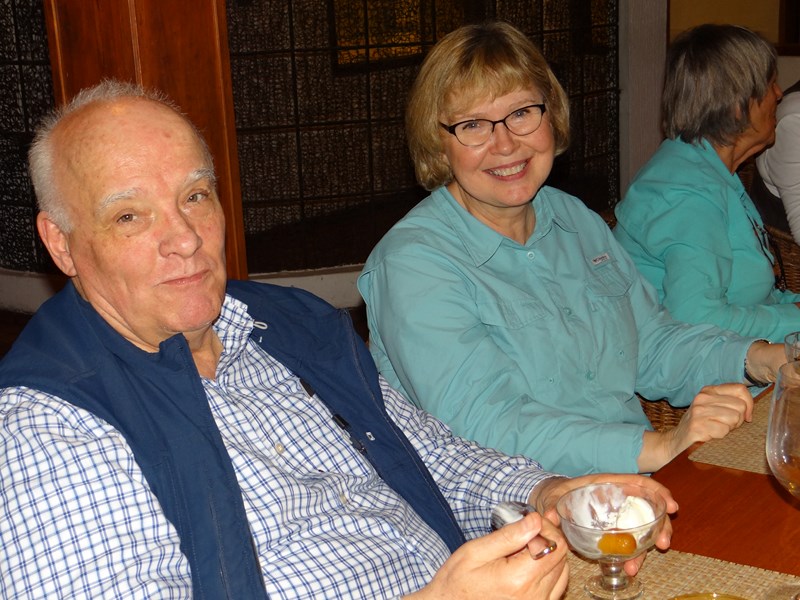
dsc09443-copy Chuck and Kathy.dsc09444-copy
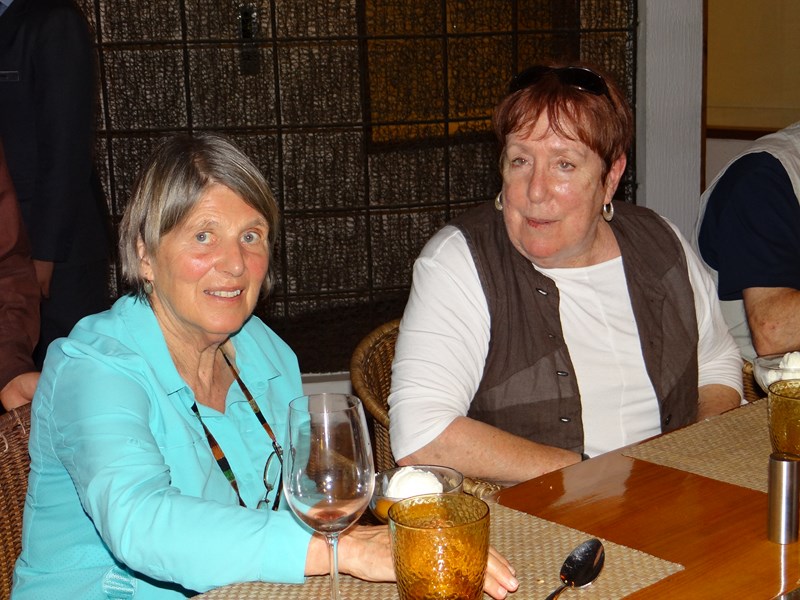
Hazel and Pam.dsc09445-copy
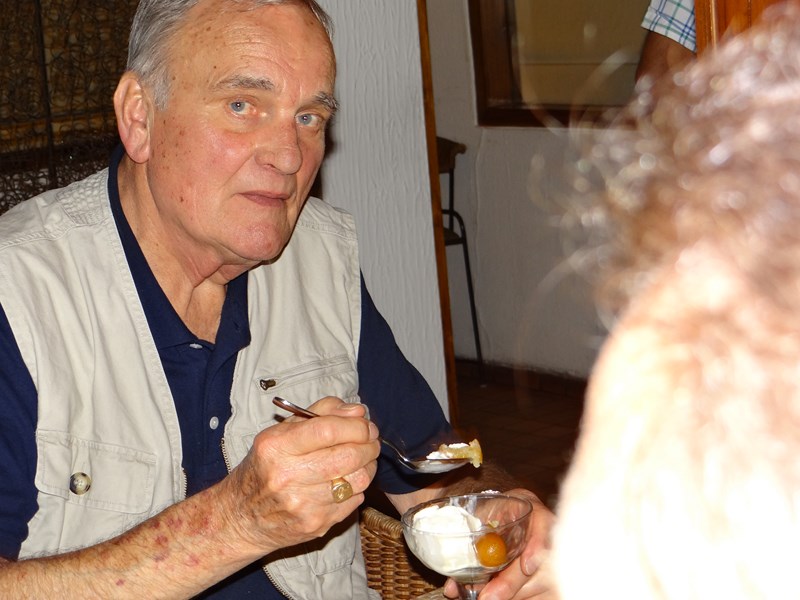
Otto.dsc09446-copy
Ranvir and Theo. I didn't get everyone's picture.
dsc09429-copy
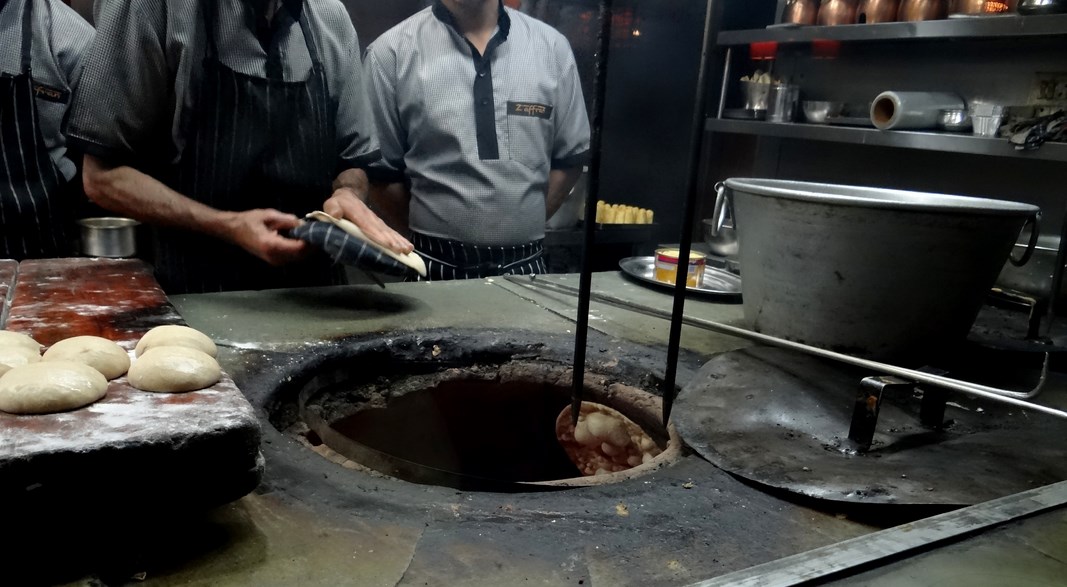
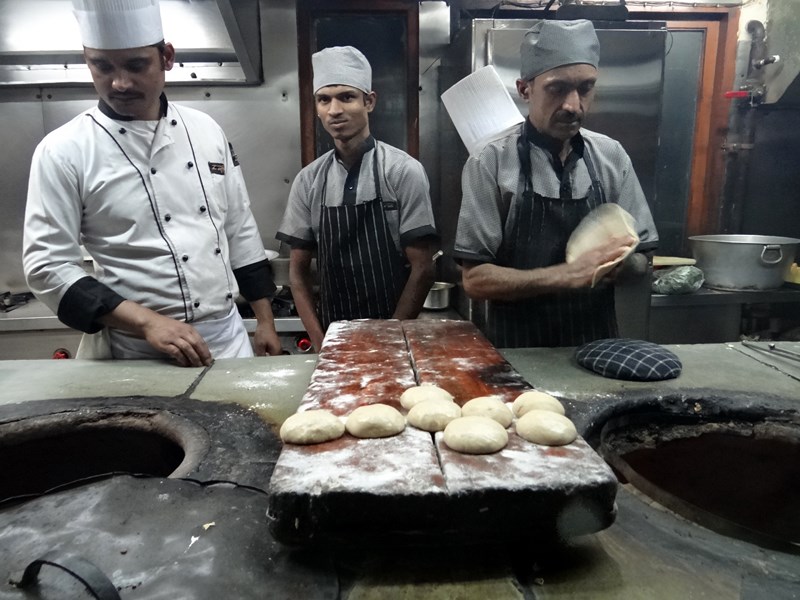
All of the restaurants are quality places to eat, but this restaurant had a glass window into the kitchen where chefs made nan in special barrel shaped ovens.
dsc09430-copy
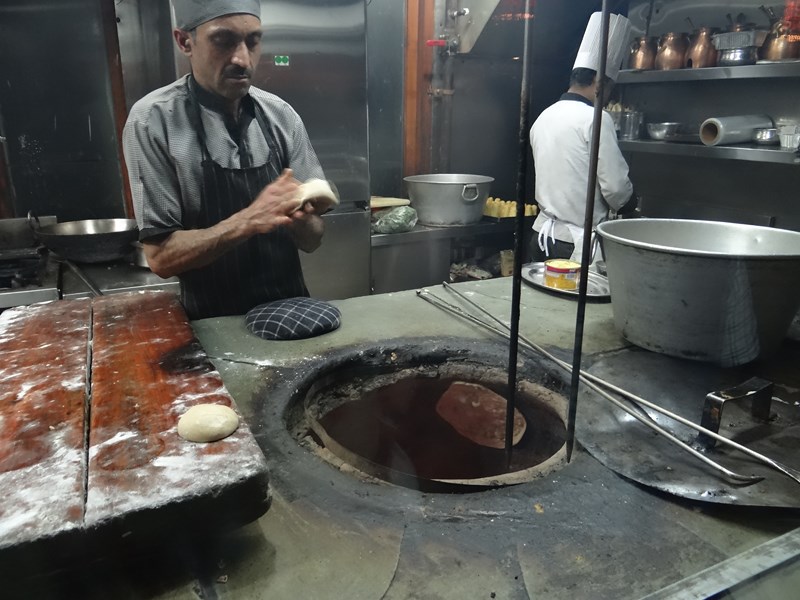
They are fast and the man on the right quickly shapes the dough into a flat bread.
dsc09433-copy
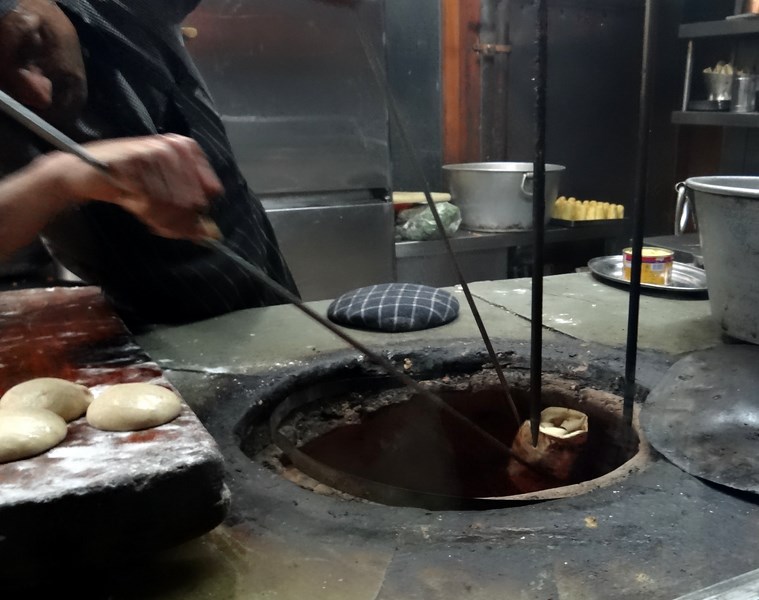
With two irons he takes  the cooked nan off the side of the oven where he plastered it moments before with no gloves or protection. He sets the bread on the blue, cloth-covered wooden "plate" and reaches into the heat and plasters it to the side of the oven.
dsc09439-copy
Then he begins again. Tonight we have dinner on our own.
dsc09398-copy
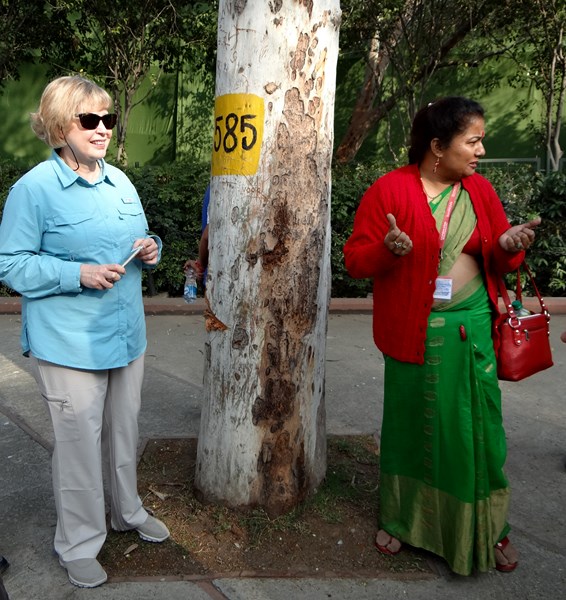
Manju Sharmei is a Brahman woman, part of what is known as the Warrior Class.  Women are educated and in modern India, have jobs. Her children are grown and she enjoys the extra income and the challenge of perfecting her languages and in general, being a tour guide. Not all marriages are arranged in India but her marriage was an arranged one and she arranged it. Her father was a retired minister of the government at some time and they lived far from city life; a rural area where no perspective husbands could meet their class. So, she advertised herself, from a good family, credentials (her father's position) no dowry, also something changing, the dowry. She said she was attractive and had a pleasant personality. She advertised in several big city newspapers and got six potentials. Men like to marry a little bit above their class and that was the case with her husband.  She met with at least two men at a hotel in Dehli with both families present.  When her future husband presented, he met with the family, they spoke for about 15 minutes and he presented a ring which she accepted. Then, the date for a marriage has to be chosen by astrology. Their personalities must have at least 20 matching astrological points before they can marry. She was very happy to be a wife and mother until her boys grew to manhood. Her husband does not mind that she works.  India is definitely changing. I thought it was nice that she shared such personal information with us.

Monday, June 13, 2016

THE CHAMBER OF HORRORS.

Karl Rove had a horrible, Grinchy, ugly idea.  Supreme court judges are prohibited from spending more than $5,000 to run for re-election in some states. Why not outspend them and get rid of "liberal" judges?

John Grisham wrote a book on just how it could happen.  It was fiction and being a fan, when I read it, it was a scary prospect, IF it could really happen.

In real life, could a well-financed shadowy,  group,  get an ordinary judge, one who made decisions for people suing for redress from corporate neglect, be replaced by a corporate leaning judge?  They began their push in the Southern States of Mississippi, Oklahoma and Texas which is how they caught the attention of John Grisham.

Grisham appeared on LINK public television, along with members of Public Citizen and explained that it is happening all over the United States.  The Chamber of Commerce funds these power grabs,  attacking judges who make decisions in favor of ordinary people and replaces them on the bench with corporate friendly judges.

Here is how they did it to Judge Oliver Diaz of Oklahoma.
The Chamber spent $19 million dollars distorting his reputation, using decisions he made for a defendant, and dishonestly twisting the results in the newspaper.  When Diaz tried to buy ad time on television in his area, the Chamber used all the ad time and squeezed him out.
 He borrowed money from an attorney friend, Paul Minier, to defend himself with ads in the newspapers. The Chamber of Horrors immediately filed suit against him claiming that he made decisions in favor of this attorney. He was suspended from the bench. But, he had recused himself every time his friend came before his court. The case got thrown out after the opposition pulled delay after delay after delay. Then they filed suit against him for tax evasion while he was still in suspension. Again, delay, after delay and the phony suit was thrown out, costing the judge a million in defense, and three years off the bench.
 When he finally got back on the bench, he lost re-election to Keith Starret because people believe, where there is smoke there is fire. There MUST have been something shady going on.

There was. The Chamber of Horrors.

Chamber CEO Richard Bush has turned the Chamber of Commerce into the leading lobbying group for removal of judges and tort reform, which is another avenue of attack on ordinary citizens in favor of corporate rule. (More about that tomorrow.)

If a defendant has his leg cut off by a piece of farm machinery that was defective and goes for a jury trial and wins in court. The court has the power to reverse the decision, lower the amount, or throw it out and the defendant has to start over again.  Corporations win over 90% of the time against people suing for redress. This is the only weapon the people have against corporate neglect and we are losing our ability to fight because corporate money is strangling the life out of our democracy.

Make your vote count. Vote for corporate regulation and protect judges in your community. Support every measure you can to keep money out of politics.

Wednesday, October 29, 2014

NOBEL PRIZE WINNING ECONOMIST PAUL KRUGMAN.

The Nobel Prize-winning economist, once one of the president’s most notable critics, on why Obama is a historic success

 
When it comes to Barack Obama, I've always been out of sync. Back in 2008, when many liberals were wildly enthusiastic about his candidacy and his press was strongly favorable, I was skeptical. I worried that he was naive, that his talk about transcending the political divide was a dangerous illusion given the unyielding extremism of the modern American right.
And I wasn't wrong. Obama was indeed naive: He faced scorched-earth Republican opposition from Day One, and it took him years to start dealing with that opposition realistically. Furthermore, he came perilously close to doing terrible things to the U.S. safety net in pursuit of a budget Grand Bargain; we were saved from significant cuts to Social Security and a rise in the Medicare age only by Republican greed, the GOP's unwillingness to make even token concessions.
But now the shoe is on the other foot: Obama faces trash talk left, right and center – literally – and doesn't deserve it. Despite bitter opposition, despite having come close to self-inflicted disaster, Obama has emerged as one of the most consequential and, yes, successful presidents in American history. His health reform is imperfect but still a huge step forward – and it's working better than anyone expected. Financial reform fell far short of what should have happened, but it's much more effective than you'd think. Economic management has been half-crippled by Republican obstruction, but has nonetheless been much better than in other advanced countries. And environmental policy is starting to look like it could be a major legacy.
I'll go through those achievements shortly. First, however, let's take a moment to talk about the current wave of Obama-bashing. All Obama-bashing can be divided into three types. One, a constant of his time in office, is the onslaught from the right, which has never stopped portraying him as an Islamic atheist Marxist Kenyan. Nothing has changed on that front, and nothing will.
president obama
Photo: Sean Gallup/Getty
There's a different story on the left, where you now find a significant number of critics decrying Obama as, to quote Cornel West, someone who ''posed as a progressive and turned out to be counterfeit.'' They're outraged that Wall Street hasn't been punished, that income inequality remains so high, that ''neoliberal'' economic policies are still in place. All of this seems to rest on the belief that if only Obama had put his eloquence behind a radical economic agenda, he could somehow have gotten that agenda past all the political barriers that have con- strained even his much more modest efforts. It's hard to take such claims seriously.
Finally, there's the constant belittling of Obama from mainstream pundits and talking heads. Turn on cable news (although I wouldn't advise it) and you'll hear endless talk about a rudderless, stalled administration, maybe even about a failed presidency. Such talk is often buttressed by polls showing that Obama does, indeed, have an approval rating that is very low by historical standards.
But this bashing is misguided even in its own terms – and in any case, it's focused on the wrong thing.
Yes, Obama has a low approval rating compared with earlier presidents. But there are a number of reasons to believe that presidential approval doesn't mean the same thing that it used to: There is much more party-sorting (in which Republicans never, ever have a good word for a Democratic president, and vice versa), the public is negative on politicians in general, and so on. Obviously the midterm election hasn't happened yet, but in a year when Republicans have a huge structural advantage – Democrats are defending a disproportionate number of Senate seats in deep-red states – most analyses suggest that control of the Senate is in doubt, with Democrats doing considerably better than they were supposed to. This isn't what you'd expect to see if a failing president were dragging his party down.
More important, however, polls – or even elections – are not the measure of a president. High office shouldn't be about putting points on the electoral scoreboard, it should be about changing the country for the better. Has Obama done that? Do his achievements look likely to endure? The answer to both questions is yes.
HEALTH CARE
When Obama signed the Affordable Care Act, an excited Joe Biden whispered audibly, ''This is a big fucking deal!'' He was right.
Related Obamacare, RS issue 1207
Obamacare: It's Working!
The enactment and implementation of the Affordable Care Act, a.k.a. Obamacare, has been a perils-of-Pauline experience. When an upset in the special election to replace Ted Kennedy cost Democrats their 60-vote Senate majority, health reform had to be rescued with fancy legislative footwork. Then it survived a Supreme Court challenge only thanks to a surprise display of conscience by John Roberts, who nonetheless opened a loophole that has allowed Republican-controlled states to deny coverage to millions of Americans. Then technical difficulties with the HealthCare.gov website seemed to threaten disaster. But here we are, most of the way through the first full year of reform's implementation, and it's working better than even the optimists expected.
We won't have the full data on 2014 until next year's census report, but multiple independent surveys show a sharp drop in the number of Americans without health insurance, probably around 10 million, a number certain to grow greatly over the next two years as more people realize that the program is available and penalties for failure to sign up increase.
It's true that the Affordable Care Act will still leave millions of people in America uninsured. For one thing, it was never intended to cover undocumented immigrants, who are counted in standard measures of the uninsured. Furthermore, millions of low-income Americans will slip into the loophole Roberts created: They were supposed to be covered by a federally funded expansion of Medicaid, but some states are blocking that expansion out of sheer spite. Finally, unlike Social Security and Medicare, for which almost everyone is automatically eligible, Obamacare requires beneficiaries to prove their eligibility for Medicaid or choose and then pay for a subsidized private plan. Inevitably, some people will fall through the cracks.
Still, Obamacare means a huge improvement in the quality of life for tens of millions of Americans – not just better care, but greater financial security. And even those who were already insured have gained both security and freedom, because they now have a guarantee of coverage if they lose or change jobs.
What about the costs? Here, too, the news is better than anyone expected. In 2014, premiums on the insurance policies offered through the Obamacare exchanges were well below those originally projected by the Congressional Budget Office, and the available data indicates a mix of modest increases and actual reductions for 2015 – which is very good in a sector where premiums normally increase five percent or more each year. More broadly, overall health spending has slowed substantially, with the cost-control features of the ACA probably deserving some of the credit.
In other words, health reform is looking like a major policy success story. It's a program that is coming in ahead of schedule – and below budget – costing less, and doing more to reduce overall health costs than even its supporters predicted.
 And some on the left were outraged, arguing that the program would do more to raise profits in the medical-industrial complex than it would to protect American families.
You can still argue that single-payer would have covered more people at lower cost – in fact, I would. But that option wasn't on the table; only a system that appeased insurers and reassured the public that not too much would change was politically feasible. And it's working reasonably well: Competition among insurers who can no longer deny insurance to those who need it most is turning out to be pretty effective. This isn't the health care system you would have designed from scratch, or if you could ignore special-interest politics, but it's doing the job.
And this big improvement in American society is almost surely here to stay. The conservative health care nightmare – the one that led Republicans to go all-out against Bill Clinton's health plans in 1993 and Obamacare more recently – is that once health care for everyone, or almost everyone, has been put in place, it will be very hard to undo, because too many voters would have a stake in the system. That's exactly what is happening. Republicans are still going through the motions of attacking Obamacare, but the passion is gone. They're even offering mealymouthed assurances that people won't lose their new benefits. By the time Obama leaves office, there will be tens of millions of Americans who have benefited directly from health reform – and that will make it almost impossible to reverse. Health reform has made America a different, better place.
 
FINANCIAL REFORM
Let's be clear: The financial crisis should have been followed by a drastic crackdown on Wall Street abuses, and it wasn't. No important figures have gone to jail; bad banks and other financial institutions, from Citigroup to Goldman, were bailed out with few strings attached; and there has been nothing like the wholesale restructuring and reining in of finance that took place in the 1930s. Obama bears a considerable part of the blame for this disappointing response. It was his Treasury secretary and his attorney general who chose to treat finance with kid gloves.
It's easy, however, to take this disappointment too far. You often hear Dodd- Frank, the financial-reform bill that Obama signed into law in 2010, dismissed as toothless and meaningless. It isn't. It may not prevent the next financial crisis, but there's a good chance that it will at least make future crises less severe and easier to deal with.
Dodd-Frank is a complicated piece of legislation, but let me single out three really important sections.
First, the law gives a special council the ability to designate ''systemically important financial institutions'' (SIFIs) – that is, institutions that could create a crisis if they were to fail – and place such institutions under extra scrutiny and regulation of things like the amount of capital they are required to maintain to cover possible losses.  During the 2012 presidential campaign, Mitt Romney claimed that by announcing that some firms were SIFIs, the government was effectively guaranteeing that they would be bailed out, which he called ''the biggest kiss that's been given to New York banks I've ever seen.''
But it's easy to prove that this is nonsense: Just look at how institutions behave when they're designated as SIFIs. Are they pleased, because they're now guaranteed? Not a chance. Instead, they're furious over the extra regulation, and in some cases fight bitterly to avoid being placed on the list. Right now, for example, MetLife is making an all-out effort to be kept off the SIFI list; this effort demonstrates that we're talking about real regulation here, and that financial interests don't like it.
Another key provision in Dodd-Frank is ''orderly liquidation authority,'' which gives the government the legal right to seize complex financial institutions in a crisis. This is a bigger deal than you might think. We have a well-established procedure for seizing ordinary banks that get in trouble and putting them into receivership; in fact, it happens all the time. But what do you do when something like Citigroup is on the edge, and its failure might have devastating consequences? Back in 2009, Joseph Stiglitz and yours truly, among others, wanted to temporarily nationalize one or two major financial players, for the same reasons the FDIC takes over failing banks, to keep the institutions running but avoid bailing out stockholders and management.
A third piece of Dodd-Frank is the Consumer Financial Protection Bureau. That's Elizabeth Warren's brainchild, an agency dedicated to protecting Americans against the predatory lending that has pushed so many into financial distress, and played an important role in the crisis. Warren's idea was that such a stand-alone agency would more effectively protect the public than agencies that were supposed to protect consumers, but saw their main job as propping up banks. And by all accounts the new agency is in fact doing much more to crack down on predatory practices than anything we used to see.
There's much more in the financial reform, there's enough evidence even now to say that there's a reason Wall Street – which used to give an approximately equal share of money to both parties but now overwhelmingly supports Republicans – tried so hard to kill financial reform, and is still trying to emasculate Dodd-Frank. This may not be the full overhaul of finance we should have had, and it's not as major as health reform. But it's a lot better than nothing.
THE ECONOMY
Barack Obama might not have been elected president without the 2008 financial crisis; he certainly wouldn't have had the House majority and the brief filibuster-proof Senate majority that made health reform possible. So it's very disappointing that six years into his presidency, the U.S. economy is still a long way from being fully recovered.
Make no mistake about it – the devastation wrought by the financial crisis was terrible.  Even in advanced countries, the median post-crisis decline in per- capita real GDP is seven percent. Recovery has been slow: It took almost six years for the United States to regain pre-crisis average income. But that was actually a bit faster than the historical average.
Or compare our performance with that of the European Union. Unemployment in America rose to a horrifying 10 percent in 2009, but it has come down sharply in the past few years. It's true that some of the apparent improvement probably reflects discouraged workers dropping out, but there has been substantial real progress. Meanwhile, Europe has had barely any job recovery at all, and unemployment is still in double digits. Compared with our counterparts across the Atlantic, we haven't done too badly.
Did Obama's policies contribute to this less-awful performance? Yes, without question. You'd never know it listening to the talking heads, but there's overwhelming consensus among economists that the Obama stimulus plan helped mitigate the worst of the slump. For example, when a panel of economic experts was asked whether the U.S. unemployment rate was lower at the end of 2010 than it would have been without the stimulus, 82 percent said yes, only two percent said no.
Still, couldn't the U.S. economy have done a lot better? Of course. The original stimulus should have been both bigger and longer. And after Republicans won the House in 2010, U.S. policy took a sharp turn in the wrong direction. Not only did the stimulus fade out, but sequestration led to further steep cuts in federal spending, exactly the wrong thing to do in a still-depressed economy.
We can argue about how much Obama could have altered this literally depressing turn of events. He could have pushed for a larger, more extended stimulus, perhaps with provisions for extra aid that would have kicked in if unemployment stayed high. (This isn't 20-20 hindsight, because a number of economists, myself included, pleaded for more aggressive measures from the beginning.) He arguably let Republicans blackmail him over the debt ceiling in 2011, leading to the sequester. But this is all kind of iffy.
The bottom line on Obama's economic policy should be that what he did helped the economy, and that while enormous economic and human damage has taken place on his watch, the United States coped with the financial crisis better than most countries facing comparable crises have managed. He should have done more and better, but the narrative that portrays his policies as a simple failure is all wrong.
While America remains an incredibly unequal society, and we haven't seen anything like the New Deal's efforts to narrow income gaps, Obama has done more to limit inequality than he gets credit for. The rich are paying higher taxes, thanks to the partial expiration of the Bush tax cuts and the special taxes on high incomes that help pay for Obamacare; the Congressional Budget Office estimates the average tax rate of the top one percent at 33.6 percent in 2013, up from 28.1 percent in 2008. Meanwhile, the financial aid in Obamacare – expanded Medicaid, subsidies to help lower-income households pay insurance premiums – goes disproportionately to less-well-off Americans. When conservatives accuse Obama of redistributing income, they're not completely wrong – and liberals should give him credit.
THE ENVIRONMENT
In 2009, it looked, briefly, as if we might be about to get real on the issue of climate change. A fairly comprehensive bill establishing a cap-and-trade system to limit greenhouse-gas emissions actually passed the House, and visions of global action danced like sugarplums in environmentalists' heads. But the legislation stalled in the Senate, and Republican victory in the 2010 midterms put an end to that fantasy. Ever since, the only way forward has been through executive action based on existing legislation, which is a poor substitute for the new laws we need.
Related Former US Vice President Al Gore
The Turning Point: New Hope for the Climate
But as with financial reform, acknowledging the inadequacy of what has been done doesn't mean that nothing has been achieved. Saying that Obama has been the best environmental president in a long time is actually faint praise, since George W. Bush was terrible and Bill Clinton didn't get much done. Still, it's true, and there's reason to hope for a lot more over the next two years.
president obama
Photo: Doug Mills/The New York Times
First of all, there has been much more progress on the use of renewable energy than most people realize. The share of U.S. energy provided by wind and solar has grown dramatically since Obama took office. True, it's still only a small fraction of the total, and some of the growth in renewables reflects technological progress, especially in solar panels, that would have happened whoever was in office. But federal policies, including loan guarantees and tax credits, have played an important role.
Nor is it just about renewables; Obama has also taken big steps on energy conservation, especially via fuel-efficiency standards, that have flown, somewhat mysteriously, under the radar. And it's not just cars. In 2011, the administration announced the first-ever fuel-efficiency standards for medium and heavy vehicles, and in February it announced that these standards would get even tougher for models sold after 2018. As a way to curb green house-gas emissions, these actions, taken together, are comparable in importance to proposed action on power plants.
Which brings us to the latest initiative. Because there's no chance of getting climate-change legislation through Congress for the foreseeable future, Obama has turned to the EPA's existing power to regulate pollution – power that the Supreme Court has affirmed extends to emissions of carbon dioxide and other greenhouse gases. And this past summer, the EPA announced proposed rules that would require a large reduction over time in such emissions from power plants. You might say that such plants are only a piece of the problem, but they're a large piece – CO2 from coal-burning power plants is in fact a big part of the problem, so if the EPA goes through with anything like the proposed rule, it will be a major step. Again, not nearly enough, and we'll have to do a lot more soon, or face civilization-threatening disaster. But what Obama has done is far from trivial.
NATIONAL SECURITY
So far, i've been talking about Obama's positive achievements, which have been much bigger than his critics understand. I do, however, need to address one area that has left some early Obama supporters bitterly disappointed: his record on national security policy. Let's face it – many of his original enthusiasts favored him so strongly over Hillary Clinton because she supported the Iraq War and he didn't. They hoped he would hold the people who took us to war on false pretenses accountable, that he would transform American foreign policy, and that he would drastically curb the reach of the national security state.
Related
Obama Vs. The Hawks
None of that happened. Obama's team, as far as we can tell, never even considered going after the deceptions that took us to Baghdad, perhaps because they believed that this would play very badly at a time of financial crisis. On overall foreign policy, Obama has been essentially a normal post-Vietnam president, reluctant to commit U.S. ground troops and eager to extract them from ongoing commitments, but quite willing to bomb people considered threatening to U.S. interests. And he has defended the prerogatives of the NSA and the surveillance state in general.
Could and should he have been different? The truth is that I have no special expertise here; as an ordinary concerned citizen, I worry about the precedent of allowing what amount to war crimes to go not just unpunished but uninvestigated, even while appreciating that a modern version of the 1970s Church committee hearings on CIA abuses might well have been a political disaster, and undermined the policy achievements I've tried to highlight. What I would say is that even if Obama is just an ordinary president on national security issues, that's a huge improvement over what came before and what we would have had if John McCain or Mitt Romney had won. It's hard to get excited about a policy of not going to war gratuitously, but it's a big deal compared with the alternative.
SOCIAL CHANGE
In 2004, social issues, along with national security, were cudgels the right used to bludgeon liberals – I like to say that Bush won re-election by posing as America's defender against gay married terrorists. Ten years later, and the scene is transformed: Democrats have turned these social issues – especially women's rights – against Republicans; gay marriage has been widely legalized with approval or at least indifference from the wider public. We have, in a remarkably short stretch of time, become a notably more tolerant, open-minded nation.
As you can see, there's a theme running through each of the areas of domestic policy I've covered. In each case, Obama delivered less than his supporters wanted, less than the country arguably deserved, but more than his current detractors acknowledge. The extent of his partial success ranges from the pretty good to the not-so-bad to the ugly. Health reform looks pretty good, especially in historical perspective – remember, even Social Security, in its original FDR version, only covered around half the workforce. Financial reform is, I'd argue, not so bad – it's not the second coming of Glass-Steagall, but there's a lot more protection against runaway finance than anyone except angry Wall Streeters seems to realize. Economic policy wasn't enough to avoid a very ugly period of high unemployment, but Obama did at least mitigate the worst.
And as far as climate policy goes, there's reason for hope, but we'll have to see.
Am I damning with faint praise? Not at all. This is what a successful presidency looks like. No president gets to do everything his supporters expected him to. FDR left behind a reformed nation, but one in which the wealthy retained a lot of power and privilege. On the other side, for all his anti-government rhetoric, Reagan left the core institutions of the New Deal and the Great Society in place. I don't care about the fact that Obama hasn't lived up to the golden dreams of 2008, and I care even less about his approval rating. I do care that he has, when all is said and done, achieved a lot. That is, as Joe Biden didn't quite say, a big deal.
I co-opted this from an interview of Krugman by Rolling Stones Magazine, and shortened it somewhat without changing meaning.


Friday, July 18, 2014

A SHAMEFUL POWER PLAY.

DSC07332 (Copy)

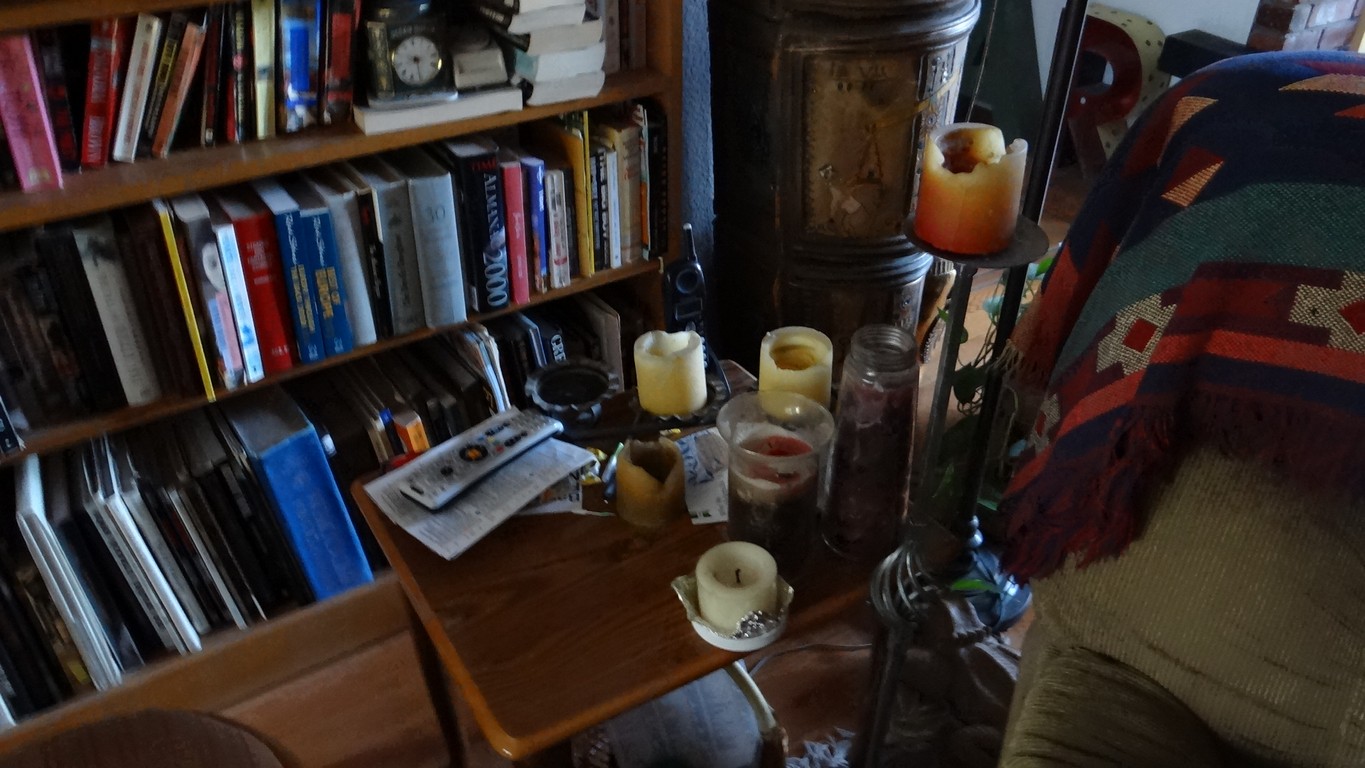
Last night, just as it was getting dark, the power went out. We have no street lights and when it gets dark, it is black hole dark. I spent the evening in my chair trying to read by candle light. Makes you appreciate your power company, but that kind of power is not my subject today.

I’m disgusted by John Boehner’s  frivolous lawsuit against President Obama. I’m remembering Kenneth Starr’s useless pursuit of the Whitewater Case during the Clinton Administration. The guy didn’t even give up his day job to investigate and cost we taxpayers millions of dollars for no indictments of anybody in the Whitewater case. He stretched out that investigation for months and bilked all of us.  Now, Boehner expects the taxpayers to pay for this lawsuit?

There has never been such an obstructionist congress since the constitution was ratified, and our founding father’s were a contentious bunch. But, their aim was the betterment of all. I believe this lawsuit is purely a power play at our expense.

I’m not a great fan of Obama, but let the guy do his job. If you don’t like him, and his cohorts, offer a better plan and vote them out.

Lets take a look at where we are. Food stamp use is skyrocketing, more Americans are unable to live on their wages. Not good. But it was congress who cut food stamps from $7 a day to $6. Can’t blame that on Obama. And businesses like Walmart, MacDonalds, etc. who pay their hundreds of thousands of workers half the poverty level wages while we taxpayers have to subsidize them with food stamps and medical care? The Republicans were lock step against raising the minimum wage.

Both parties, everyone including Obama, seem to be against regulating Wall Street interests and taxing the super rich to the previous working checks and balances.

Even so,  the jobless rate is forecast to drop to 6.1% from 6.3%, and many cities and states  are raising minimum wages, and many major economic indicators are pointing to a steady economic recovery. The real estate market is virtually recovered, though not at bubble prices. And millions of people have medical insurance who didn’t have it before.

Obama hasn’t performed miracles, but he ended two wars, secured the world’s loose nukes, got rid of Bin Laden and brought the last POW home. He disarmed a middle-eastern madman without firing a shot, and dashed Putin’s hope of a new Soviet empire. Now, if he could just get congress to work instead of pontificate, it really would be a miracle.

There are still pressing world issues, like climate change, extreme weather costs, women’s choices, equal pay, decisions made from an anti-scientific attitude. School textbook companies re-writing history to please the religious beliefs of a minority. Extremists trying to break down the wall between government and religion. But hey,  let’s sue Obama and spend a lot of taxpayer money and take attention away from any real issues.  It disgusts me.

Thursday, November 7, 2013

OUR BUSY LIVES.

DSC01724 (Copy)
These last two days have been horrendously busy ones. My friend Ann was hospitalized, I went to visit her. She is out now home and her caretaker is sick. I went to look after her on the 5th for several hours while her live-in caretaker went to prompt care.  The home healthy care nurse ordered the place quarantined because both of them have pneumonia and don't want Ann exposed to anyone else's germs.
DSC01749 (Copy)
My living room propane heater needed servicing. I have wood heat for back up, but just like to take the chill off cold mornings before starting my day. We don't need to fire up the wood stove yet because daytime temperatures are still ambient. Art Alexander fixed it. It needed a new thermocoupler and the fan needed oiling. Art is a good friend.

His daughter was murdered for insurance money by her husband, Karl about 20 years ago. She was in the shower when the house erupted into flames. The broken bathroom window was boarded over. The fire supposedly started from a kerosene soaked rug in front of the bathroom door. In those days we had a volunteer fire department and they were not educated enough to detect whether the fire was deliberately set or not but Art and the neighbors suspected. Karl took off with their two kids and moved to the East Coast as soon as he collected the $100,000 insurance settlement. (The house was rented.) Karl then collected $700,000 in insurance money on his 21 year old son last year. He saw the opportunity to kill him by shoving a car the son was working on off the jack so it crushed him. This time, Karl's wife turned states evidence. She was wired, she got him to admit on tape that he killed him and now the investigation into Christine's death by fire is also part of the investigation. Art is jubilant that at last this monster is behind bars and facing a trial. He prayed for this day to come and we celebrated over a glass of wine.

I also had my Prius serviced before Art arrived. The check engine light went on while I was on my way to Orgeon.  These smart cars have a computer in them. The computer told me that some dampness occurred near the inverter board which is installed under the driver's seat. Doug and I verbally traced the probable source of moisture from my air conditioning system. Now I can have my air conditioning system flushed without an expensive trip to the dealership in Modesto.

I began work on fixing a sprinkling system leak. The pipes are buried about ten inches deep and digging them out around entwined root systems was a huge job. I put a soak hose on them to finish the job today. I found the crack in the pipe. Two major water leaks have cost me a bundle in water bills over the last three months, two of those months I was gone. My yard worker fixed one leak two weeks ago; this leak was pretty invisible but the water bill alerted me to the second leak.
OLYMPUS DIGITAL CAMERA
Ann's situation reminded me of my friend Sandee Voges, who has myasthenia gravis. She fell and hit her head on the tile in her bathroom and couldn't get up. She adopted a medium sized dog who was about to be euthanized. The dog she rescued saved her life. Amy came to her rescue, licking her awake. Sandee held onto Amy's collar and the dog dragged her to the nearby bedroom where Sandee could reach up,  pull the cord of her phone down off the night stand, and call 911. Pets. They are such a wonderful presence in our lives, especially as we age. (Sandee lives in Arizona.)

Then, I like to keep up with the news and politics. Saw this funny poster:
!cid_1_1007972351@web120005_mail_ne1_yahoo
I hope this doesn't offend anyone. I thought it was pretty funny.

Then the rather meager "study", where two scientists dissected two different chicken nuggets from two different fast food restaurants and found 40% chicken in one, and 50% chicken in another, except, the chicken had ground up blood vessels, cartilage and skin with very little muscle meat. That, as they say, is disgusting. The scientists admit, not all chicken nuggets were examined and it was a tiny sample just to see if the nuggets lived up to their claims of "healthy and good for you.." etc. I guess, they'll do a bigger sampling in the future. Fatty, breaded, laden with sugar and flavor enhancers, you would do well to keep your kids away from such stuff no matter how good they taste. (That is my opinion.)

Yes, I'm busy. Retired people I know claim they don't know how they ever worked and raised children. They are busier than ever. Would I have it any other way? NO!

Wednesday, November 21, 2012

SPOTLIGHT BIG BROTHER.

I didn’t mean to rant again but I’m remembering something from the early 1960′s. As a young married, I attended a City of Fremont public meeting about a planning issue. I no longer remember what my publicly stated objection was, but within weeks, my neighbors were getting visits and calls about me, what kind of person I was, my habits and etc. I was under investigation by the FBI. Those were the J. Edgar Hoover days.
Also, before I got married, I worked for Alameda County. I showed up for work with a bumper sticker supporting Don Dillion for mayor. He wasn’t a mafia member. He was a local businessman who owned a citrus orchard. This was a local city election, but the county told me I had to remove my bumper sticker. I was furious but I needed the job and did it.

And, when I did marry, I had to quit my job because employees were not allowed to fraternize (let alone date) each other. Marriage? Out of the question.

Now, the Patreaus/Broadwell investigation has led to intrusive examination of private emails.  Democrat Patrick Leahy needs a healthy dose of censure from activists for his new and even stricter revision of the House of Representatives SNOOP law.  It is tiring that regular ciitizens like thee and me have to be government watchdogs. Not only guard dogs of the intrusive and corrupting influence of money, but the perceived and over rated dangers of email correspondence.

Most egregious, Leahy’s rewritten bill would allow more than 22 agencies — including the Securities and Exchange Commission and the Federal Communications Commission, OSHA, Federal Reserve, the Federal Trade Commission, the Federal Maritime Commission, the Postal Regulatory Commission, the National Labor Relations Board, and the Mine Enforcement Safety and Health Review Commission? Why should they be  allowed to subpoena my private information, with no judge to approve their need to know? They don’t even have to notify us that they are looking or have looked for as long as a year after the event. Unacceptable.

It isn’t law yet, but be aware if you have concerns. The entire document is available at this link if you wish to read it for yourself. That is, the discovery content from the online news organization from C/Net:
http://m.yahoo.com/w/legobpengine/news/senate-bill-rewrite-lets-feds-read-your-e-mail-without-warrants-191930756.html?orig_host_hdr=news.yahoo.com&.intl=US&.lang=en-US

Friday, November 2, 2012

MONEY INTERESTS COME FIRST.

I had a brain scan yesterday.  A result of the May 27th accident has left me with continual headaches and some balance problems.  So, while slogging along with medical problems It seems I have nothing better to concentrate on than the election. And, glad to know my brain is still there.  So wrap your brain around this: A Romney/Ryan presidency might look something like this:

Mitt Romney’s running mate, called the Cayman Islands “the place where you hide your money,” arguing that the United States needs to slash tax rates below those of other countries in order to make this country “the haven for capital formation.” But in a previously unnoticed exchange in an interview with American Business Magazine in August 2011, Ryan went even further on the same topic, saying “let’s make this country a tax shelter for other countries instead of having other countries be a tax shelter for America.”

A very corporate vision for America. Kind of leaves a huge percentage of us out in the cold.

And from the Weis investment newsletter, one writer, Mike Larsen, practically chortles over the wonderful investment opportunities to be made out of  his (and his cohorts)  predicted next depression.

An historic, world-changing event
is about to permanently alter your life!
This monumental event will plunge vast numbers of families into the nightmare of poverty, homelessness and hunger. In the worst case scenario, you will see soaring crime, the confiscation of property, the suspension of civil rights, and even martial law enforcement by the U.S. military …
But while the vast majority of Americans will suffer, a select handful will use this crisis to build substantial wealth. If you act on the easy-to-follow recommendations I’ll give you in this presentation, you could be one of them.

Oh, boy. I can’t wait to get rich on the backs of the suffering middle class. A world in turmoil is just another investment opportunity for the 1%.

And, the California Proposition 30 is looking like it won’t make it. It should, though. I had a hard time understanding it until I heard the League of Women’s voters presentation on the complexity of it. Safety officers? Mixed with education? Billions here and billions there. But, do we want to stay at the bottom of the education ladder?  The taxes are  on those making 250,000 as singles, or 500,000 dollars a couple and will last seven years.  We will have a slightly increased sales tax for four years. And, we’ll begin paying down our bond debt which will help with California’s enormous deficit. I couldn’t find the video I watched on the subject. The written explanation isn’t as thorough, but, you can check it out online at:
http://ca.lwv.org/election/2012/november/ballot-measure/proposition-30

Sunday, October 28, 2012

FACTS OR VITRIOL?

Someone I know and like, dislikes my writing vitriolic, bitter stuff  during this divisive political climate. I guess stating facts like The Salt Lake City Tribune endorsed Obama, and Republican Senator Larry Pressler endorsed Obama, and Republican Colin Small got arrested and fired from his position as a Registrar of Voters supervisor because he tossed Democratic registration ballots in the garbage, and, the New York Republican Board of Elections changed polling places without telling people where their new polling place was located during the primaries, are considered vitriol by my friend.

There is more, much more of that type of activity and lies and dishonesty like I’ve never seen before. So, if I question and report dishonesty, I’m vitriolic and bitter?

It kind of reminds me of the “kill the messenger mentality. If you don’t like the message, kill (or blame) the messenger.

I think my friend loves his country,  and his ideology doesn’t square with what his party is doing.

I love my country too, but silence in the face of oppression and dishonesty has never been an option for me. I actually believe that a healthy democracy is better when two sides can discuss their opposing views and come to understand where they each may find some common ground, and work out solutions from there.
If honesty is lacking, then debate and exchange of ideas is quite impossible.

So, let’s see:
Last week, the Republican-run Ottawa County Board of Elections sent a mailer to 2,300 voters in three northwestern Ohio precincts informing them that Election Day was November 8. It is, of course, November 6.
Further, voters were told in the mailer their voting location had been moved to a building on the east side of Danbury High School. Unfortunately, the actual voting location is on the west side of the high school

The above abuse of power is a fact, and I can tell you I think it is shameful and ugly no matter who perpetrated such obfuscation on Ohio voters. I don’t think reporting shameful and ugly facts is vitriolic. I haven’t asked, but I think my Republican friends would agree with me.  This is America. I believe the very words This Is America stand for something special.

And, I believe Obama is more concerned with social justice than Romney. His views are more in line with my own. And, I don’t see how that is vitriolic.

Let us look at some facts:
Romney,  who brags about his job creation efforts as Governor of Massachusetts, was unremarkable,  according to the Washington Post. You can read these facts for yourself at:
http://www.washingtonpost.com/business/economy/as-massachusetts-governor-romneys-record-on-jobs-was-unremarkable/2012

And, Obama’s accomplishments in the year 2009 alone, are quite remarkable. This is not even half the list. But, they are facts:
In the first months of his presidency, he initiated the The American Recovery and Reinvestment act.
He bailed out the auto industry.
He stopped the war in Iraq, and is now brought Iran to its knees.
He prohibited members of congress from profiting from insider trading.
He reduced Social Security payroll taxes.
Reduced wait time for business patent approvals.
Defense of Marriage act.
Equal pay for women.
Reduced nuclear war heads and missiles with Russia until 2017.
Exempted small family farms from Federal regulation to sell products on their land.
For our safety, large factory farms are required to register every handler of their food products.
He Improved food safety programs.
Gay and Lesbians can serve openly in the military.
He granted 40 billion in tax credits for college students and low income families with children.
Extended unemployment benefits, twice.
Provided for on the job training for vets and reimbursed the energy sector jobs for that training.
Gave 68 Billion in Pell grants.
Saved an estimated 143 Billion in health care costs in health care reforms.
Strengthened hate crime laws.
He voluntarily disclosed the White House Visitors log, something past presidents refused to do.
He provided 80 million to investigate and prosecute fraud in financial institutions.

There is much, much more to add to this list for 2009. I must make mention though of a recent goal nearly accomplished.
October 23, 2012
“The Energy Department forecasts that U.S. production of crude and other liquid hydrocarbons, which includes biofuels, will average 11.4 million barrels per day next year. That would be a record for the U.S. and just below Saudi Arabia’s output of 11.6 million barrels. Citibank forecasts  U.S. production could reach 13 million to 15 million barrels per day by 2020, helping to make North America “the new Middle East.”
This report comes from USA Today, Oct. 23rd issue.
I rest my case.

Tuesday, October 16, 2012

MONSANTO'S GOALS.

I blogged genetically modified food labeling previously. Now, Monsanto is spending a million dollars a day to defeat the proposition on the ballot to label genetically modified foods.  So far, they’ve spent $48 million with some very misleading ads about why we shouldn’t allow genetically modified foods to be labeled. Not prevented. But, not labeled. What do they fear?  It seems to me, any time a company that peddles poisons that have already done damage to birds, fish and animals fights with their big bucks, it is not because they are concerned for us. They are afraid you won’t buy their products. Agribusiness in California is very successful. It isn’t the farmers who stand to lose. It is Monsanto. They expect to make millions on GMO foods and they don’t want you to know. Another block to transparency.

I will repeat parts of my former blog, in case you didn’t see it.
We’ve had genetically modified products for ages. Just hand pollinating or cross pollinating is genetically modifying a plant. Or, grafting a scion from a different fruit tree onto another, is an example.  Adding herbicides to seeds, is a bit different.  Any company who modifies a product that grows in our common soil,  should know the end result if the seedlings spread to the wild or cause unwanted changes. The company should have to prove that their GMO seeds will in fact, cause no harm or affect nature in a negative way. But, our weakened FDA did not make that happen.
Now comes information from a study that is disturbing and begs caution.  However, I don’t know the size of the study and who conducted it. I read about it on MoveOn.org. an organization I trust.

Rats fed a lifetime diet of Monsanto’s genetically engineered corn or exposed to the company’s popular Roundup herbicide, in amounts considered “safe” in drinking water and genetically modified crops in the U.S., developed tumors and suffered severe kidney and liver damage, according to a study released this week.

We may not develop the same problems as rats, but even rats are part of the environmental balance we need. What else will it affect?  Birds? Or raptors that eat rats and gophers?
And this from the editors of On Earth Magazine, a publication that deals with environmental issues:

Carbon-fueled climate change is responsible for many terrifying things, but some normal-seeming rice plants in one recent study is a warning. Scientists from the U.S. Dept. of Agriculture grew a feral, weedy form of rice along side of  a cultivated form in controlled environments that reflected carbon dioxide levels of a century ago. As C0-2 levels went up, the weedy rice was better able to synchronize its flowering period to that of the cultivate rice, leading to cross pollination and resulting in a zombie-like hybrid with alarming characteristics. From the feral parent, came a diminished nutritional content and a weaker hull. But, the cultivated parent gave it a genetic resistance to weed killers. The weedy rice that always pops up in fields has been traditionally controlled by herbicides.

Now, add in climate change with genetically modified seeds with resistant chemicals in them?  It could be a horror movie.
We don’t have corporate soil and private soil. Don’t allow Monsanto to buy its way around labeling to prevent you from having a choice of whether you want to eat GMO foods or not. Or feed baby food to your baby from seeds injected with herbicides.

Monsanto’s goal?  Higher profits.

Sunday, October 14, 2012

THE CRAZIES OUT THERE ARE NOT ALL FROM WALMART.


It is a mad campaign swirling around us and it is hard not to get caught up in the whirlwind. Speaking of mad, I recently read that people who study serial killers have made credible comparisons to people who run for office. They share many of the same traits.

How many times have we heard someone say, “Ya gotta be crazy to run for President?” I am chuckling, folks, but then Hitler, Saddam Hussein, and other monsters pop into my head. 

I’ll be glad when the election is over and we can all get back to some semblance of normal life, whatever that is.
I find it unbelievable that a man can get elected to public office and claim slavery is a blessing in disguise.

 “The following link is too funny/scary not to pass on.”

http://www.thedailyshow.com/watch/thu-october-11-2012/you-magnificent-bastards—down-ballot-notables

Friday, October 12, 2012

POLITICS FRONT AND CENTER.

The debates have everyone atwitter, Biden smiled and chuckled too much, Ryan hesitated too long before answering a question he clearly didn’t expect about abortion, yatta ta yatta ta yatta. I guess the pundits have to earn their money someway, but not one of them mentioned the most telling line from Biden:
The next president will pick two jurists to serve on the United States Supreme Court. If the Romney ticket wins, you can expect a conservative court to be even more conservative. I think having such an unbalanced court is a disaster as in their recent decision giving corporations the same rights as a human. That is something to think about.
Ryan avoids answering the direct question, what is their plan to bring 12 million higher-paying jobs to Americans.  He says they will do it, but he can’t explain how. Biden says the way to get back to work is to let the Bush tax cuts expire and level the playing field for middle class Americans. Help out where needed just like the banks were helped. Working people PAY taxes.
It makes me nervous to watch the debates. I don’t watch the horrible ads I hear about. But, we have so much to lose and be concerned about if our leaders fail us. If there was only some way we could be guaranteed what we hear is honest, and hear plans to solve problems that are clear and concise. This campaign has given the fact checkers a lot of business. There are more, and more fact checkers needed. We should require our congressional leaders to take ethics classes before they take their oath. I would just once like to see a fact checker at a debate slap one of them across the knuckles with a ruler when he or she lies. And, I’d just once like to hear an ad that says, “This message has passed the fact checker for truthfulness.”
(I didn’t hear from the pundits that there was a proliferation of lies at this debate like the Presidential debate.)
And, no one mentioned Republican Senator Larry Pressler’s endorsement of President Obama, and the positive things the Obama Administration has done for veterans.
Yesterday, I proudly endorsed President Obama.
As a combat veteran of two tours of Vietnam with 22 years of service as a Republican member of the U.S. House and Senate, the choice was not easy.
But it is clear: President Obama recognizes that our sacred trust with those who serve starts when they take their oath, and never ends.
That’s why he’s enacted tax credits to spur businesses to hire unemployed veterans and wounded warriors. He implemented and improved the post-9/11 GI Bill, the largest investment in veterans education since the original GI Bill more than 60 years ago. He’s proposing a Veterans Jobs Corps that would help put returning service members to work as police officers, firefighters, and first responders.
President Obama ended the war in Iraq, and has a plan to responsibly end the war in Afghanistan. He’s laid out a clear plan that would reduce the deficit and prevent the mandatory arbitrary military spending cuts that no one wants.
And something that hits close to home: President Obama secured the largest increase in VA investments in decades, so veterans get the care and benefits they earned, like treatment for post-traumatic stress disorder (PTSD) and traumatic brain injury. As someone with service-related PTSD, I meet with younger veterans weekly to help them through the treatment and transition. It makes a difference for them knowing their president has their back.
And let me be clear: Mitt Romney and Paul Ryan would be disastrous for America’s service members, veterans, and military families.
When you fail to mention an ongoing war in accepting your party’s nomination to be president, or veterans in a so-called jobs plan, the public praise rings hollow.
Mitt Romney has time and again failed the test to be commander-in-chief of our nation’s military. When he politicized the death of Ambassador Chris Stevens and three other brave Americans in Libya, he demonstrated that he lacks the required resolve and steadiness. He sowed division between “us” and “them” when he wrote off 47 percent of Americans, including any veteran collecting disability like myself. He has still failed to outline any plan to end the war in Afghanistan or bring our troops home.
He has not proven himself fit to serve as commander-in-chief of this nation.
Now, that is clear and concise.

Tuesday, September 25, 2012

POLITICS IS IN THE AIR.

Fall is in the air, there is no mistaking it, the cooler nights; waking up in the dark instead of those sunny mornings. Brrr! There is something else in the air as well, politics. It’s become so ugly I know people who refuse to listen or to vote. I’m tired of the two-party system where you often have to hold your nose to vote. And, now the mega-bucks with attack ads on both sides filling the airwaves. Money that could so easily be spent on positive change. There are good things about politics, though. A local man, Tom Pratt, wholesome, positive, experienced and dedicated to excellence in education is running for School Board. He meets voters at a neighbors house. Now, that’s democracy you can identify with and get behind.

And, Alex Milward, a young high school student who put on a fundraising dinner for Obama as his senior project.  I attended the dinner, and I find my values more in line with the Democratic Party. But, this was such a wholesome event because this young man did it to encourage discourse in our local community. He learned skills like project management, financial tracking, sales and marketing, and public speaking to name a few. Hard work, too.

It was nice to meet neighbors at the event. The local caterer, I have no idea what Jenny Baxter’s political affiliation is, because it doesn’t matter in small town Murphys. Likewise the local musicians who played for the event.

We are all citizens in this soup together.  All morning, I emailed to friends and acquaintances something we can all get behind, Public Citizen, if you haven’t heard. Public Citizen is a non-partisan group attempting to return our campaign laws to the sanity of former years. They are working hard to overturn Citizens United Vs. Federal Election Commission.  Here is an excerpt from their letter:

A recent survey by the Associated Press and the National Constitution Center shows that 83% of Americans think there should be limits on how much money corporations can give to the outside groups that run so many of the dirty campaign ads polluting our airwaves.
It’s not about political parties: 85% of Democrats, 81% of Republicans and 78% of Independents support limiting corporate influence in elections.
And it’s not about income groups: Among people with household incomes over $100,000, the number actually goes up to 90%.
Overwhelmingly, We the People — across political and income spectrums — want corporations out of politics.
Yet a staggering amount of money is being spent by corporations (on behalf of candidates from both major parties, it must be said) seemingly bent on taking us back to the age of the Robber Barons.
With the problem so stark, with people so unified, Public Citizen has an unprecedented opportunity to capitalize on all the momentum we’ve built together to overturn Citizens United v. Federal Election Commission.
Please contribute $5, $50 or even $500 — whatever you can — right now to help Public Citizen seize the day in our shared fight against the corporate takeover.
This election is one of the most impactful and divisive of our time. I’m guessing you’re getting, and responding to, emails from candidates soliciting your support.
Public Citizen is proudly nonpartisan. We won’t tell you which candidates to support with your vote or your dollars.
But we’re doing critical work that we can’t just put on hold until after Election Day.
We have to prepare now so that we’re at maximum strength to make the most of the opportunities — and respond to the challenges — we’re going to face once the election results are in.
We simply can’t afford to ease off. Not for a month. Not for a day. Not for one moment.

I know not everyone can or will contribute to any of these political groups. But, just be aware they are out there and can use your financial help if you are so minded.

Thursday, September 13, 2012

CASTING OUR FATE TO THE SUN AND WIND.

This year, the Obama administration moved to streamline the development of large-scale solar projects on public lands by approving vast tracts across the West  identified as the highest generating potential with the fewest environmental impacts. These sites were identified after the results of an environmental impact report.  An area of 285,000 acres, with sites in Nevada, Colorado, Utah, California, Arizona and New Mexico are in the works.  Jim and I saw one of those massive solar plants  being built in New Mexico earlier in the year.  We wondered why it was out in the middle of no-where. We didn’t know about the way the sites were chosen. Anyway, net result is clean power and jobs, jobs, jobs.
When I had my solar installed, there was a handful of people installing under rigid inspections and rules to make sure there was no space for failure during the process. Now I could choose from 600 different solar producers and as many installers. The rigid inspection process is still that way. I’m investigating solar for a rental because costs have come down so far.
And, we get enough electricity from wind power for 13 million homes. The energy department predicts  that by 2030, we could get 20 percent of our energy from the wind, about as much as we now get from nuclear power plants.
But progress on wind power is in jeopardy because Congress  has yet to renew an important incentive set to expire at the end of this year. It is called the production tax credit, or PTC,  Without it orders for wind turbines are likely to stall, impeding our transition away from coal. The wind industry employs over 37,000 Americans, and we need to keep those jobs, jobs, jobs.
The PTC was instituted by the George H.W. Bush administration, a sensible policy where anyone who operates a wind turbine or solar biomass, or other type of renewable power plant that produces a significant level of electricity to the commercial grid, receives a federal tax credit of 2.2 cents for every kilowatt-hour of power it produces for the first ten years of its life. It got renewed by the American Recovery and Reinvestment Act stimulus package of 2009.
Two Republicans, Representative David Reichert, and Senator Chuck Grassley have sponsored versions to renew it through 2016 in the house, and 2014 in the senate. Neither measure  has come up for a vote but it is already being heavily lobbied against by the fossil fuel industries.
As a political pessimist, I fear the worst, and hope I’m wrong.  Wind generation is actually competitive in price with the energy produced by NEW coal plants and in my opinion no NEW coal plants should  be issued permits until they can reduce industrial pollution to an acceptable level. Coal plants actually cause deaths from their mercury, soot and carbon emissions, not to mention death to fish in streams.  Wind and solar save our planet from tons and tons of carbon emissions, a clean air benefit for everybody.
THIS HEADLINE WAS IN THE WASHINGTON POST YESTERDAY MORNING:
Security lapses at nuclear site found before break-in
Security problems at Y-12 nuclear complex were identified in classified reports nearly two years before three activists broke into the facility where weapons-grade uranium is stored.
( by Dana Priest , The Washington Post)
After the Japanese disaster, and the huge up front government subsidies to build nuclear power plants (way over the small PTC tax credits), and proven vulnerability of nuclear power plants,  why would we as a responsible nation even consider building more nuclear power plants? The cost to run them  per watt exceeds that of wind and solar. The volatile nature of Uranium, its storage and no ability to render it harmless, are an ever-present danger. In a nuclear plant disaster, the cost to bring it back on-line, if it could be repaired at all, is billions.
If you add into the equation the affects of climate change on hydro power,  wind and solar seem like an even better bet. Check the link below.
http://www.washingtonpost.com/national/health-science/climate-change-challenges-power-plant-operations/2012/09/09/42b26b8e-f6a5-11e1-8b93-c4f4ab1c8d13_story.html
And, don’t get me started on fracking. What a dismal proposal that is. I hope you are listening Obama and Canada.

Friday, September 7, 2012

WORLD TRADE IS COMPLICATED (AND NUTS)

Things are far more complicated than they seem, certainly more complicated than I’m capable of imagining.
I try to buy whatever I need made in America and  avoid buying stuff made in China, nearly impossible in my community. We don’t have the variety of shopping options that city people do. And, I’m a solar nut. I love it, I’m delighted that California leads the nation in solar installations and even without taking the subsidies away from big oil, solar is booming. Now, listen to this:
Solar is booming because cheap panels are coming from China. That leads to competition. Solar panels made in the USA, Germany and Japan are still available and China has forced prices down everywhere.  Since we have a trade deficit with China, it is nice to see it benefit us in such a big way.  American installers are doing a brisk business and we are moving toward sustainable energy because  clean technology is almost as cheap as dirty fossil fuels. The US and the European Union are threatening to stifle this breakthrough. So, how?
Both the US and EU give billions in taxpayer subsidies to Big Oil and Coal. Do they turn those subsidies to clean energy?  No, they are about to drive solar prices back up by putting tariffs on China and China is threatening to retaliate?  Oh, let’s have a trade war. Who would benefit by hurting the burgeoning, green solar industry?  The oil and coal industry, of course. I’m not saying we don’t need oil, I’m just saying we shouldn’t subsidize it anymore. Why not turn those subsidies into clean energy. The oil companies rake in billions in profits and we still subsidize them?  Enough is enough.
I’d rather see them rescind the whole trade agreement than tariff solar. China has a poor human rights record and they supply us with our own stuff at cheaper prices. I read in Smithsonian Magazine where one expert claims that “Every major company in the United States has already been penetrated by China.”  He also fears they have implanted logic bombs , trapdoors and Trojan horses in our electronics, l that can be activated on command like a cyber-Pearl Harbor attack. That may be fear mongering, but we certainly stand to lose our competitive edge. Our F-35 Bomber technology- important and our early American quilt patterns- irritating.
The farm industry in the U.S. has been facing declining beef and pork consumption in the U.S.  Now, land grabs for grazing land are being taken over to keep beef flowing to Asian countries. Yup!  They take our electronics, steal or buy our technology, and now we export our food to them.
China has a poor human rights and environmental record, and its strategy of flooding the global market with subsidised goods is annoying and costly to jobs. The best thing is not to blame China, but to aggressively entreat our leaders to subsidize US solar manufacturers with cheap loans just like China does. We should learn from their practices.
Experts predict that tariffs could cost 60,0000 US jobs. So, cheaper panels provide more work for people. Forget the tariff. It only sounds like a good answer.
More information:


NYT — “U.S. Slaps High Tariffs on Chinese Solar Panels”
Bloomberg – “U.S. Solar Tariffs On Chinese Cells May Boost Prices”
http://www.bloomberg.com/news/2012-05-17/u-s-solar-tariffs-on-chinese-cells-may-boost-prices.html
http://www.nytimes.com/2012/05/18/business/energy-environment/us-slaps-tariffs-on-chinese-solar-panels.html?pagewanted=all

Friday, April 20, 2012

RIGHT OUT OF DICKENS


PBS programming has featured Charles Dickens programming  this month in honor of his 200th birthday, or some such hallmark of accomplishment, and they’ve proved to be very popular programs indeed. Maybe because there are parallels to today’s social and political system? From the early 1600′s, in merry olde England, destitute people were cared for with money raised by a tax on their neighbor parishioners. A parish was a unit of combined religious and political authority. The parish distributed money or food to the poor, who were allowed to remain in their homes and maintain some dignity. Parishes recognized that caring for their poor people was a public responsibility and that it was in the best interests of all to look after their poor neighbors.

Large estate owners always had the upper hand in things from Napoleonic times,  passing laws that favored the rich, keeping peasant people in control enough to just let them get by. (Middle class).  Even though wealth and avarice controlled  the legal system and always had, during the Industrial Revolution  the ranks of the poor grew steeply and the growing poor became an outrageous nuisance. Thus The Poor Law of 1834  was passed, and instituted  debtors prisons, and being poor became  a crime. (Not unlike our homeless today).   Dickens’ father, who temporarily fell on hard times, was dropped out of the middle class and locked up in a debtors prison along with thousands of others.  Oh, the wonder of   government at work. It didn’t reduce the number of poor, of course, but the cost of caring for them was reduced by 36 per cent. A great accomplishment!   Our prisons are full, too, but not from the ranks of  “white collar” criminals. That designation of  “white collar” is interesting. It is a division of class, where the rich and powerful are treated differently than the common man.  Not much has changed. Our prisons are mostly  filled with uneducated, poor black men.

The rich really didn’t care about the abject misery they had created, then.  And our current political climate is determined to stomp the middle class into the ground and make laws to keep them there. I know many people who vote against their own best interests. The purveyors of wealth and avarice can make you believe we can run this country today, on the same amount of taxes we paid thirty years ago, while our infrastructure is falling apart, our educational institutions can’t find enough doctors, nurses and teachers to fill our needs,  and immigration is blamed for our problems instead of the rich, congressional shareholders.  Americans pay billions of dollars over cost for their health care,  and our political system runs on a steady stream of corporate money. That money never trickles down to our pockets. The 99% are desperately trying to change that, but without a free press (you only think it is free), the battle they are waging is a drop of water in an ocean of contempt. Not much about government has changed since Dickens.
But, there was a time of honorable intentions, insisting that all men were created equal. Unfortunately, they aren’t, and they weren’t treated equally, either. Despite the fact the preamble to our constitution states in part that our government was organized for:  “…the general welfare of the people.”

Tuesday, January 17, 2012

HELPED BY HOG POOP.

Being a committed greenie, I rarely eat pork. Not because I don’t like it, but because of the disgusting way it is raised on huge  hog farms. Shoot,  cities build sewage  treatment plants for human waste, but the hog farmer’s animal wastes pollute rivers and  spoil (collectively) thousands of acres of  land. Disastrous messes are cleaned up by you and me, babe, our taxes. How fair is that? Without a strong pork lobby, and our weak willed congress, government could and should  require they build treatment plants.
Tatah!! The answer is at hand and it is  wonderful.
Thankfully, farmer Loyd Bryant, fromYadkinville, North Carolina has come up with a solution. Mr. Bryant used to be the guy who pumped the poop, now Mr. Bryant is the guy who runs a power plant.
Mr. Bryant built a power plant with off the shelf parts on a 154 acre farm. The power plant, that is actually more like a waste processing plant, uses bacteria to digest the poop and then the plant burns the methane to make electricity. Additionally, Mr. Bryant’s plant converts the ammonia into forms of nitrogen that can be used as a fertilizer.
The project cost $1.2 million to build with financing secured from both Google and Duke University. Duke University claims that Mr. Bryant’s system is one of the cleanest in existence, and it solves all of the environmental problems associated with animal waste (namely, methane, ammonia, and disposal of said waste.)
In the three way partnership everyone wins. Mr. Bryant saves money on electricity and gets a cleaner farming environment. The 65-kilowatt turbine generates enough electricity to power the plant system and five of Bryant’s nine hog barns. Meanwhile, Google and Duke earn carbon offset credits.
According to the Environmental Protection Agency (EPA), the number of waste to energy systems in the U.S. grows every year – last year 162 systems on U.S. farms were in action using poop as a renewable source of energy. Such systems are also being touted as a way to dispose of human sewage in developing areas like Africa, providing power for an ever-growing population that lacks proper infrastructure.
The EPA estimates that if 8,200 eligible dairy and hog farms nationwide used systems like Mr. Bryant’s these farms could generate enough electricity to power 980,000 homes for one year. The EPA predicts that this would create the equivalent of removing 6.7 million cars from America’s roads by reducing methane emissions and avoiding power plant carbon dioxide emissions.
(Source: sfgate.com)

The picture accompanying the article  shows this darling free ranging mother and baby. But, I still won’t be eating pork regularly, even though the news is good. Those hog farms do not have free range hogs. They are tightly cooped, grown and slaughtered in an ugly, despicable way. Raising meat in general is a  reprehensible if efficient practice. I’m still struggling with the ethics of eating meat at all and I attempt to eat less and less of it,  including avoiding beef. In a world of burgeoning population and a country of poor land use practices, someday, we will be forced to change.  But, those times when I do cave in and eat pork, I can feel a smidge less guilty.