Monday, September 5, 2011

WENATCHEE YOUTH CIRCUS


Around the pool yesterday morning, everyone was talking about the circus Thousand Trails booked in for the Labor Day Weekend. They talked about the head honcho, a guy in an electric wheelchair, who has put this thing on the road for 52 years. An amazing feat in itself.  He told me that today’s circus kids are an off-shoot of the gymnastics craze. Not everyone can go to the Olympics and be a standout, but the circus…well you will see the  talent at work.
I’m taking a break from my China Trip of 2006 to acquaint you with the Wenatchee Youth Circus because it is a great venue, and because I have two personal connections to the circus.  Earlier this year, two of my grandsons attended a circus camp and I was quite impressed with the program and the head honcho there who started this camp in Mendocino County, California over 50 years ago. He dresses as a clown and gets around in an electric wheel chair.  You know what I’m thinking, don’t you?  This has to be the same outfit.  But, it was not.

This little youth circus has a fire-eater, and that is my second connection to circus.  My great-aunt Mitzi was a sword swallower and fire-eater in the circus during the 1920′s and 30′s.  She said they practically starved to death, sometimes surviving on leftover popcorn or bread and gravy when money was thin. But enough!  Wenatchee kids are from 3 years to 18 years in age. The fire-eater was tearful because after 9 years with the circus, this was her very last performance. She also does high wire.

The day was so bright and sunny, we were truly in point and shoot mode and hoped we’d get something on camera. The three-year old is probably one of the children of an adult associated with the circus. There are plenty of adults around to make sure the kids don’t get hurt. But, the kids are fearless, well-practiced and impressive performers.

The high wire acts, (and they were numerous) were by the book, the standard acts you see in all circuses on professionally rigged  high wires.

Billy and Amanda. Billy does tumbling, high wire, flying trapeze, swings and  just about every thing in the line-up. He is one of the top talents.

Here he is on the top of the free-standing ladders. The strong man is in the middle.

Billy  again, on the high wire as part of the wheel barrow. These kids performed five or six different difficult feats, sitting on a chair, walking a bike rim, stopping mid wire, performing, and getting back up to a standing position on the wire. Great strength and coordination is a must.

Billy is also a flyer. The catcher is Brendan, an 18-year-old who also retires from the circus this year to enter college. This circus is a non-profit, supported by grants and donations, but what a marvelous youth experience, responsibility, hard work, team work, sharing  living quarters, all ages. It’s a given that these kids have a one-up on their peers from working the circus.

No act is too small. They start out as clowns, they learn balance, how to fall, timing, to entertain and graduate to more strenuous feats.

And, a final bow.
You can read a bit about the circus on the following website: http://www.circus4youth.org/res_det.php?res_id=30

Sunday, September 4, 2011

CHINA'S STONE FOREST


Stretching for miles, the number one attraction in this area near Kunming is the unique topography called the Stone Forest. It was once  part of a huge ocean. The crust lifted and formed the Himalayas and left the fantastic shapes of the stone forest.

We travel through a three-mile long tunnel to get to the stone forest which replaced a twisty, tortuous road. (The Chinese do things in a big way. Probably unsafe at that length as well.) I would have preferred the twisty route because I enjoy those kind of roads. Our  driver first circles a huge section of the forest and our city guide  points out various configurations  that resemble hats, or a baby, or an elephant.

Almost every configuration has a cap or hat that gives them their unique form.


Our group enjoys walking around the huge stones. Like a maze, a person could get lost among them. Rock climbing would be wonderful but is not allowed. I can imagine the people of long ago enjoying just such a simple pleasure.

In this particular area of the forest, a visitors center has been built on a small lake. Since there is no parking, we take a shuttle ride to this beautiful spot. It is high season for Chinese tourists who love to come here.  They have weddings, and picnics, celebrate birthdays and enjoy the “park”.

And, in turn, we enjoy watching the colorfully dressed locals arrange themselves along this pretty lake to have their pictures taken.

The beautiful girls in their colorful clothing are irresistible.

They all carry a basket of yellow flowers. Certainly it has some significance, but we know not what.

Among the tourists I see this woman’s style of clothing and the woman with a typical Chinese sun hat and a man with a more modern cap.
The Yi people of this area were featured in a movie about a woman who was persecuted because she was against arranged marriage. The Yi people show their single status by the way they arrange their feathers. A girl shows interest in a man by touching her horn.  We didn’t see anyone wearing a feather or a horn.

This fellow was resting with what may have been a musical instrument or horn. Or, maybe a pipe?

Chinese women carry huge burdens and think nothing of it. This back pack was loaded as you can see, and there is a feather in her pack.

We chuckled at the Chinglesh of this warning sign.
Vicki informs us that Mau came from Yunnan Province, his grandfather was born here. Yunnan means south of the cloud. The land here is fertile and there are many farms in the area.  A great flood killed 1500 people. The land was allowed to revert to forest after that.

Loading back on the shuttle, I spot another interesting headdress on this gentleman.
Back on the bus, Vicki gives us a history of the minority people from this area.  The Suni Muslims are a branch of the Yi people.  The black Yis enslaved the white Yis because they admired the rare black tigers of Asia over the white tigers.  Great hunters and wrestlers, strong and muscular,  they walk in fire and have fire torch festivals unique to the area. Mau banished slavery among the Yis.
Other minorities are the Hui People. They are known for their roast duck. The nucleous of this minority came with Kubla Khan. They were called barbarians for their way of life.
The Wah minority favor rat meat. They are from Tibet and in older times lent their wives to friends, or two sisters were allowed to share one husband. Those practices are now forbidden. Many Wah are still nomadic and they live on the road and move about with their burden animals and small tents. Girls live in white tents. Any man can go in the tent and fornicate with her because she has to have a baby to prove that she is fertile before she can marry. She usually chooses the first one to impregnate her. But, the tent is guarded by a dog and the man must fight off a huge guard dog to take his chances with this girl. He cannot use modern weapons, he can fight the dog with stones and his fists.  A Tibetan man shares his sister if her husband dies. She can fornicate with her son in Mongolian Culture. From a modern view, they were all barbarians.

Saturday, September 3, 2011

KUNMING

We take  a short sweet flight to Kunming, (koo-ming) a city of eight million people. Kunming, the old kingdom,  was named by Kubla Khan. At the airport, one member of our group, left the tour because his Chinese fiancĂ©, who was supposed to meet him,  was having trouble with her visa.  In order to marry a Chinese woman now,  a foreigner  must prove his income, own a house, buy the marriage certificate, pay other fees and provide medical proof that he can father children. Mark’s  visit was part vacation and part business.  Vicki is upset by this and claims she has never had anyone leave her tour.
On the plane, I sat next to a Chinese man who had just come from vacationing in North Korea. He and his friend were young and spoke good English. He claimed it was frightening. The people on the streets avoid eye contact afraid to look at you, very repressed. He was not allowed to photograph buildings. The guards were always in evidence, like they were being followed. Then, at the airport the guards looked at every photo in his camera before letting them go. He said he had been tempted to take a forbidden picture and didn’t. At the airport he was glad he had obeyed.

We settle into our hotel and  head for the bird market past this unique curved building, called the Sister Building.  Kunming means eternal spring. This city is home to about 25 different ethnic groups with North Koreans, Arab Muslims from India, Burmese  many minority Chinese. The Burma (now Myanmar) border is near. Kumning was once an opium growing area, part of the Golden Triangle and also the base for the Flying Tigers.

As we hurry across the street, ( no pedestrian right of way),   I grab a quick shot of this vendor who is selling dog and cat pelts. Kids, unaccompanied, walk along the busy highway to schools and cross busy city streets independently.
The bird market is normally an interesting tour but because there is bird flu going around, Vicki makes this a very quick pass through and we agree with that. My memory disk is now full and I can not take any photos until I get back on the bus.  We saw birds in cages, bunnies and kittens in tight cages, not exactly what we like to see anyway. They had “white meat” snails with beautiful striped shells. Very large crickets and beautifully made cricket cages, which they race. Trained rats, too. The city is quite modern because it was rebuilt after the Japanese bombed it. The old town section looks like poor Mexico and gives us an idea of what the city looked like at one time. The old feudal walls were torn down in 1953.

Our next stop is a Green Lake Park.  Huge flocks of seagulls winter here, arriving mid to late November. They are messy and dirty and we are glad we’ve missed them.

I got a kick out of the blonde curls attached to this child’s hat. The park was full of cute kids; a lovely place to relax, play cards, have tea, do tai chi. Most Chinese socialize outside rather than in their small houses and apartments.

In China, you are never far from something ornate and beautiful. We guess at whether this huge vessel had a function of some type at one time.

At lunch we taste a local specialty, fish skin,  which is quite spicy and tasty. We had the usual meats and vegetables and condiments with a surprise, watermelon for dessert. A nice change. We have a couple of hours of  free time before dinner and a show;  a chance to rest, shop, or walk around  town on our own. There is much to see and do here, but as the saying goes, “You can’t see it all.”

Dinner is a western buffet in the hotel where everyone is dressed for Halloween. I preferred this beautiful jug over the carved pumpkins pandering to American tourism. During dinner the loudest,  awful television in the dining room told Halloween stories in Chinese. All the wait persons danced to incredibly loud music. It chased us out of the place. We return to our rooms to  dress for the Peacock Extravaganza that features 200 ethnic peoples, a tradition in this area from the time of Kubla Kahn.
No pictures were allowed, but I’m inclined to describe this impressive program anyway. The first dance features this famous woman peacock dancer with an enormous drum moving in very strenuous body movements. The dancers have painted bodies, the background is stormy suggesting how early people feared thunder and lightning and they made loud noises to scare off the evil spirits and wild animals that also fear storms.
The peacock dance was followed by the moon dance with  great costuming and beautiful sinuous moves.  The stage settings are rich and dramatic. In one scene dancers in bird costumes with iridescent wings flapping in the darkened theater gave the impression of birds flying away in a captivating beautiful way.
The Chinese use very shrill high pitched screeching instruments that do not set very well to the western ear.  I usually find it hard to tolerate but in this huge theater it was okay. They dance a ritual child sacrifice and a sensual birth of a baby. They danced the Muslim people coming into China through the mountains,  facing hardships and bringing Buddhism to China. And the last show brought back the great peacock dancer with balance, grace and beauty performing, with her fingers displayed in huge shadows on a screen, a peacock grooming, and strutting and eating.
This engaging, historical, world-class performance,  cost us a small $20 bill. The peacock show travels all over the world. We returned to our rooms entranced.
The main attraction in this area is the famous Stone Forest-tomorrow.

Friday, September 2, 2011

STONE DRUM RESTAURANT

We leave Jiliang on the bus. Scenic villages, cows, horses, yaks and donkeys over-laden, hauling goods on the road.  Many children hanging drying baskets of  corn or grain outside. Terraced gardens and fields follow the river. We look back at the snow capped Himalayan peak marveling at its beauty and that we were there.

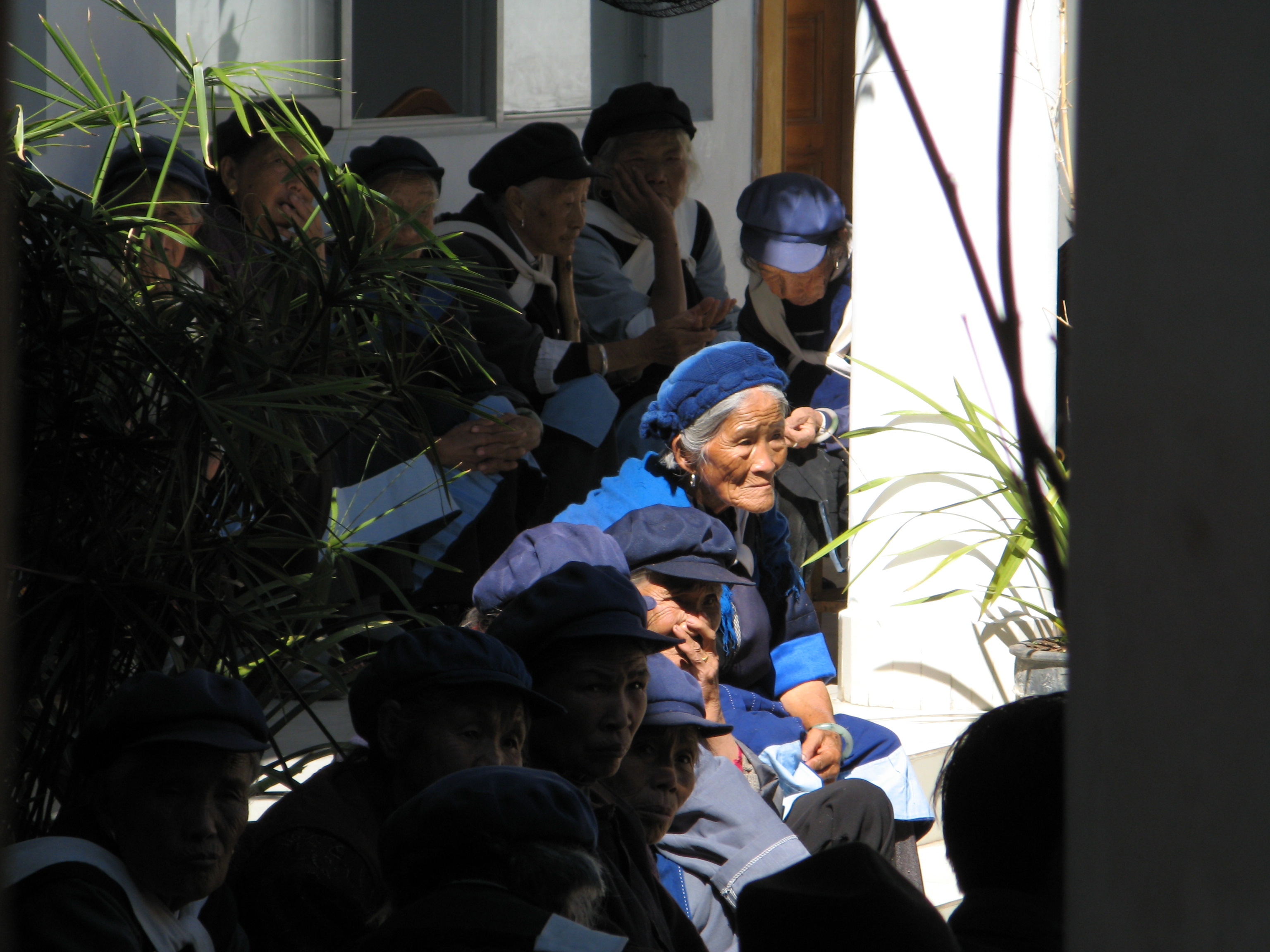
We stop at Stone Drum Town, a Naxi village for lunch at the Stone Drum restaurant. In the courtyard are many tables filled with Naxi people.

Except, none of them are eating lunch. They are playing majong, dice, dominoes, or cards as though it is a holiday.

The faces are animated and noticeably, none are young. Vicki claims this is very unusual and asks around. She learns that a government official is due in the village and will speak to the elders today. They are waiting for him while we lunch.

The eating area was separated from the courtyard by a curtain of chili peppers.

I managed to get two  pictures of the open-air restaurant kitchen, the cooking area…

And the pantry. I didn’t see a refrigerator, but they must have one. This is an inland village and the only place we ate that didn’t have fish on the menu. Service here is more casual than city restaurants and the foods simpler but still delicious.

It was a photo bonanza for us, the magnificent faces, the interplay at the tables, the rapt concentration on their games.

I saw two men smoking an opium pipe.

They were very attentive when their speaker arrived. What is he saying, I asked Vicki. “Oh, just  lot of government propaganda. We all laughed. Same as home!

We had fifteen minutes to walk around and stretch our legs before getting back on the bus. Wanning tried to talk with this bent over little man. She speaks Chinese but couldn’t understand the language  even with the help of another Chinese  fellow.

Again, the Naxi were not the least bit shy about having their pictures taken and indicated to me they wanted to see the results; obviously familiar with digital cameras.

This fellow wanted to sell me a stool he had made.  I could only take a picture.

After we loaded into the bus, this woman was seeking to sell trinkets through the windows. Vicki called her a beggar and told us it is very unusual to find a beggar in a remote village like this one. Vicki didn’t want us to buy from her and the bus drove off before any transactions could be made. We are headed for the airport to take us to Kunming.  More tomorrow.

Thursday, September 1, 2011

TIGER LEAPING GORGE


We walk old town after we get back to Jiliang. The town square is teeming with people from everywhere. There are performers and  a hodge-podge of eating places. We witness a rat being carried out of a candy shop with a tongs.

If only we could speak the language. What tales might this fellow tell?
You have to cross the moat on makeshift boards in some places to visit a shop.

Like this Chinese couple we could have had “fast food”, but instead we chose to dine at crowded tables along the moat for our evening meal.

We choose various sticks of vegetables and meat served with a small wok of  hot oil to cook it in. Safe!  We avoid the snails, pig tails, pigs  feet, crickets, grasshoppers, ants, beetles, lizard  and the ever popular dog meat, even though the Naxi love their pets. Maybe they love them too much.  Vicki buys an unattractive looking bean cake with spices for all of us to taste and it is delicious. Sweets in this part of China have been very good. Our last night in Jiliang, reluctant to let go, we enjoy the street  party until 11 p.m.

In the morning, we take the bus up the mountain again, this time to view Tiger Leaping Gorge. The gorge is on the Yangtze and stretches about 10 miles  along the Chinese and Tibetan border. The Chinese claim it is the  deepest canyon in the world and are planning to obliterate it and build a dam. This gorge is also a UNESCO site.  We are hooked up with a rickshaw driver for the two miles up  the canyon.
We get our first look at what is ahead.

The rickshaw journey ends at the spot where the Emperor went hunting and aimed at a tiger. It escaped by jumping across the gorge at one of its narrowest points. Thus the name of the gorge. The gorge may have been narrower then, but from what we could see, no animal could have jumped the 70-75 feet across the gorge.

On the return, we pay our drivers off and tell them we’d rather walk. The canyon is beautiful but the road is ever more fascinating, chiseled out of solid stone.
At one point I tried to get an idea how the railing was attached to the wall.

Leaning over, I could barely see  the super structure.  For the  most part the posts seem to be sunk into the solid rock and you wonder how they built this marvelous road without huge machinery.

In some places the posts seem perilously close to a disintegrating edge. And, in fact, at one spot in our two-mile stretch, soldiers stood guard to prevent anyone from wandering too close to the edge.

We came to a spot where the road continues down an adjoining canyon, blocked to us.  Vicki says backpackers go everywhere in the canyon.
Far below us, the water rushes and sings over the rocks.

In other places it is calm and serene. Always beautiful.

At every turn in the road is another sheer wall tapestry of rock formations. Tomorrow we leave this area for Kumning.