Leaving Stone Drum Village, we take a short sweet flight to the
Provincial Capital of Kunming, (Koon-ming) a city of eight million
people with another six million in the surrounding territory. On the
plane I sat next to a young Chinese man who spoke perfect English. Vicki
tells us all Chinese learn English in school since Mau. He and his
friend were on vacation in Korea. He claimed it was scary. People on the
streets avoid eye contact with you, afraid to look at you and very
repressed even in a bar or restaurant. Military guards were in evidence
everywhere they went. They felt like they were being followed. You are
not allowed to take pictures of buildings. He was tempted a few times
to take a forbidden picture, but didn’t. Then, when he got to the
airport, the guards looked at every photo in his digital camera before
letting them go. He was glad he obeyed but, it was an unpleasant
vacation.

Our city guide takes us by bus to the center of old town Kunming to see the bird market. We pass by a famous curved building called the Sister Building. He walks so fast, I can’t hear half of what he is telling us because I’m trying to fill my eyes.

I managed to grab a quick shot of this guy selling dog and cat pelts. Argh! I know, we all grimaced. I wanted to stop and buy old Chinese coins from a vendor, but I was getting left behind and had to abandon my purchase and run to catch up with the group.

This area of Kunming has modern ads and minority frescoes on the street wall which is what is left of the old part of the city. The government demolished most of the older part of town in 1953. It looked like the Hutongs of Beijing, built on a courtyard with a common well and underground water running back to the river. The old people have to use city water and they hate hand carrying their water home in big plastic jugs.
At this point, my memory disk is full and my camera bag is back in the bus. The bird market is not to our liking very much anyway because bird flu is in all the news and we see people wearing masks. We saw birds in cages hanging from just about every business doorway, including restaurants. Stacked tight cages of bunnies and kittens, none of which we were excited to see. Most interesting were very large crickets in beautifully made wooden cricket cages, which they race. Rats, too, which they eat. “White meat” snails with beautiful striped shells for sale. Vicki tells us this is the poor section of town. We move on to the flower market which is much more to our liking. The rest of the city is quite modern after being rebuilt after the Japanese bombed it. Kunming also has the base where the Flying Tigers were cosseted during WWII. And, it was once part of the Golden Triangle, a famous opium growing area.

The City Tour takes us to a beautiful Green Lake Park, mobbed with people. Huge flocks of seagulls winter here but haven’t come in yet in huge numbers.

We love seeing cute kids. And the Chinese, with a limit of one child, dote on their beautiful children and love showing them off.

It is a lovely place to relax, play cards, dominoes, mah jong. Have tea. Most Chinese have small apartments and houses. They socialize in their public places.

And exercise together. It seems such a healthy practice, both, being outside and exercising regularly.

Green Lake Park is beautiful and enjoyable. People watch and feed the birds and koi.

I’m tickled by this Chinese woman dressing her child in a blonde wig cap as they feed and watch the koi.

.

We eat at a restaurant that minimizes the heat of asphalt parking by burying cement blocks and growing grass in them. I wanted to build my driveway in Murphys that way but the cost at the time, labor intensive, was too high. We eat an area specialty called fish skin, which is quite spicy and tasty, along with the usual noodles and vegetables. A surprise was watermelon for desert.
Back at our hotel, we nap and read before getting ready for a very famous evening show called the Peacock Extravaganza that features 200 ethnic peoples. The Peacock Dance is a tradition in this area from the time of Kublai Khan. Fabulous costuming throughout, but especially this woman peacock dancer with an enormous drum moving in very strenuous body positions. The dancers have painted bodies, the background is stormy suggesting how early peoples feared thunder and lightening. They made loud noises to scare off evil spirits and wild animals that also fear storms. The stage settings for all of the dances are rich and dramatic.

In this moon dance, human figures float down from the ceiling appearing to fly, flapping their iridescent wings like huge butterflies. They dance a ritual child sacrifice and a sensual babies birth. They danced the Muslim people bringing Buddhism to China. All done with grace and beauty. This show travels all over the world with its 200 performers. We paid a $20 bill to see it. Stunning.
Tomorrow-the stone forest.

Our city guide takes us by bus to the center of old town Kunming to see the bird market. We pass by a famous curved building called the Sister Building. He walks so fast, I can’t hear half of what he is telling us because I’m trying to fill my eyes.

I managed to grab a quick shot of this guy selling dog and cat pelts. Argh! I know, we all grimaced. I wanted to stop and buy old Chinese coins from a vendor, but I was getting left behind and had to abandon my purchase and run to catch up with the group.

This area of Kunming has modern ads and minority frescoes on the street wall which is what is left of the old part of the city. The government demolished most of the older part of town in 1953. It looked like the Hutongs of Beijing, built on a courtyard with a common well and underground water running back to the river. The old people have to use city water and they hate hand carrying their water home in big plastic jugs.
At this point, my memory disk is full and my camera bag is back in the bus. The bird market is not to our liking very much anyway because bird flu is in all the news and we see people wearing masks. We saw birds in cages hanging from just about every business doorway, including restaurants. Stacked tight cages of bunnies and kittens, none of which we were excited to see. Most interesting were very large crickets in beautifully made wooden cricket cages, which they race. Rats, too, which they eat. “White meat” snails with beautiful striped shells for sale. Vicki tells us this is the poor section of town. We move on to the flower market which is much more to our liking. The rest of the city is quite modern after being rebuilt after the Japanese bombed it. Kunming also has the base where the Flying Tigers were cosseted during WWII. And, it was once part of the Golden Triangle, a famous opium growing area.

The City Tour takes us to a beautiful Green Lake Park, mobbed with people. Huge flocks of seagulls winter here but haven’t come in yet in huge numbers.
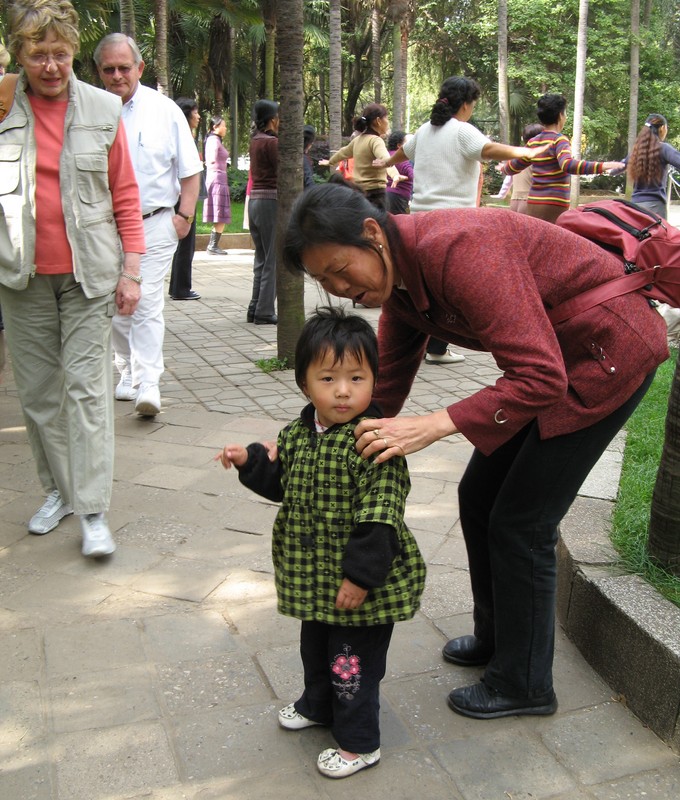
We love seeing cute kids. And the Chinese, with a limit of one child, dote on their beautiful children and love showing them off.

It is a lovely place to relax, play cards, dominoes, mah jong. Have tea. Most Chinese have small apartments and houses. They socialize in their public places.

And exercise together. It seems such a healthy practice, both, being outside and exercising regularly.

Green Lake Park is beautiful and enjoyable. People watch and feed the birds and koi.

I’m tickled by this Chinese woman dressing her child in a blonde wig cap as they feed and watch the koi.

.
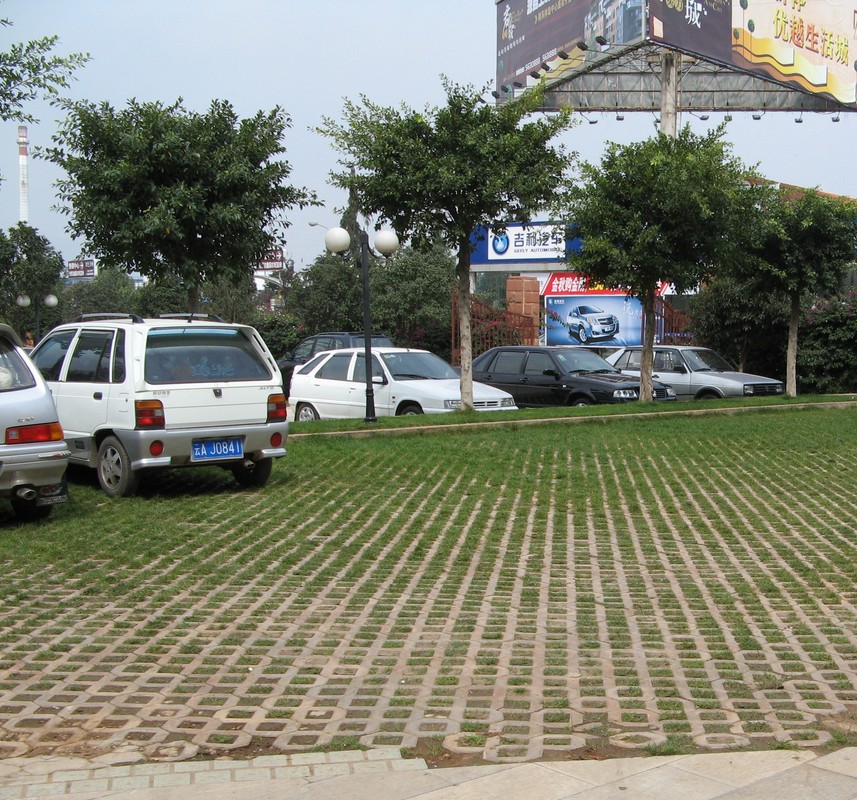
We eat at a restaurant that minimizes the heat of asphalt parking by burying cement blocks and growing grass in them. I wanted to build my driveway in Murphys that way but the cost at the time, labor intensive, was too high. We eat an area specialty called fish skin, which is quite spicy and tasty, along with the usual noodles and vegetables. A surprise was watermelon for desert.
Back at our hotel, we nap and read before getting ready for a very famous evening show called the Peacock Extravaganza that features 200 ethnic peoples. The Peacock Dance is a tradition in this area from the time of Kublai Khan. Fabulous costuming throughout, but especially this woman peacock dancer with an enormous drum moving in very strenuous body positions. The dancers have painted bodies, the background is stormy suggesting how early peoples feared thunder and lightening. They made loud noises to scare off evil spirits and wild animals that also fear storms. The stage settings for all of the dances are rich and dramatic.

In this moon dance, human figures float down from the ceiling appearing to fly, flapping their iridescent wings like huge butterflies. They dance a ritual child sacrifice and a sensual babies birth. They danced the Muslim people bringing Buddhism to China. All done with grace and beauty. This show travels all over the world with its 200 performers. We paid a $20 bill to see it. Stunning.
Tomorrow-the stone forest.


