Port Hudson is a Louisiana State Historic Civil War Battle site. Its located just north of Baton Rouge at the confluence of the Red and the Mississippi Rivers. Confederates knew this was an important strategic position to keep supplies flowing to the Confederate Army, so they prepared and literally dug in. Under command of an able West Point educated Major General, Franklin Gardner, with 6,800 troops, they stood the longest, bloodiest siege of the Civil War against an inexperienced appointed Union Major General, Nathaniel P. Banks with 30,000 troops. It was a slaughter of Union troops. Two regiments of Africans were allowed their first chance to fight and proved themselves able soldiers for the Union. Banks, when given leave to bury his dead, refused, and used the stench of rotting bodies as a weapon against the Confederates. Hunger, thirst and weather won after 48 days and a confederate surrender was negotiated.
This battlefield retained cannon balls and musket shot in large quantities. Other artifacts testify to the human casualty of the battle, enough to make you wonder why war is still considered a viable answer to solve problems. I tend to side with the Thai's who sent King against King into battle instead of the King's subjects.
These wicker "baskets" were filled with stones and bits of steel to provide protection from gun fire.The interpretive center at Port Hudson does an excellent and thorough job. It has the only known picture of troops surrendering during the Civil War.
There are several cannon around the battlements. Re-enactments are held here yearly as archeologist have traced the area of the battle encampment. Its an interesting, calm terrain with much beauty that hardly gives belief to its bloody history.
This camp stove was invented by a Confederate Soldier and was used throughout the war and afterward. It is an interesting place to visit. My grandmother from Michigan died in 1952 with a Civil War uniform in her attic. No family member remembered, or knew who it belonged to. A computer in the museum allows you to type in your relative's name and it will print out all men with the same last name who served on both sides in the Port Hudson siege. The 6th Infantry Regiment from Michigan served at Port Hudson and I found six men with the same last name and their fate. Three mustered out, one died in 1865, one man's identity was unsure, one was unaccounted for but not listed as a deserter. I found this research tool very interesting and intrigues me to search family history more intently and find out who wore that uniform.
Sunday, March 21, 2010
ANGOLA PRISON MUSEUM
Just outside the entrance to the largest penitentiary in the United States is an open to the public museum about this notorious prison. A sugar plantation in the 1700's, the slaves that worked here were mostly from Angola, thus the name.
In the late 1800's this plantation contracted prison labor and simply continued slavery in a different form. The abuses were so great, the state eventually bought three neighboring plantations and built the first facility. The abuses, however, didn't stop. Conditions were brutal. Mounted, rifle carrying trusty's, under threat for their own lives, ran the work crews. In one recorded incident, a trusty approached a "Red Hat" inmate and told him he would give him a chance to escape because they were from the same town and knew each others family. When the inmate declined, the trusty told him, they intend to kill you anyway.
No one was allowed to talk to or even look at a Red Hat inmate. In the punishment block, beds were cement with no blanket or padding, no toilet or water. Inmates were sometimes welded into their cells. In Angola, solitary confinement could last years, not months.
Another verified incident, an inmate was not allowed closer than 15 feet to an officer. The officer threw the inmate a tool he needed. When it landed too close, the inmate protested he couldn't pick it up. The officer assured him it was okay to move closer just this time. When he did, he was shot. A planned execution.
The beatings and mistreatment, poor food and horrible conditions were exposed and ordered cleaned up. Instead, the abuses continued well into the 1950's.
A typical cell without a window.
The showers had only cold water and were expected to serve 400 men. These conditions were not changed until 1955.
The long prod was used to motivate anyone working too slowly.
Reform began after 8 inmates slashed and severed their achilles tendons rendering themselves crippled and unable to work. The prison had no doctor but did have a nurse. When the incident became before a review board, Nurse Daughtry testified to the horrible conditions inside the prison and Governor Long ordered the place cleaned up once and for all.
While the past was brutal, reforms have brought humanizing changes to Angola. This prison will someday be an old folks home because of life sentences. The cost to warehouse human beings could send all of them to Harvard.
The inmates built this hearse and make satin lined wooden coffins for their dead to have a dignified funeral.
They have the rest of their lives to maintain sanity in captivity, a job of its own. Inmates here have jobs; they work in menial labor for 4 cents to 35 cents a day. They box, play ball, and compete in a once a year rodeo attended by 10,000 outside spectators. Its their high point of the year. They have a newspaper and a radio station. Laundry, print shop, bakery, and so on, their own micro city services.
Prisons are in some ways a cross section of our current society. Freddy Fender, Leadbelly, famous singers served time here. This is the only prison that had an inmate who secured a patent for an invention while incarcerated. In the gift shop, you can buy CD's of inmate songs. The Museum itself is very well done and gives unvarnished evidence of the brutal past and the more hopeful future. For more photos check my link:http://picasaweb.google.com/1579penn/32010Angola#
It currently holds approximately 5000 inmates, all men, and most of them lifers. At one time, any prisoner in Louisiana sentenced to 40 years was automatically moved to Angola. Officer Dixon, who runs the museum, told us "...all the bad guys come here."
en.wikipedia.org/wiki/Louisiana_State_Penitentiary
Saturday, March 20, 2010
TOUR GUIDE EXTRAORDINAIRE
Michele Boulet just popped into our lives and took on we tourist junkies. Nice! We spent three days, plus, with her and met people we would not have known about without her introduction. Michele, "the mysterious one with the beautiful eyes" as part of a collage, below.
Her path to what she calls her Farm School, where she takes in abandoned, in trouble animals, gives them nurturing care, and helps find them a home is checkered, adventurous and intense.
Half-orphan-local-girl graduates Sacred Heart Boarding School at Grand Coteau and heads off to college at Loyola to be near grandmama.
Her siblings were brothers and she joined a sisterhood of girlfriends, all of whom found their way into theatre arts.
Theatre professionals and semi-professionals generally ride a hard road. Competition is wicked. With only High School drama, a play-a-year experience, Michele hooked a paying role with Richard Schenker Productions at 18, The Manson Family play. She shivers when she mentions her part in stabbing the pregnant woman. Scarey. Schenker's talent nurtured Sam Shepard and Will DeFoe. His philosophy was everybody works, nobody complains. Even without another role from Shenkeer, she knew acting is what she wanted to do.
Young, adventurous and brash, the sisterhood decided to go to London to try acting on the big stage. Kennsington Drama Club, the Childrens Hour with Lillian Hellman, competitive venues. Michele did one show that got decent reviews, then nothing. Back to the states.
University of Southern Louisiana had a great drama teacher in Rich Zimmerman. Moving there, learning gobs, loving it, she left just short of getting her degree because Zimmerman left USL and was replaced by an "inferior" teacher. "We were bored, the program we loved was gone. We went everywhere and did everything. San Francisco, L.A., Seattle-that was the best; Beer Theatre, Tap Roots, Christian Theatre."
In the process she discovered her talent as a Light Designer; enjoyed teaching kids to love Shakespeare; did some writing and eventually burnt out.
"We got tired of performing, then packing the van to move on to another location."
She attended Evergreen State College in Olympia, WA. where she learned writing and film production.
And, she returned to Louisiana. "I accomplished my goal, to be home by age 30 with a degree."
She formed a production company called CoonAss Girl Productions. She tried out for and won a part on America's Most Wanted, and Vampire Lestat-cast as a prostitute both times. "My grandmama was offended and I had promised her I'd never embarrass her on screen," she laughs.
She worked five years with Louisiana Folk Festival, as a volunteer the first year before being written into the grants."I just fell into a documentary about Cajun Culture. I wanted to story my people." She became their documentarian on film.
At the same time she volunteered for five years with the St. Martins Parish Animal Shelter. Michele bought 15 acres outside of Arnaudville and started her "Farm School." She loves this beautiful spot and has a studio space at Nunu's so her creative juices have an outlet.
What's next?
"I'm organizing to relaunch my company and plan to make my ranch a blind horse sanctuary and rehab for abused horses."
Meet Michele my new friend at: www.myspace.com/coonasswarriorprincess
We said goodbye to Michele and her friend Russell, and hit the road for St. Francesville from which we will visit the Angola Penitentiary Museum.
Labels:
Angola,
Michele Boulet,
Penitentiary Museum,
RV Travel
Thursday, March 18, 2010
GREG GUIRARD, A CAJUN ACTIVIST
All of us would undo the damage past generations have done to the environment if we could. Greg Guirard, teacher, writer, speaker, fisherman, woodsman, historian, activist skips the "if" and is doing something about it, one tree at a time. That is, 40,000 of them in his own sphere of control. He planted them himself, over a 30 year span, converting cane fields to trees.
He was working on this crawfish trap when we drove up to his house. Its made from plastic coated chicken wire. "Not good this year," he said. He is working with the Atchafalaya BASINKEEPER, an organization dedicated to saving the River Of Trees, and saving a way of swamp life for man, fish and birds. They have a website: www.basinkeeper.org.
While building a new house out of replaned cypress wood, he remembered seeing some discarded cypress full of holes from a fungus. Replaned, it made a beautiful cover for this wall. His cupboards, walls, ceilings and some furniture are made of cypress. Only the floors are oak.
Next to a cypress plank, framing stained glass, stands a broom, unsupported by the wall. It stands by itself. Greg is hoping to reach a record time. This one has been standing in the corner for five months now.
Cypress wood deteriorates slowly. Years ago, the cypress was completely logged off. Logs sunk into the muddy waters. When the water gets low, woodworkers remove the "sinkers", replane them and find new uses for this beautiful wood. A form of recycling and preservation.
Greg not only preserves wood, he has preserved the stories of old time Cajun Fishermen and women in his books, Cajun Families of the Atchafalaya. Psycho Therapy For Cajuns is a humorous take on Cajun Culture surviving in a crazy world. He wrote the fiction story, taken from real life, The Land of Dead Giants. His latest book, in conjunction with C.Ray Brassieur is a broader look at the past and future of the Atchafalaya Basin, and the folklife of the people who lived there, entitled Inherit The Atchafalaya.
Unique views of a way of living fading into obscurity and which few could write about with the insight and clarity as the Cajun, Greg Guirard.
Meet Wilmer Blanchard who typifies Cajun fishermen: "I have eleven children, three boys. I would take my boys in the woods as soon as they could walk enough..."
Women fished to, and when Yolande Bonin had a stroke, her husband, Cezaire, carried her into the boat each day. Her contribution to fishing was limited to opening the right can as she saw a gar, a catfish, or whatever come out of the net. Cezaire says, "When I raise them nets, you ought to see her smile when they got fish in 'em."
Myrtle Bigler claimed, "All kind of work gets me tired. But I'm not sick..." This when she was in her eighties. She and her husband, Harold, lived off the swamp all their married lives. He died at age 90, and she died at 95.
Alcee Seritte went blind in his seventies. He continued to take his boat from Atchafalaya Station to Catahoula and back, a distance of 8 miles one way. He'd run into the bank and just turn away and keep going.
The lessons of simplicity are there for all of us to learn from, as are Greg's books.
To contact Greg Guirard: Paroona9@yahoo.com or phone him at 337-394-4631. ATT is supposed to fix his website which is not currently working at www.gregguirard.com.
A sure sign of a real Cajun is this outboard motor hanging from an oak tree in Greg's driveway. He gave a slide show for Elder Hostel and his photographs of the basin and people are superb.
We spent the rest of the day with Michele, our erstwhile "guide." She took us to see the legendary wedding bower of the Pre-Civil War sugar plantation Durand. Durand imported spiders into a young planting of pine, magnolia and oak trees lining his quarter mile driveway. The day of the wedding, the spider webs were sprinkled with the glitter of gold and silver dust. The bower is now know as Pine Alley and is all that remains of the once successful plantation.
Evening closed with friends and family "hanging out" around the bonfire and eating Michele's great jambalaya washed down with good beer. Life is good.
Wednesday, March 17, 2010
NUNUS MARKET AND SACRED HEART MIRACLES
Rita Datreauie (pronounced Daughtry) Marks is a talented woman who speaks Creole French, Cajun French and English. She attends formal Parisian French classes at the Town Market Rural Art Center in Arnaudville, where she lives.
"Whatever for, I queried?"

She and her son, George, explained the complicated fusion of cultures and languages that makes up the Southern, Louisiana landscape.
"Just seven miles away at Cecile, the language is different than here." Rita can speak and understand them both. Punished as a child for speaking her language at school, she was spanked, hard, or made to kneel all day. The resulting humiliation made her feel insecure about her heritage. Outsiders often regarded people who spoke, so called, "bastard" French, as dumb and inferior.
Collectively, Cajun/Creole peoples like Rita and George have seen a welcome renaissance of their culture. So, Rita is learning a third "French" language to be able to communicate with Canadians and Parisians. And, in answer to my why do you do it? "People from all over the world come to this little village, to dance, to hear the music and enjoy this place, I want to be able to communicate with them." There is an elevation of pride, here, to being a French speaking person now.
This marvelous Cultural Arts Community Center is named Nunu's for Rita's husband which is vernacular for "teddy bear" in fun reference to a man's half-circle front balding pattern that George Marks also inherited from his father. Their website is: nunuscafe.homestead.com.
Families once held their dances at each others houses. Rita described it like this: "We'd go to each others house. My boys would remove one wall of the house and take it to the barn. Everybody would come, the babies would be laid to sleep on the floor. We played and listened to the music and danced, sometimes for three days, all night and all day. Never stop. Then they'd go get the wall and nail it back up, but not too tight."
The model projects funded for community centers that held dances where alcohol was consumed excluded children, by law. As the older people died off, the centers closed. George Marks went to an Attorney in Milwaukee to learn how to keep the children involved, as they did in the past, and still be within the law. It turned out they needed a restaurant with their bar and a catering license. So, now the children dance and sing right along with their parents. George described one young Cajun musician who rocks her child's cradle on stage while she's playing. "How nice is that?" he says.
But, NuNu's is so much more, as George is want to say. An art center, bar, restaurant, and dance hall. It serves potters and painters and poets and dancers. It serves musicians, performance art, writing, culinary arts and healing. It has movies, classes, its an educational center and gallery. A vibrant arts community with so much to admire. Non pariel!
I fell for this painting by Vera Judycki, Dancers Collage.
Michele showed us outside, Nunu's, door, where the two bayou's meet, a tiny island created when the damn yanks were coming.

The citizens sunk a boat and loaded it with heavy junk to block the bayou from any marauding boats. The spot, now an island, is soon to be designated a National Heritage Point of Interest. Here, they hold a festival, Le Feu Et L'eau, Fire And Water. This year it will be Dec. 4th, 5th and 6th. They line an area of the bayou with metal boats and light fires in them. Friday is the warm-up, Sat. the fires and Sunday, the embers. People boat down to Arnaudville and view, enjoy the music, art, demos, an auction and food. If I ever leave California, it will be to Arnaudville.
Besides, I want to see the Cajun Cyclists. A group of ragin', dancin', drinkin' , ass kickin' Cajuns who haul their own paddy wagon along with them. They dance at every zydeco venue within bicycling distance for a week and then go home and rest to try again another day. Its Awesome. Their website: cyclezydeco.com
Michele, our trusty tour guide took us on to Grand Coteau, a neighboring community, to visit Casa Azul, a gift shop and art gallery, that deals in Parisian, Haitian, Indian and other works. With an open mic night for locals, also part of the Rural Arts grant that serves Nunu's, we saw unusual gift ideas that weren't stamped "made in China." Refreshing.

How nice to be able to emote, recite poetry, sing, preach or whatever? The spirit lives! I don't know how to say that in French.
Besides, this is "hard core" Catholic country. The nearby Sacred Heart Academy at Grand Coteau was founded in 1821. The bricks and mortar went together starting in 1838. It is the only one of 200 Sacred Heart Schools that has never closed and is still graduating kids at a high rate into colleges. Its also the only remaining boarding school in the United States. Michele Anne Boulet, attended Sacred Heart. She and her friends are still convinced the school is haunted, possibly by Sister Mary Wilson who was a librarian. No one admits to tossing books off the shelves onto the floor. Yet, when teachers arrive in the morning, certain books have been tossed onto the floor.
A miracle happened in this school. Mary Wilson, a young novitiate was sent to Grand Coteau for her health in 1886. Since she was gravely ill, they moved her bed into a room by herself as she prayed and struggled with her illness. She prayed to John Berchmans, a Jesuit Priest from Belgium who died at an early age. John Berchmans appeared to her twice and she was immediately healed. With his two miraculous appearances and her miraculous healing, he was canonized a saint. She served as a nun until her death and is buried on the grounds of Sacred Heart. It is a religious pilgrimage for people to come to places like Sacred Heart, Lourdes in France and other holy sites. It was old home week for Michele as she ran into people she knew in a place she loves.

Just to roam or meditate under this ancient oak canopy, wow!
This particular Sacred Heart School has never closed, even during the Civil War. the Captain of the Federal Troops was asked to protect Grand Coteau Sacred Heart since he knew someone who had a relative, a young nun, serving at Grand Coteau during the those years. He was as good as his word. He protected the church and people from the town even gave the soldiers food and helped them in any way they could. It was the Civil thing to do. the Academy was spared, classes continued all during the occupation time, a minor miracle of its own.
The Academy now teaches boys as well. It offered a first rate equestrian program after 1850 when the stable and equestrian dressage area was built.
I took great pictures but our signal here is frustrating and slow. Before we leave I hope to get up an album.
"Whatever for, I queried?"
She and her son, George, explained the complicated fusion of cultures and languages that makes up the Southern, Louisiana landscape.
"Just seven miles away at Cecile, the language is different than here." Rita can speak and understand them both. Punished as a child for speaking her language at school, she was spanked, hard, or made to kneel all day. The resulting humiliation made her feel insecure about her heritage. Outsiders often regarded people who spoke, so called, "bastard" French, as dumb and inferior.
Collectively, Cajun/Creole peoples like Rita and George have seen a welcome renaissance of their culture. So, Rita is learning a third "French" language to be able to communicate with Canadians and Parisians. And, in answer to my why do you do it? "People from all over the world come to this little village, to dance, to hear the music and enjoy this place, I want to be able to communicate with them." There is an elevation of pride, here, to being a French speaking person now.
This marvelous Cultural Arts Community Center is named Nunu's for Rita's husband which is vernacular for "teddy bear" in fun reference to a man's half-circle front balding pattern that George Marks also inherited from his father. Their website is: nunuscafe.homestead.com.
Families once held their dances at each others houses. Rita described it like this: "We'd go to each others house. My boys would remove one wall of the house and take it to the barn. Everybody would come, the babies would be laid to sleep on the floor. We played and listened to the music and danced, sometimes for three days, all night and all day. Never stop. Then they'd go get the wall and nail it back up, but not too tight."
The model projects funded for community centers that held dances where alcohol was consumed excluded children, by law. As the older people died off, the centers closed. George Marks went to an Attorney in Milwaukee to learn how to keep the children involved, as they did in the past, and still be within the law. It turned out they needed a restaurant with their bar and a catering license. So, now the children dance and sing right along with their parents. George described one young Cajun musician who rocks her child's cradle on stage while she's playing. "How nice is that?" he says.
But, NuNu's is so much more, as George is want to say. An art center, bar, restaurant, and dance hall. It serves potters and painters and poets and dancers. It serves musicians, performance art, writing, culinary arts and healing. It has movies, classes, its an educational center and gallery. A vibrant arts community with so much to admire. Non pariel!
I fell for this painting by Vera Judycki, Dancers Collage.
Michele showed us outside, Nunu's, door, where the two bayou's meet, a tiny island created when the damn yanks were coming.
The citizens sunk a boat and loaded it with heavy junk to block the bayou from any marauding boats. The spot, now an island, is soon to be designated a National Heritage Point of Interest. Here, they hold a festival, Le Feu Et L'eau, Fire And Water. This year it will be Dec. 4th, 5th and 6th. They line an area of the bayou with metal boats and light fires in them. Friday is the warm-up, Sat. the fires and Sunday, the embers. People boat down to Arnaudville and view, enjoy the music, art, demos, an auction and food. If I ever leave California, it will be to Arnaudville.
Besides, I want to see the Cajun Cyclists. A group of ragin', dancin', drinkin' , ass kickin' Cajuns who haul their own paddy wagon along with them. They dance at every zydeco venue within bicycling distance for a week and then go home and rest to try again another day. Its Awesome. Their website: cyclezydeco.com
Michele, our trusty tour guide took us on to Grand Coteau, a neighboring community, to visit Casa Azul, a gift shop and art gallery, that deals in Parisian, Haitian, Indian and other works. With an open mic night for locals, also part of the Rural Arts grant that serves Nunu's, we saw unusual gift ideas that weren't stamped "made in China." Refreshing.
How nice to be able to emote, recite poetry, sing, preach or whatever? The spirit lives! I don't know how to say that in French.
Besides, this is "hard core" Catholic country. The nearby Sacred Heart Academy at Grand Coteau was founded in 1821. The bricks and mortar went together starting in 1838. It is the only one of 200 Sacred Heart Schools that has never closed and is still graduating kids at a high rate into colleges. Its also the only remaining boarding school in the United States. Michele Anne Boulet, attended Sacred Heart. She and her friends are still convinced the school is haunted, possibly by Sister Mary Wilson who was a librarian. No one admits to tossing books off the shelves onto the floor. Yet, when teachers arrive in the morning, certain books have been tossed onto the floor.
A miracle happened in this school. Mary Wilson, a young novitiate was sent to Grand Coteau for her health in 1886. Since she was gravely ill, they moved her bed into a room by herself as she prayed and struggled with her illness. She prayed to John Berchmans, a Jesuit Priest from Belgium who died at an early age. John Berchmans appeared to her twice and she was immediately healed. With his two miraculous appearances and her miraculous healing, he was canonized a saint. She served as a nun until her death and is buried on the grounds of Sacred Heart. It is a religious pilgrimage for people to come to places like Sacred Heart, Lourdes in France and other holy sites. It was old home week for Michele as she ran into people she knew in a place she loves.
Just to roam or meditate under this ancient oak canopy, wow!
This particular Sacred Heart School has never closed, even during the Civil War. the Captain of the Federal Troops was asked to protect Grand Coteau Sacred Heart since he knew someone who had a relative, a young nun, serving at Grand Coteau during the those years. He was as good as his word. He protected the church and people from the town even gave the soldiers food and helped them in any way they could. It was the Civil thing to do. the Academy was spared, classes continued all during the occupation time, a minor miracle of its own.
The Academy now teaches boys as well. It offered a first rate equestrian program after 1850 when the stable and equestrian dressage area was built.
I took great pictures but our signal here is frustrating and slow. Before we leave I hope to get up an album.
Tuesday, March 16, 2010
THAT SOUTHERN HOSPITALITY IS REAL.
Out of the blue, Jim and I received an irresistible invitation from a stranger, would we like to come visit her place, and stay, and play and get acquainted with some local folks of Cajun heritage?
For real? Southern Hospitality is very real and we promptly accepted.
Michele Boulet is camera shy, but we found befriending strangers and animal rescue is just a small niche of Michele Boulet's personality. She and her friend Russell fill their days caring for critters who have come upon hard times, five horses, two of them blind; multiple dogs, a mule, and a boer goat. Independent is another name for cat and Michele's wouldn't have anything to do with me but it was puppy love at first sight.
Besides a passel of puppies, her newest acquisition is Helper, a stately bulldog who fits right into the menage and imperially guards the porch or flowers, or whatever needs a lookout.
The horse on the left is totally blind, the other has shadow vision. I forgot to ask Michele if the animals will eventually be placed with others? She says she is learning as she goes. Horses are not a critter to be taken lightly. (The picture below is Michele's, by the way.)
Her Boer goat, resembled my daughter's herd of milk goats from a 4-H project. Michele handed me a reference identifying her meat goat which looks quite like the Nubians..
Michele invited strangers, but we soon found we had a lot in common, a love of cooking, art, books, film production, animals, learning about family heritage, and people. We never fail to learn something new and I'm looking forward to more time and the killer lunch she promised us.
Below is Dancing Pig #6 by Chris Landry.
She threw us a list of names and I failed to remember this handsome fellow's.
Monday, March 15, 2010
WASHINGTON, LA, ANTIQUES MECCA
Opelousas, Louisiana was once the Capital of the state, for a brief period during the Civil War and nearby Washington was a busy steamboat port, sending cotton out and bringing in needed goods and equipment.

Washington is a sleepy little place, especially on Sunday when most businesses close there doors for Church and family. They have several fine historical buildings one with the original slate roof. Makes me wonder why we use anything but slate?
A grand old steamboat warehouse survived and has been converted to a restaurant.


The old wooden hasp on the warehouse door.
The old Washington schoolhouse, the Mudd family home and several other places have been turned over to Antiques and the town is known as an antique mecca by locals. Looking through antique stores is much like looking back through history.

I sincerely can’t imagine the chair above in an ordinary home, even an antebellum mansion. Makes me wonder, where did it come from? Who did it belong too? Who sat in it?

I would have bought this beautiful stained glass but it wouldn’t fit in the motor home. I settled for something smaller.

I collect old decks of cards, a habit (collecting) I’m trying to break. These old Civil War era cards remind me how little the kings and queens of playing cards have changed over the years. With video games, television and other exciting attractions, kids don’t play cards much anymore.
During my own childhood, when relatives came to visit, the adults played cards and we cousins were able to run wild with less supervision then usual. My own kids and grandchildren are avid card players and I expect the tradition will continue in some families, anyway.
Today, we move on to Arnaudville.
Washington is a sleepy little place, especially on Sunday when most businesses close there doors for Church and family. They have several fine historical buildings one with the original slate roof. Makes me wonder why we use anything but slate?
A grand old steamboat warehouse survived and has been converted to a restaurant.
The old wooden hasp on the warehouse door.
The old Washington schoolhouse, the Mudd family home and several other places have been turned over to Antiques and the town is known as an antique mecca by locals. Looking through antique stores is much like looking back through history.
I sincerely can’t imagine the chair above in an ordinary home, even an antebellum mansion. Makes me wonder, where did it come from? Who did it belong too? Who sat in it?
I would have bought this beautiful stained glass but it wouldn’t fit in the motor home. I settled for something smaller.
I collect old decks of cards, a habit (collecting) I’m trying to break. These old Civil War era cards remind me how little the kings and queens of playing cards have changed over the years. With video games, television and other exciting attractions, kids don’t play cards much anymore.
During my own childhood, when relatives came to visit, the adults played cards and we cousins were able to run wild with less supervision then usual. My own kids and grandchildren are avid card players and I expect the tradition will continue in some families, anyway.
Today, we move on to Arnaudville.
Sunday, March 14, 2010
SALUTE TO NFL CHAMP DEVERY HENDERSON AND OTHER STUFF.
If you've kind of forgotten the New Orleans Saints big victory in the Super Bowl this year, the people of Opelousa did not. For starters, I noticed this sign on a local business window-
We happened to be camped close to Devery's house where last night's party was long, and joyous and loud. But we didn't mind. So, today, we went to a local parade honoring Opelousas' Native Son, Devery Henderson.
The admiring little kids, cheering their idol, were seeing the possibilities for their future as they watched Devery himself out on the street throwing beads to everyone.
He came up to an ederly woman sitting near us and placed beads around her neck. A talented player and a nice guy.
After the parade we ate at the Palace Cafe which is next door to Jim Bowie's boyhood home. A 300 year old oak tree stands in front of the place and is known as the Jim Bowie Tree. I paced it off and the roots alone spread 30 feet along the sidewalk.
The visitor center has information about Bowie and his part in the battle at the Alamo.This set of knives, donated to their museum, was made from drawings of Bowie Knives. Jim's brother developed the knives, Jim made them famous.
Yams are grown in this part of Louisiana and celebrated with a Yambili every October with music, a recipe contest and good food. Getting ready for it in Vieux Village, I admired these painted guitars.
The promised recipe from Tony Chachere's book: Yam Candle Cakes
5 cups grated raw yams
4 1/2 cups sugar
1 tsp. vanilla
1 cup oil
4 eggs separated
1/2 tsp cinnaomon
2 1/2 tsps nutmeg
3 1/2 cups flour
2 tsps baking soda diluted with 2/3rds cup water
1 tsp. salt
2 cups chopped nuts
1/2 cup raisins
i cup cane syrup
1/2 cup coconut
8 to 10 empty soup cans.
Cook yams with 1 1/2 cups sugar about 3 minutes. Cool and add vanilla. Set aside. Cream remaining sugar with oil. Add egg yolks and spice. Sift some of the flour into a bowl and mix. Continue adding flour until all has been blended. Mix soda with water and add to batter along with salt, nuts, raisins, syrup and coconut.Stir in yam mixture. Beat egg whites and fold into batter. Pour batter into well greased cans, leaving 3/4 space for rising. Bake at 350* for one hour. Yields 60 servings.
Saturday, March 13, 2010
OPELOUSAS CROSSROADS
Opelousas, named for an Indian Tribe, was always a crossroads, a gumbo of cultures, trading, hunting, trapping, spices, music and food. Before Mardi Gras, a couple we met at Mamou, from Targil Spice Company of Opelousas, invited us to stop in and say hello! They weren’t available, but we stopped and found retail spices, in large and small sizes; everything from a can cooker, butcher supplies, cookie cutters to boots. Boots? You need those boots to catch things in the swamp before you spice ‘em up and cook ‘em, doncha know. We left there with some Seasonall that has a picture of hot peppers on the package. Compliments of the nice folks at Targils.

Next stop, Tony Chachere’s, (say Sash-sherries), a hardworking character with a penchant for success. A pharmacist who made and sold his own cough syrups, bug spray and other products. He switched to insurance, was very successful and retired a rich man. A love of cooking, with his own concoction of spices that he brought with him everywhere he went, turned into a multimillion dollar business, putting together spices and convenient food packages. His was the first cookbook on Creole cooking and it sold 10,000 copies the first week it came out. The company is huge and doesn’t do tours but Tanya Bellard, the Gourmet Sales, and Customer Service Manager said she would let us take pictures, for our blog. When we arrived, she regaled us with wonderful stories about Tony Chaschere, his irrepressible personality, trying out his recipes on the staff at the company and always involving everyone he met in food and spices, and fun.

We laughed out loud when we spotted a garbage can of popcorn and Tanya explained it was an environmentally friendly packing material for shipping their products and people call her and complain the popcorn is stale, or it didn’t have any seasoning, it was all broken…They now include a sticker that explains
the popcorn is used for fill only.
Three million pounds a year of raw materials go into their packaged food and spices. They sell 90 different food items and spices plus Tony Chachere’s Cajun Country Cookbook. I’m going to print a recipe from the book tomorrow, but here is a list of things you’ll find in it: Piquante Alligator Sauce, Roast Goose with Sauerkraut and Dumplings, Coot in Soy Sauce, Pork Backbone Stew, Stuffed cucumbers, Broiled Frogs, Yam Candle Cakes, Japanese Chicken-Pork Barbeque, Irish Potato Casserole, and Hot Tamales. He left no cuisine untested. www.tonytachere.com
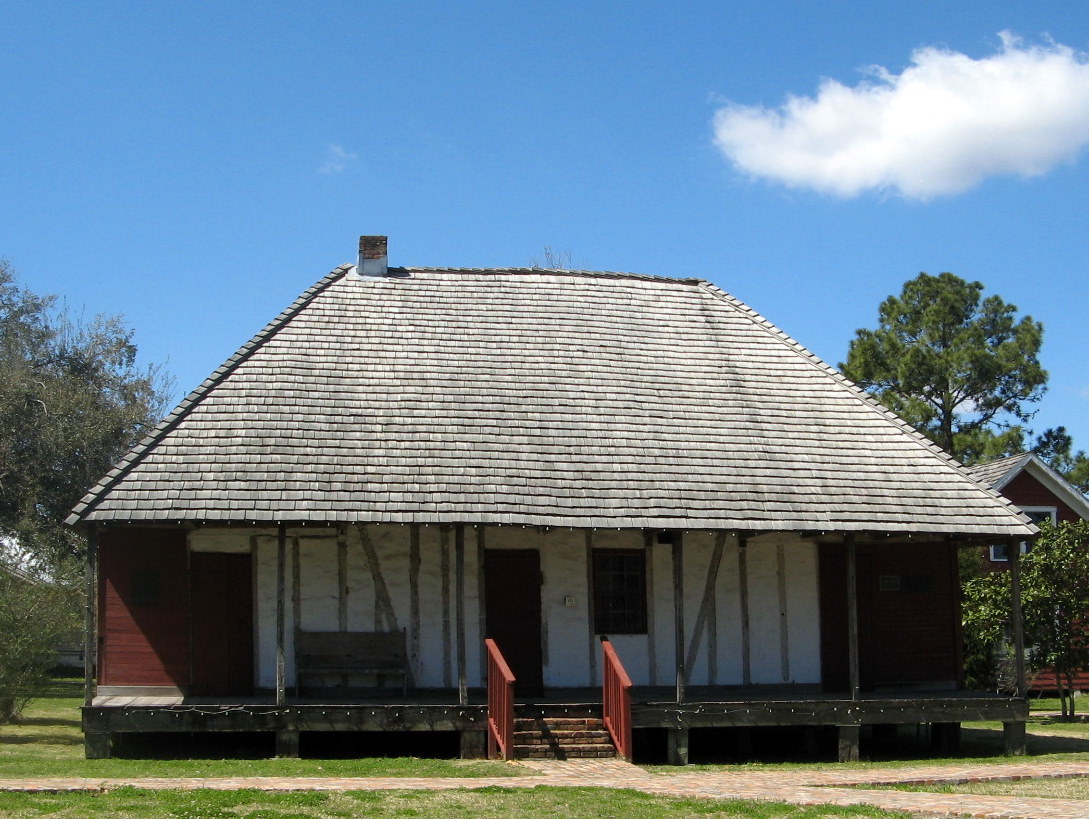
Opelousas made their visitor’s center into a little complex of buildings called Le Vieux Village (The Old Village). They were donated and moved here to be preserved. The buildings are typical “of their time” from an 1890 outhouse to a mud and moss (boissage) Creole House from 1791, below.

An African-American Methodist Church from 1948.

Also in this complex is the Orphan Train Museum. It started with a wealthy woman who heard her parents planning her funeral while she was in a coma. She prayed that if God allowed her to live she would dedicate her life to others. And, she did, as Sister Irene with the Sisters of Charity. Immigrants were flowing into New York. Many could find no housing or jobs. Many died and left children. Babies were found on doorsteps, in alleys, toddlers were eating garbage on the streets.
Sister Irene rented a cottage. The very next day, a baby was found on the doorstep. The need was so great, the cottage grew, with help from her wealthy women friends, and eventually, the church and state, into a foundling hospital and orphanage.
There were so many children, the Foundling Home decided to reach out into Catholic Communities and ask for families to adopt or care for kids until they reached 18. It was the first foster care program in the United States.
In 1907, the first train full of orphans arrived, with numbers pinned to their clothing, to meet prospective families from Opelousas. Many just wanted to have a child work for them as indentured servants. Others wanted young children to raise as their own. The Foundling Society visited the families once a year to check up on them. Subsequent years, two more trains arrived in Opelousas.

While they wouldn’t allow pictures in the museum, volunteer Frank Lipari, active in forming the Opelousas Foundling Children Society, is the son of a foundling father. There is only one known foundling in Louisiana still living, but their descendants are now choosing to tell their stories, which was once a source of shame. Frank’s Lipar’s father tried to find out what nationality he was, he found his endentured papers. He learned that his birth mother told her child’s name as Frank Reiger, and her own name as Schoencloster. He was born in the foundling hospital in 1903. Many foundlings didn’t even have that much information, not even records of their birth or their age.
At the first meeting of the Opelousas Foundling Society in 2003, two lifelong local friends met each other, neither had ever divulged that they were children of a foundling, such was the ingrained shame of their circumstances.
The Orphan trains reached everywhere the railroad went over the years, placing 400,000 children in family situations.
Next stop, Tony Chachere’s, (say Sash-sherries), a hardworking character with a penchant for success. A pharmacist who made and sold his own cough syrups, bug spray and other products. He switched to insurance, was very successful and retired a rich man. A love of cooking, with his own concoction of spices that he brought with him everywhere he went, turned into a multimillion dollar business, putting together spices and convenient food packages. His was the first cookbook on Creole cooking and it sold 10,000 copies the first week it came out. The company is huge and doesn’t do tours but Tanya Bellard, the Gourmet Sales, and Customer Service Manager said she would let us take pictures, for our blog. When we arrived, she regaled us with wonderful stories about Tony Chaschere, his irrepressible personality, trying out his recipes on the staff at the company and always involving everyone he met in food and spices, and fun.
We laughed out loud when we spotted a garbage can of popcorn and Tanya explained it was an environmentally friendly packing material for shipping their products and people call her and complain the popcorn is stale, or it didn’t have any seasoning, it was all broken…They now include a sticker that explains
the popcorn is used for fill only.
Three million pounds a year of raw materials go into their packaged food and spices. They sell 90 different food items and spices plus Tony Chachere’s Cajun Country Cookbook. I’m going to print a recipe from the book tomorrow, but here is a list of things you’ll find in it: Piquante Alligator Sauce, Roast Goose with Sauerkraut and Dumplings, Coot in Soy Sauce, Pork Backbone Stew, Stuffed cucumbers, Broiled Frogs, Yam Candle Cakes, Japanese Chicken-Pork Barbeque, Irish Potato Casserole, and Hot Tamales. He left no cuisine untested. www.tonytachere.com
Opelousas made their visitor’s center into a little complex of buildings called Le Vieux Village (The Old Village). They were donated and moved here to be preserved. The buildings are typical “of their time” from an 1890 outhouse to a mud and moss (boissage) Creole House from 1791, below.
An African-American Methodist Church from 1948.
Also in this complex is the Orphan Train Museum. It started with a wealthy woman who heard her parents planning her funeral while she was in a coma. She prayed that if God allowed her to live she would dedicate her life to others. And, she did, as Sister Irene with the Sisters of Charity. Immigrants were flowing into New York. Many could find no housing or jobs. Many died and left children. Babies were found on doorsteps, in alleys, toddlers were eating garbage on the streets.
Sister Irene rented a cottage. The very next day, a baby was found on the doorstep. The need was so great, the cottage grew, with help from her wealthy women friends, and eventually, the church and state, into a foundling hospital and orphanage.
There were so many children, the Foundling Home decided to reach out into Catholic Communities and ask for families to adopt or care for kids until they reached 18. It was the first foster care program in the United States.
In 1907, the first train full of orphans arrived, with numbers pinned to their clothing, to meet prospective families from Opelousas. Many just wanted to have a child work for them as indentured servants. Others wanted young children to raise as their own. The Foundling Society visited the families once a year to check up on them. Subsequent years, two more trains arrived in Opelousas.
While they wouldn’t allow pictures in the museum, volunteer Frank Lipari, active in forming the Opelousas Foundling Children Society, is the son of a foundling father. There is only one known foundling in Louisiana still living, but their descendants are now choosing to tell their stories, which was once a source of shame. Frank’s Lipar’s father tried to find out what nationality he was, he found his endentured papers. He learned that his birth mother told her child’s name as Frank Reiger, and her own name as Schoencloster. He was born in the foundling hospital in 1903. Many foundlings didn’t even have that much information, not even records of their birth or their age.
At the first meeting of the Opelousas Foundling Society in 2003, two lifelong local friends met each other, neither had ever divulged that they were children of a foundling, such was the ingrained shame of their circumstances.
The Orphan trains reached everywhere the railroad went over the years, placing 400,000 children in family situations.
Subscribe to:
Posts (Atom)