Last night, a friend came over and together we watched the video,
"It's A Wonderful Life." Her parting comment to me was, every time I
complain, I have to remember how good we have it." I would say AMEN to
that.
Then, in my email this morning came a video honoring a
particular CNN Hero, Anurada (Can't remember her last name.) But, my
friend Wendy's words to me: "We don't realize how safe we are." I hope
we can step into a new year and do one thing to assist the safety of
daughters everywhere. Please watch this video from CNN.
https://www.facebook.com/photo.php?v=136222669915551&set=vb.100005834562339&type=2&theater
Let's Make the New Year Better.
Showing posts with label slavery. Show all posts
Showing posts with label slavery. Show all posts
Monday, December 30, 2013


Wednesday, April 24, 2013
MUD ISLAND RIVER WALK, MEMPHIS.

A place not to miss when you travel to Memphis is the river walk on Mud Island. The best way to do it is park your car at the Visitors Center, walk across the street and take the tram across to Mud Island, so-called because it was at one time a natural sandbar. Dredging mud to deepen the channel made it big enough to turn into a great park.

Enjoy the views from the gondola ,or you can walk over on the walking bridge above the tram. We enjoyed very much the John Grisham movie The Firm much of which was filmed in Memphis. Particularly memorable was a tense scene from this gondola and the mezzinine where you disembark near the escalators. We decided to re-watch the movie just to see it again.

From the mezzanine, you peer down on a miniature replica of the Mississippi River and its environs as it passes through every state, from its source in Minnesota, to its ending in the Gulf of Mexico. I’ve been here previously and I love this park. Unique, educational, beautiful and stimulating.

The cement floor of the river bed details every little elevation and bank and floodplain. It features the rivers, levees, bridges and places where the river has dramatically changed course and no longer flows. The park is only a half mile long. The scale is every 30 inches, one step, is a mile.

When you cross from one state to the next, the border is clearly marked.

All the major cities along the way are plotted in grey slate with their bridges both rail and car built across the river.
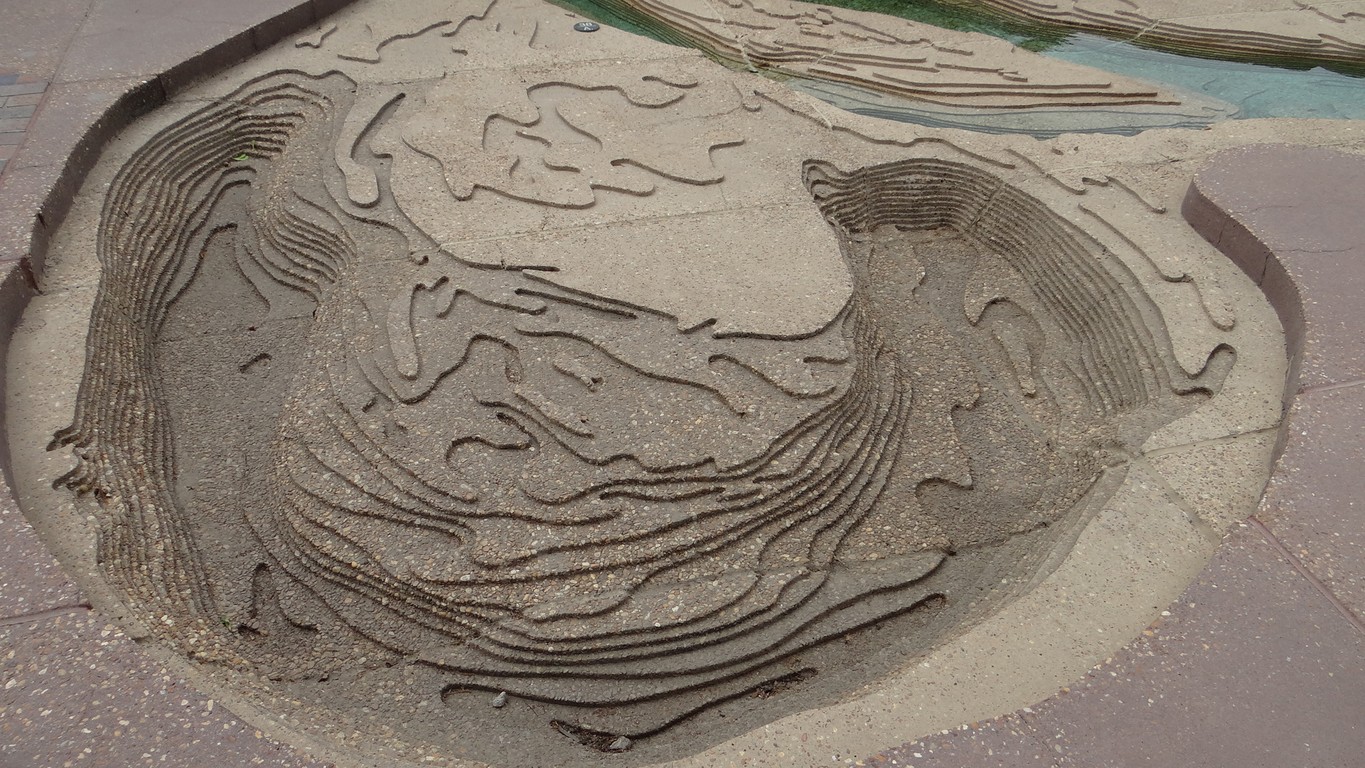
An oxbow is a section where the river once flowed and was then cut off and now contains a lake or a dry bed.

At this spot, you can see the miniature river along with the real Mississippi rolling along beside the park and a real bridge in the background. The park offers many places to sit and watch. One couple I talked to had chosen to follow a leaf and watch it make the entire trip just for the fun of it.

Jim enjoyed cities he has visited. Here he stands in Natchez, across from Vidalia, Louisiana. Kids here love to take off their shoes and play in the water or float little boats. There are picnic tables and lawn aplenty.

As you pass from state to state, the plantings along the miniature river match the flora and fauna of that state. Story boards identify the plant life as you pass through each state.

If you’ve ever viewed a major river from the air, you know it resembles this curving, snake-like path. The river has carved the earth and given life to humans and animals for thousands of years. Some people walk down one side and back on the other. We often stepped over the river to see both sides because it is so easy to do.

Here we are at the sprawling contours of New Orleans. To the right is a cafe where you can lunch before heading back. To the left a small lake with a fountain. But the Mississippi doesn’t actually end here.

We chose to follow it to the small deltas where the river is building islands that will one day be one solid piece. We found 1/B, a spot of one of our unique adventures, our trip to Pilots Island.

We hired a boat to take us to Pilottown in 2010. There isn’t much there, but we enjoyed the adventure for many reasons. It was fun to see it designated at the very tip of the Gulf of Mexico where the river meets ocean. A ticket for seniors at $9 includes the tram, the river walk and the museum.
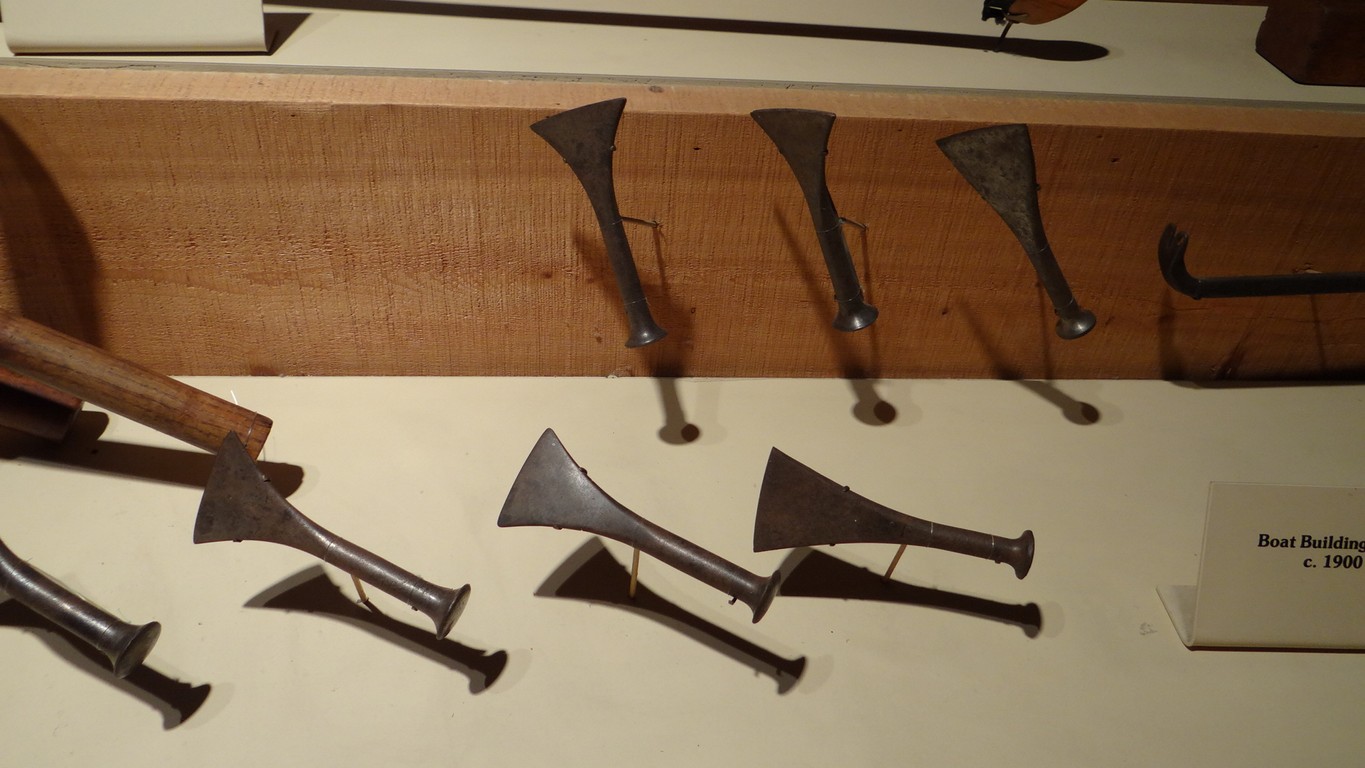
The museum is very thorough. It gives early Native American History, which we skipped because we’ve seen so much of it. Here is riverboat history. Above are boat builders tools.
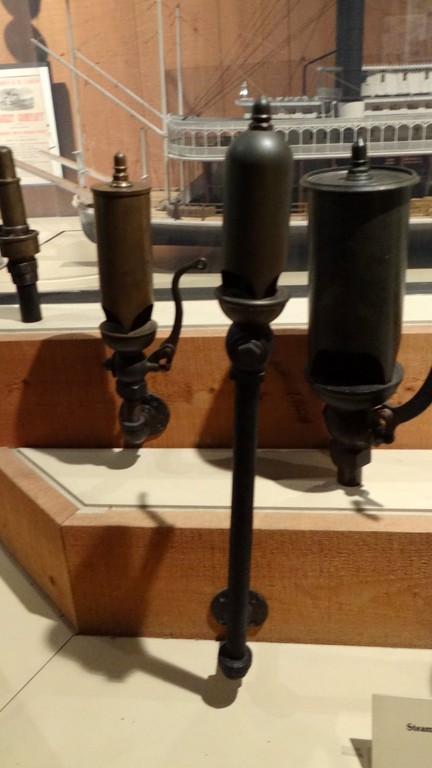
Steamboat whistles.

Inside a typical passengers berth on a steam-powered paddle wheeler. The river is dangerous. Awful accidents killed many. There was a film about disasters on the river. The saddest, the sinking of the Sultana.

A section on slavery and sharecroppers that built the south. And, another section on how the blues developed from the black churches and field hollers from slave days. It gives very interesting lyrics and clips of old-time music. Lyrics and music that Scott Joplin put on paper and saved. His own tragic story is here as well. Ragtime piano, opera, one of his that failed during his lifetime has been produced and put on stage to great acclaim.
I’m still struggling to walk a half-mile even with plenty of rest stops. We go this morning for a second acupuncture treatment. But, I see signs of wellness and hope.
Sunday, March 21, 2010
ANGOLA PRISON MUSEUM
Just outside the entrance to the largest penitentiary in the United States is an open to the public museum about this notorious prison. A sugar plantation in the 1700's, the slaves that worked here were mostly from Angola, thus the name.
In the late 1800's this plantation contracted prison labor and simply continued slavery in a different form. The abuses were so great, the state eventually bought three neighboring plantations and built the first facility. The abuses, however, didn't stop. Conditions were brutal. Mounted, rifle carrying trusty's, under threat for their own lives, ran the work crews. In one recorded incident, a trusty approached a "Red Hat" inmate and told him he would give him a chance to escape because they were from the same town and knew each others family. When the inmate declined, the trusty told him, they intend to kill you anyway.

No one was allowed to talk to or even look at a Red Hat inmate. In the punishment block, beds were cement with no blanket or padding, no toilet or water. Inmates were sometimes welded into their cells. In Angola, solitary confinement could last years, not months.
Another verified incident, an inmate was not allowed closer than 15 feet to an officer. The officer threw the inmate a tool he needed. When it landed too close, the inmate protested he couldn't pick it up. The officer assured him it was okay to move closer just this time. When he did, he was shot. A planned execution.
The beatings and mistreatment, poor food and horrible conditions were exposed and ordered cleaned up. Instead, the abuses continued well into the 1950's.

A typical cell without a window.

The showers had only cold water and were expected to serve 400 men. These conditions were not changed until 1955.

The long prod was used to motivate anyone working too slowly.
Reform began after 8 inmates slashed and severed their achilles tendons rendering themselves crippled and unable to work. The prison had no doctor but did have a nurse. When the incident became before a review board, Nurse Daughtry testified to the horrible conditions inside the prison and Governor Long ordered the place cleaned up once and for all.
While the past was brutal, reforms have brought humanizing changes to Angola. This prison will someday be an old folks home because of life sentences. The cost to warehouse human beings could send all of them to Harvard.

The inmates built this hearse and make satin lined wooden coffins for their dead to have a dignified funeral.

They have the rest of their lives to maintain sanity in captivity, a job of its own. Inmates here have jobs; they work in menial labor for 4 cents to 35 cents a day. They box, play ball, and compete in a once a year rodeo attended by 10,000 outside spectators. Its their high point of the year. They have a newspaper and a radio station. Laundry, print shop, bakery, and so on, their own micro city services.
Prisons are in some ways a cross section of our current society. Freddy Fender, Leadbelly, famous singers served time here. This is the only prison that had an inmate who secured a patent for an invention while incarcerated. In the gift shop, you can buy CD's of inmate songs. The Museum itself is very well done and gives unvarnished evidence of the brutal past and the more hopeful future. For more photos check my link:http://picasaweb.google.com/1579penn/32010Angola#
It currently holds approximately 5000 inmates, all men, and most of them lifers. At one time, any prisoner in Louisiana sentenced to 40 years was automatically moved to Angola. Officer Dixon, who runs the museum, told us "...all the bad guys come here."

en.wikipedia.org/wiki/Louisiana_State_Penitentiary

In the late 1800's this plantation contracted prison labor and simply continued slavery in a different form. The abuses were so great, the state eventually bought three neighboring plantations and built the first facility. The abuses, however, didn't stop. Conditions were brutal. Mounted, rifle carrying trusty's, under threat for their own lives, ran the work crews. In one recorded incident, a trusty approached a "Red Hat" inmate and told him he would give him a chance to escape because they were from the same town and knew each others family. When the inmate declined, the trusty told him, they intend to kill you anyway.

No one was allowed to talk to or even look at a Red Hat inmate. In the punishment block, beds were cement with no blanket or padding, no toilet or water. Inmates were sometimes welded into their cells. In Angola, solitary confinement could last years, not months.
Another verified incident, an inmate was not allowed closer than 15 feet to an officer. The officer threw the inmate a tool he needed. When it landed too close, the inmate protested he couldn't pick it up. The officer assured him it was okay to move closer just this time. When he did, he was shot. A planned execution.
The beatings and mistreatment, poor food and horrible conditions were exposed and ordered cleaned up. Instead, the abuses continued well into the 1950's.

A typical cell without a window.

The showers had only cold water and were expected to serve 400 men. These conditions were not changed until 1955.

The long prod was used to motivate anyone working too slowly.
Reform began after 8 inmates slashed and severed their achilles tendons rendering themselves crippled and unable to work. The prison had no doctor but did have a nurse. When the incident became before a review board, Nurse Daughtry testified to the horrible conditions inside the prison and Governor Long ordered the place cleaned up once and for all.
While the past was brutal, reforms have brought humanizing changes to Angola. This prison will someday be an old folks home because of life sentences. The cost to warehouse human beings could send all of them to Harvard.

The inmates built this hearse and make satin lined wooden coffins for their dead to have a dignified funeral.

They have the rest of their lives to maintain sanity in captivity, a job of its own. Inmates here have jobs; they work in menial labor for 4 cents to 35 cents a day. They box, play ball, and compete in a once a year rodeo attended by 10,000 outside spectators. Its their high point of the year. They have a newspaper and a radio station. Laundry, print shop, bakery, and so on, their own micro city services.
Prisons are in some ways a cross section of our current society. Freddy Fender, Leadbelly, famous singers served time here. This is the only prison that had an inmate who secured a patent for an invention while incarcerated. In the gift shop, you can buy CD's of inmate songs. The Museum itself is very well done and gives unvarnished evidence of the brutal past and the more hopeful future. For more photos check my link:http://picasaweb.google.com/1579penn/32010Angola#
It currently holds approximately 5000 inmates, all men, and most of them lifers. At one time, any prisoner in Louisiana sentenced to 40 years was automatically moved to Angola. Officer Dixon, who runs the museum, told us "...all the bad guys come here."

en.wikipedia.org/wiki/Louisiana_State_Penitentiary
Subscribe to:
Posts (Atom)