Sunday, March 14, 2010

SALUTE TO NFL CHAMP DEVERY HENDERSON AND OTHER STUFF.

If you've kind of forgotten the New Orleans Saints big victory in the Super Bowl this year, the people of Opelousa did not. For starters, I noticed this sign on a local business window-
 
We happened to be camped close to Devery's house where last night's party was long, and joyous and loud. But we didn't mind. So, today, we went to a local parade honoring Opelousas' Native Son, Devery Henderson. 
The admiring little kids, cheering their idol, were seeing the possibilities for their future as they watched Devery himself out on the street throwing beads to everyone. 


 He came up to an ederly woman sitting near us and placed beads around her neck. A talented player and a nice guy.
After the parade we ate at the Palace Cafe which is next door to Jim Bowie's boyhood home. A 300 year old oak tree stands in front of the place and is known as the Jim Bowie Tree. I paced it off and the roots alone spread 30 feet along the sidewalk.

 The visitor center has information about Bowie and his part in the battle at the Alamo.This set of knives, donated to their museum, was made from drawings of Bowie Knives. Jim's brother developed the knives, Jim made them famous.


Yams are grown in this part of Louisiana and celebrated with a Yambili every October with music, a recipe contest and good food. Getting ready for it in Vieux Village, I admired these painted guitars.


The promised recipe from Tony Chachere's book:  Yam Candle Cakes
 
 5 cups grated raw yams
4 1/2 cups sugar
1 tsp. vanilla
1 cup oil
4 eggs separated
1/2 tsp cinnaomon
2 1/2  tsps nutmeg
3 1/2 cups flour
2 tsps baking soda diluted with 2/3rds cup water
1 tsp. salt
2 cups chopped nuts
1/2 cup raisins
i cup cane syrup
1/2 cup coconut
8 to 10 empty soup cans.

Cook yams with 1 1/2 cups sugar about 3 minutes. Cool and add vanilla. Set aside. Cream remaining sugar with oil. Add egg yolks and spice. Sift some of the flour into a bowl and mix. Continue adding flour until all has been blended. Mix soda with water and add to batter along with salt, nuts, raisins, syrup and coconut.Stir in yam mixture. Beat egg whites and fold into batter. Pour batter into well greased cans, leaving 3/4 space for rising. Bake at 350* for one hour. Yields 60 servings.

Saturday, March 13, 2010

OPELOUSAS CROSSROADS

Opelousas, named for an Indian Tribe, was always a crossroads, a gumbo of cultures, trading, hunting, trapping, spices, music and food. Before Mardi Gras,  a couple we met at Mamou, from Targil Spice  Company of Opelousas, invited us to stop in and say hello!  They weren’t available, but we stopped and found retail spices, in large and small sizes; everything from a can cooker, butcher supplies, cookie cutters to boots. Boots? You need those boots to catch things in the swamp before you spice ‘em up and cook ‘em, doncha know. We left there with some Seasonall that has a picture of hot peppers on the package. Compliments of the nice folks at Targils.

Next stop, Tony Chachere’s, (say Sash-sherries), a hardworking character with a penchant for success. A pharmacist who made and sold his own cough syrups, bug spray and other products. He switched to insurance, was very successful and retired a rich man. A love of cooking,  with his own concoction of spices  that he brought with him everywhere he went,  turned  into a multimillion dollar business, putting together spices and convenient food packages. His was the first cookbook on Creole cooking and it sold 10,000 copies the first week  it came out. The company is huge and doesn’t do tours but Tanya Bellard, the Gourmet Sales, and Customer Service Manager said she would let us take pictures, for our blog.  When we arrived, she regaled us with wonderful stories about Tony Chaschere, his irrepressible personality, trying out his recipes on the staff at the company and always involving  everyone he met in food and spices, and fun.

We laughed out loud when we spotted a garbage can of popcorn and Tanya explained it was an environmentally friendly packing material for shipping their products and people call her and complain the popcorn is stale, or it didn’t have any seasoning, it was all broken…They now include a sticker that explains
 the popcorn is used for fill only.


  Three million pounds a year of raw materials go into their packaged food and spices. They sell 90 different  food items and spices plus Tony Chachere’s Cajun Country Cookbook. I’m going to print a recipe from the book tomorrow, but here is a list of things you’ll find in it:  Piquante Alligator Sauce, Roast Goose with Sauerkraut and Dumplings, Coot in Soy Sauce,  Pork Backbone Stew, Stuffed cucumbers, Broiled Frogs, Yam Candle Cakes, Japanese Chicken-Pork Barbeque, Irish Potato Casserole, and Hot Tamales. He left no cuisine untested.  www.tonytachere.com
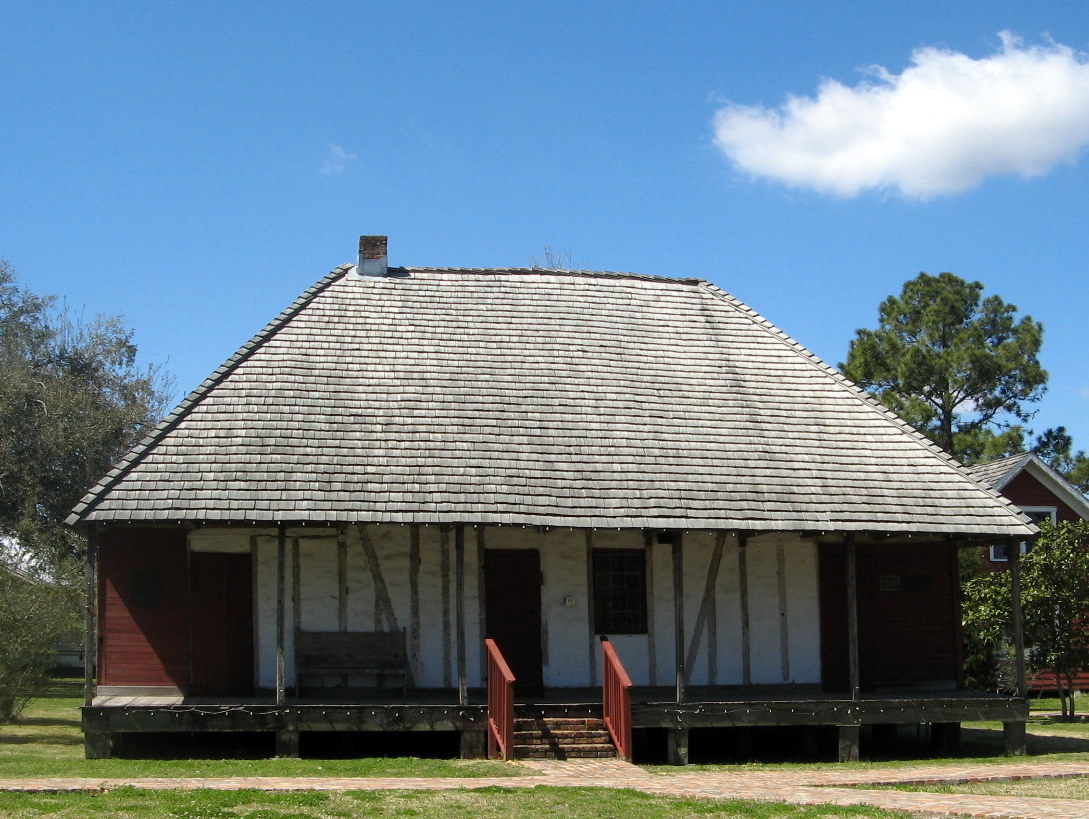
Opelousas made their visitor’s center into a little complex of  buildings called Le Vieux Village (The Old Village). They were donated and  moved here to be preserved. The buildings are typical  “of their time” from an 1890 outhouse to a mud and moss (boissage)  Creole House from 1791, below.

An African-American Methodist Church from 1948.

Also in this complex is the Orphan Train Museum. It started with a wealthy woman who heard her parents planning her funeral while she was in a coma. She prayed that if God allowed her to live she would dedicate her life to others. And, she did, as Sister Irene with the Sisters of Charity.  Immigrants were flowing into New York. Many could find no housing or jobs. Many died and left children. Babies were found on doorsteps, in alleys, toddlers were eating garbage on the streets.
Sister Irene rented a cottage. The very next day, a baby was found on the doorstep. The need was so great, the cottage grew, with help from her wealthy women friends, and eventually, the church and state, into a foundling hospital and orphanage.
There were so many children, the Foundling Home decided to reach out into Catholic Communities and ask for families to adopt or care for kids until they reached 18. It was the first foster care program in the United States.
In 1907, the first train full of orphans arrived, with numbers pinned to their clothing, to meet prospective families from Opelousas.  Many just wanted to have a child work for them as indentured servants.  Others wanted young children to raise as their own. The Foundling Society visited the families once a year to check up on them. Subsequent years, two more trains arrived in Opelousas.

While they wouldn’t allow pictures in the museum, volunteer Frank Lipari, active in forming the Opelousas Foundling Children Society,  is the son of a foundling father. There is only one known foundling in Louisiana still living, but their descendants are now choosing to tell their stories, which was once a source of shame. Frank’s Lipar’s father tried to find out what nationality he was, he found his endentured papers. He learned that  his birth  mother told her child’s name as Frank Reiger, and her own name as Schoencloster. He was born in the foundling hospital in 1903. Many foundlings didn’t even have that much information, not even records of their birth or their age.
At the first meeting of the Opelousas Foundling Society in 2003, two lifelong local friends met each other, neither had ever divulged that they were children of a foundling, such was the ingrained shame of their circumstances.
The Orphan trains reached  everywhere the railroad went over the years, placing 400,000 children in family situations.

Friday, March 12, 2010

SIGNS ALONG THE WAY


When traveling, you become conscious of signs that kind of bend your eye.  I find them clever, beautiful or just plain humorous.  The After Dark Cafe kind of suggests a bit of mystery. Its from the Marigny District of New Orleans.

St. Martinsville even has a street sign for an alley, which I thought was amusing, including the name. No history of why it is so named.

I’ve seen a number of neighborhood watch signs but never with a burglar graphic. Right to the point.

This humorous piece of work was located in a fresh fish shop that didn’t have any fresh fish, as it turned out.

Drive by pictures are less than readable, sometimes. But, in heavily Catholic Cajun Country, this sign struck me as funny. I guess there are malcontents in every walk of life.

This New Orleans establishment did a clever take-off on the Urban Cowboy.

I’m not sure if this is an eating establishment or a Jazz Club. But, in any case, it was a beautiful neon.
Being a perpetual tourist is hard work, as Jim likes to joke. Its nice to rest and do nothing but sit around and read. I’m learning a lot about Louisiana history and enjoying it very much. I bought four books about Louisiana and have finished two of them. What a great state.

Thursday, March 11, 2010

WHEN CAJUN WASN'T COOL!


“We were Cajuns when Cajun wasn’t cool,” said Mrs. Floyd Sonnier, above. “My husband was a fierce Cajun. “Floyd (now deceased) was known as the artist of the Cajuns. As a child, he picked up bits of charcoal from the fires and drew with them. Pen, ink, and charcoal brought to life the people and places he loved.

His grandparents above…his daughter as a child below. He published two books and has a website:
www.floydsonnier.com

Clarence Junior Martin is a famous accordion maker. He builds 150 a year, his nearest competitor and friend, Mark Savoy builds 26 and the next guy builds 7.   He was making accordions when accordion wasn’t cool, that is, anywhere but Cajun Country. His daughter Penny, explained how embarrassed people would be, and the flak and teasing they took because they played an “outdated” instrument! Shucks, now the small accordions Martin makes, (which sell for $2400 and up) are the centerpiece instrument of  Cajun and Zydeco Bands. Its called a melodeon and is most closely related to a harmonica. It arrived in Southern Louisiana with the German immigrants in the 1800’s. A former builder and cabinet maker, Martin started building accordions and never looked back.


Martin’s daughter, Penny is a school principle by day and plays guitar, triangle, and bass with the family.  Martin plays his favorite, steel guitar. “I can’t compete with my grandson, (on accordion) he’s better than me,” he proudly claims. Raised around his grandfather’s shop all his life,  Joel wasn’t interested in accordion until age 7.  He suddenly discovered its appeal when a kid his age was playing with one. Joel has two CD’s out and has written a couple songs.   ( Joel’s father, recently deceased, also played in the family band.)

Most of the great Cajun bands, (like Richard LeBouef above)  can be seen using  Martin accordions with his signature crawfish on the bellows. Don’t miss Martin Accordions if you visit Lafayette.


Another cool place was the only Borden’s retail ice cream shop in the United States. We stopped for a cool scoop because, Borden’s was always cool!

Wednesday, March 10, 2010

AN ART FIX, CONNECTIONS AND MAJORLY GOOD FOOD

I can't believe I used the slang word majorly, but, like, I'm from California, I can get away with it once, right? I needed an art fix and my partner isn't an art kinda guy. I insisted we had to go to the Blue Dog Cafe to see George Rodrigue's paintings. Everyone recognizes the Blue Dog. She's omniscient.

But lets start at the beginning.We stopped at the visitor's center first and voila! A wonderful sculpture called Miss Rose's Bar created by Al Lavergne stood on the grounds. This image is meant to commemorate the corner bar, where black folks (not allowed in Country Clubs or Recreation Centers,) found their social life in barbershops, churches and corner bars. He has a very interesting past you can read about, and see more of his art work at: http://allavergne.com/galleries/gallery_set.htm


 At the visitors center we learned about Pelicans On Parade and a location of several murals around town. So, off we went. Found some murals and a couple pelicans. Glittering glass caught my eye on Jefferson St. at Whoojoo Gallerie. Artists were working on a couple of huge glass pieces, but Richard Whiting's carved steel pieces caught my eye.


You can learn more about Richard Whiting at the web address below.


 http://www.plgart.com/Whiting/WhitingFrameset.htm

The Acadian Cultural Heritage Center #5, for us, was our next destination. It told the story in pictures of the Acadians hunting and trapping alligators, turtles, muskrats, and certain birds nearly to extinction. One cajun man replied, "We didn't know. We thought it was an endless bounty." He said his mother could skin 59 muskrats in an hour.


 Interesting and well done, early pictures of Acadians were compelling. Their close knit families, subsistence living from the land, and their independent way of life that made them happy with what they had.


Two couples we chanced to meet in the museum were full time RVers, as is my partner Jim. They recognized him, had heard him speak in Yuma, and had purchased his book.
Minutes before, two French cousins of mine, that I'd never met before, were also checking out their French Heritage at the museum.  Lawrence D'hon, a Lafayette local, and his cousin from Nova Scotia told me where to get more information about the D'hon family history, Prejean, Nova Scotia.   Serendipity!  


We flitted over to the Sans Souci Arts and Crafts Center then bee lined for the Blue Dog Cafe. Too late for lunch but open for Happy Hour, an affable bus boy routed us through the restaurant, allowed me to take pictures of the Blue Dogs, and sat us down at the bar for appetizers and beer. The Portabella Mushroom Pizza was, as they say, to die for.  I asked him for the recipe which Derek, the bartender supplied.


If that wasn't enough, Katie Bird-Brupbacher happened in. She is Louisiana Regional Sales manager for Domaine Napa Wine Company. I heard Napa and Two Buck Chuck and instantly went over to say hello. 


As I remember it, one of those years when the reds came in strong, wine prices were dropping.  Wine maker Charles Shaw sold a  million bottles of his Cab and Merlot to Trader Joe who put it on his shelves for $2 a bottle. Everyone began calling it Two Buck Chuck and I drank my share of it .

What more can you ask of a day than good art, serendipitous connections, and majorly good food and beer?
 You can see more pictures on the link below: 

http://picasaweb.google.com/1579penn/3910LafayetteLA#

Derek's recipe for Portobella Pizza:
"I don't know the amount of each ingredient, but, it contains, artichoke hearts, jack cheese, shrimp & crab broilled on a portobella and served with a butter, lemon, white wine sauce."
I love cajun food but this reminded me of home.

Tuesday, March 9, 2010

CROWLEY, LA. RICE AND CRAWFISH

Such a deal. You can grow a crop of rice, then while the fields are still flooded, you can "grow" crawfish, harvest, then put in soy beans or another crop of rice. Hey, that will put your kids through college. Now, huge dryers dry the rice so it can be stored for years and you don't have to sell until the price is right.  I never get tired of eating rice, or crawfish, so I thought I'd learn how this is done.

First we visited the Rice Interpretive Center in Crowley, a town that boasts 200 buildings on the National Historic Register. Included was Crowley Motors, an old Ford Dealership, that houses-get this-the history of Crowley, the Interpretive Center, a Ford Museum, and the J.D. Miller Recording Studio,  plus the Mayor's office and five other city offices. Whew!  All beautifully melded in this lovely, lovely restored building. We sat on the "still usable" freight elevator and watched a film. These people did a fantastic job on this place.


As you can see, the outside of the building is beautiful. The freight elevator below shows the wooden post and beam construction on the inside. No steel girders.


Tourism Coordinator, Charlotte Jeffers told us that Henry Ford shipped Model T's to Crowley Motor Company with two to a boxcar. Ford figured out how to stack them four to a box car,  balanced on the bumper with fenders and wheels removed, cutting his costs in half and putting the responsibility on the dealer to re-assemble the cars. The Model T was so successful, Ford made it unchanged for 19 years.
He ordered  Crowley rice packed in cypress boxes. The milled cypress wood made steering wheels for his special cars. Later, he farmed out the chassis to another company. He ordered the chassis shipped in an oak crate with a blueprint for how they would be made. The milled shipping crates became wooden flooring in his cars. And we thought recycling was a new idea!


The J.D. Miller Recording studio, once owned the building. We were able to press buttons and listen to Lazy Lester, Paul Simon,  blues, zydeco and cajun greats, music that led to Rock n" Roll hits like Kitty Wells "Honky Tonk Angels."


Now, the rice.  This is a did-you-know:  One rice grain produces about 300 grains? Rice is a swamp grass? There are 120,000 varieties of rice?  Rice growing provides wetlands for migratory birds? Unique to Louisiana is soaking the rice grains and planting them by airplane?
But, this isn't what I wanted to see. I wanted to get out into one of those old mud crawlers and see how they "plant" and harvest the crawfish.


 The mud crawler was there.


The rice field was full of crawfish pots like the one above.


It was rainy and muddy. We were led astray. We found ourselves in a parking lot where there was no turn around for the Motor Home, thanks to poor signage.  Finally the right parking lot, but it was full and muddy besides. We left the Crystal Rice Company without going out on a rice field in a mud crawler. Dang!  Maybe another day.For more pictures go to:
http://picasaweb.google.com/1579penn/37th8th20010Crowley#

Monday, March 8, 2010

PECAN RICE WHERE "RICE IS LIFE".


Conrad Rice Mill of New Iberia is 98 years old. It is the oldest continuous operating rice mill in the United States. Quite a feat for a relatively small family business competing with Uncle Ben, Cal-Rose and other brands.  Their rice products and seasonings are sold under the name Konriko.


The company bags rice in a plastic woven bag choosing it over gunny sacking. The machines at Conrad are still the belt driven equipment from 1912, now powered by electricity, replacing steam.  I was surprised that no one in the Louisiana rice industry, supposedly, had ever heard of a rice-straw bale house. At last count in Calaveras County, we have 13 rice-straw buildings. but it was all news to our hostess and others taking the tour. 
Having just visited a similar rice mill in Thailand, where nothing is wasted, I found Konriko only sells their rice bran for animal feed, the healthiest part of the rice. They toss the hulls or give it away for compost. Hmmm! There must be a message here! 


This funky ancient sewing machine sews those bags closed. Operated by hand, each bag is sewn across the top and sealed by a person, not a machine. Two more modern, smaller bag machines automatically fill and seal lightweight plastic bags in one operation.

When we arrived, we were escorted into a room for a slide show while our hostess cooked up some yellow saffron rice and wild pecan rice. Tasting these two blends of delicious rice with various spices, syrups and condiments sprinkled on them was new to me. Besides tasting, the store itself is worth a visit. Rough plank flooring, old wooden bins- a step back in time.
Their products are available just about anywhere, but one "secret sauce" was only available at the store. Everyone was raving about it. I liked it but the chipotle cajun seasoning was my favorite and I served up some Konriko Wild Pecan Rice for dinner last night. Good stuff! Friendly, accommodating staff. 


The wild pecan rice has no pecans in it. Customers gave it that name many years ago because it has a nutty flavor and was described as smelling like pecan. The rice is brown but treated in such a way  that it cooks as fast as white. Their products are available on-line as well.