I've always enjoyed watching the political conventions when the speaker would introduce the state representative, and he would identify himself as being from "...the Great State of Louisiana." Or the great state of Iowa, with that fun bit of fanfare and pride.
As I get ready to leave for home tomorrow to take care of business, that voice is speaking in my head and reminding me of what I now know from "...the Great State of Louisiana."
Folks along the way have asked me, what was your favorite place? What did you like most? Some places we visited are more or less interesting than others, but it is the whole experience, of slipping through small towns that seem to move you back in time about 40 years, or dallying along the many River Roads lined with bowers of giant oaks and stately mansions, or quaint subsistence shacks and rusty swamp water. The hundreds of bridges and canals and waterways and boats you can't get away from if you wanted to. Watching the season change in the swamps from no leaves, to feathery greens. Pulling into town and seeing another Washington St., another Main St., another Iberia St. Enjoying the background sounds of Cajun music from a nearby campsite as people play with their kids and roast marshmallows. The many unbelievably beautiful sunsets that traveling in a motor home allows you. From parish to parish, the difference in how they care for their roads, whether they keep things neat an clean, the signage, do they recycle. The cities all offer something different, all tout their special appeal, their food, and attractions. Each unique.
Then I thought to find a picture from each town we went through. Too difficult, too many to choose from. Suffice it to say I'm grateful to have had the opportunity to spend almost 8 weeks in one state and do and see whatever popped into view and I feel I know why each speaker says with such pride, its real, "...from the Great State of Louisiana!"
Showing posts with label traveler. Show all posts
Showing posts with label traveler. Show all posts
Monday, March 29, 2010


Thursday, March 11, 2010
WHEN CAJUN WASN'T COOL!

“We were Cajuns when Cajun wasn’t cool,” said Mrs. Floyd Sonnier, above. “My husband was a fierce Cajun. “Floyd (now deceased) was known as the artist of the Cajuns. As a child, he picked up bits of charcoal from the fires and drew with them. Pen, ink, and charcoal brought to life the people and places he loved.

His grandparents above…his daughter as a child below. He published two books and has a website:
www.floydsonnier.com

Clarence Junior Martin is a famous accordion maker. He builds 150 a year, his nearest competitor and friend, Mark Savoy builds 26 and the next guy builds 7. He was making accordions when accordion wasn’t cool, that is, anywhere but Cajun Country. His daughter Penny, explained how embarrassed people would be, and the flak and teasing they took because they played an “outdated” instrument! Shucks, now the small accordions Martin makes, (which sell for $2400 and up) are the centerpiece instrument of Cajun and Zydeco Bands. Its called a melodeon and is most closely related to a harmonica. It arrived in Southern Louisiana with the German immigrants in the 1800’s. A former builder and cabinet maker, Martin started building accordions and never looked back.


Martin’s daughter, Penny is a school principle by day and plays guitar, triangle, and bass with the family. Martin plays his favorite, steel guitar. “I can’t compete with my grandson, (on accordion) he’s better than me,” he proudly claims. Raised around his grandfather’s shop all his life, Joel wasn’t interested in accordion until age 7. He suddenly discovered its appeal when a kid his age was playing with one. Joel has two CD’s out and has written a couple songs. ( Joel’s father, recently deceased, also played in the family band.)

Most of the great Cajun bands, (like Richard LeBouef above) can be seen using Martin accordions with his signature crawfish on the bellows. Don’t miss Martin Accordions if you visit Lafayette.

Another cool place was the only Borden’s retail ice cream shop in the United States. We stopped for a cool scoop because, Borden’s was always cool!
Wednesday, March 10, 2010
AN ART FIX, CONNECTIONS AND MAJORLY GOOD FOOD
I can't believe I used the slang word majorly, but, like, I'm from California, I can get away with it once, right? I needed an art fix and my partner isn't an art kinda guy. I insisted we had to go to the Blue Dog Cafe to see George Rodrigue's paintings. Everyone recognizes the Blue Dog. She's omniscient.
But lets start at the beginning.We stopped at the visitor's center first and voila! A wonderful sculpture called Miss Rose's Bar created by Al Lavergne stood on the grounds. This image is meant to commemorate the corner bar, where black folks (not allowed in Country Clubs or Recreation Centers,) found their social life in barbershops, churches and corner bars. He has a very interesting past you can read about, and see more of his art work at: http://allavergne.com/galleries/gallery_set.htm

At the visitors center we learned about Pelicans On Parade and a location of several murals around town. So, off we went. Found some murals and a couple pelicans. Glittering glass caught my eye on Jefferson St. at Whoojoo Gallerie. Artists were working on a couple of huge glass pieces, but Richard Whiting's carved steel pieces caught my eye.


http://www.plgart.com/Whiting/WhitingFrameset.htm
The Acadian Cultural Heritage Center #5, for us, was our next destination. It told the story in pictures of the Acadians hunting and trapping alligators, turtles, muskrats, and certain birds nearly to extinction. One cajun man replied, "We didn't know. We thought it was an endless bounty." He said his mother could skin 59 muskrats in an hour.

Interesting and well done, early pictures of Acadians were compelling. Their close knit families, subsistence living from the land, and their independent way of life that made them happy with what they had.


Two couples we chanced to meet in the museum were full time RVers, as is my partner Jim. They recognized him, had heard him speak in Yuma, and had purchased his book.
Minutes before, two French cousins of mine, that I'd never met before, were also checking out their French Heritage at the museum. Lawrence D'hon, a Lafayette local, and his cousin from Nova Scotia told me where to get more information about the D'hon family history, Prejean, Nova Scotia. Serendipity!


http://picasaweb.google.com/1579penn/3910LafayetteLA#
Derek's recipe for Portobella Pizza:
"I don't know the amount of each ingredient, but, it contains, artichoke hearts, jack cheese, shrimp & crab broilled on a portobella and served with a butter, lemon, white wine sauce."
I love cajun food but this reminded me of home.
But lets start at the beginning.We stopped at the visitor's center first and voila! A wonderful sculpture called Miss Rose's Bar created by Al Lavergne stood on the grounds. This image is meant to commemorate the corner bar, where black folks (not allowed in Country Clubs or Recreation Centers,) found their social life in barbershops, churches and corner bars. He has a very interesting past you can read about, and see more of his art work at: http://allavergne.com/galleries/gallery_set.htm

At the visitors center we learned about Pelicans On Parade and a location of several murals around town. So, off we went. Found some murals and a couple pelicans. Glittering glass caught my eye on Jefferson St. at Whoojoo Gallerie. Artists were working on a couple of huge glass pieces, but Richard Whiting's carved steel pieces caught my eye.

You can learn more about Richard Whiting at the web address below.

The Acadian Cultural Heritage Center #5, for us, was our next destination. It told the story in pictures of the Acadians hunting and trapping alligators, turtles, muskrats, and certain birds nearly to extinction. One cajun man replied, "We didn't know. We thought it was an endless bounty." He said his mother could skin 59 muskrats in an hour.


Two couples we chanced to meet in the museum were full time RVers, as is my partner Jim. They recognized him, had heard him speak in Yuma, and had purchased his book.
Minutes before, two French cousins of mine, that I'd never met before, were also checking out their French Heritage at the museum. Lawrence D'hon, a Lafayette local, and his cousin from Nova Scotia told me where to get more information about the D'hon family history, Prejean, Nova Scotia. Serendipity!

We flitted over to the Sans Souci Arts and Crafts Center then bee lined for the Blue Dog Cafe. Too late for lunch but open for Happy Hour, an affable bus boy routed us through the restaurant, allowed me to take pictures of the Blue Dogs, and sat us down at the bar for appetizers and beer. The Portabella Mushroom Pizza was, as they say, to die for. I asked him for the recipe which Derek, the bartender supplied.

If that wasn't enough, Katie Bird-Brupbacher happened in. She is Louisiana Regional Sales manager for Domaine Napa Wine Company. I heard Napa and Two Buck Chuck and instantly went over to say hello.

As I remember it, one of those years when the reds came in strong, wine prices were dropping. Wine maker Charles Shaw sold a million bottles of his Cab and Merlot to Trader Joe who put it on his shelves for $2 a bottle. Everyone began calling it Two Buck Chuck and I drank my share of it .
What more can you ask of a day than good art, serendipitous connections, and majorly good food and beer?
You can see more pictures on the link below:
http://picasaweb.google.com/1579penn/3910LafayetteLA#
Derek's recipe for Portobella Pizza:
"I don't know the amount of each ingredient, but, it contains, artichoke hearts, jack cheese, shrimp & crab broilled on a portobella and served with a butter, lemon, white wine sauce."
I love cajun food but this reminded me of home.
Tuesday, March 9, 2010
CROWLEY, LA. RICE AND CRAWFISH
Such a deal. You can grow a crop of rice, then while the fields are still flooded, you can "grow" crawfish, harvest, then put in soy beans or another crop of rice. Hey, that will put your kids through college. Now, huge dryers dry the rice so it can be stored for years and you don't have to sell until the price is right. I never get tired of eating rice, or crawfish, so I thought I'd learn how this is done.
First we visited the Rice Interpretive Center in Crowley, a town that boasts 200 buildings on the National Historic Register. Included was Crowley Motors, an old Ford Dealership, that houses-get this-the history of Crowley, the Interpretive Center, a Ford Museum, and the J.D. Miller Recording Studio, plus the Mayor's office and five other city offices. Whew! All beautifully melded in this lovely, lovely restored building. We sat on the "still usable" freight elevator and watched a film. These people did a fantastic job on this place.

As you can see, the outside of the building is beautiful. The freight elevator below shows the wooden post and beam construction on the inside. No steel girders.


Tourism Coordinator, Charlotte Jeffers told us that Henry Ford shipped Model T's to Crowley Motor Company with two to a boxcar. Ford figured out how to stack them four to a box car, balanced on the bumper with fenders and wheels removed, cutting his costs in half and putting the responsibility on the dealer to re-assemble the cars. The Model T was so successful, Ford made it unchanged for 19 years.
He ordered Crowley rice packed in cypress boxes. The milled cypress wood made steering wheels for his special cars. Later, he farmed out the chassis to another company. He ordered the chassis shipped in an oak crate with a blueprint for how they would be made. The milled shipping crates became wooden flooring in his cars. And we thought recycling was a new idea!

The J.D. Miller Recording studio, once owned the building. We were able to press buttons and listen to Lazy Lester, Paul Simon, blues, zydeco and cajun greats, music that led to Rock n" Roll hits like Kitty Wells "Honky Tonk Angels."

Now, the rice. This is a did-you-know: One rice grain produces about 300 grains? Rice is a swamp grass? There are 120,000 varieties of rice? Rice growing provides wetlands for migratory birds? Unique to Louisiana is soaking the rice grains and planting them by airplane?
But, this isn't what I wanted to see. I wanted to get out into one of those old mud crawlers and see how they "plant" and harvest the crawfish.

The mud crawler was there.

The rice field was full of crawfish pots like the one above.
 It was rainy and muddy. We were led astray. We found ourselves in a parking lot where there was no turn around for the Motor Home, thanks to poor signage. Finally the right parking lot, but it was full and muddy besides. We left the Crystal Rice Company without going out on a rice field in a mud crawler. Dang! Maybe another day.For more pictures go to:
http://picasaweb.google.com/1579penn/37th8th20010Crowley#
First we visited the Rice Interpretive Center in Crowley, a town that boasts 200 buildings on the National Historic Register. Included was Crowley Motors, an old Ford Dealership, that houses-get this-the history of Crowley, the Interpretive Center, a Ford Museum, and the J.D. Miller Recording Studio, plus the Mayor's office and five other city offices. Whew! All beautifully melded in this lovely, lovely restored building. We sat on the "still usable" freight elevator and watched a film. These people did a fantastic job on this place.

As you can see, the outside of the building is beautiful. The freight elevator below shows the wooden post and beam construction on the inside. No steel girders.


Tourism Coordinator, Charlotte Jeffers told us that Henry Ford shipped Model T's to Crowley Motor Company with two to a boxcar. Ford figured out how to stack them four to a box car, balanced on the bumper with fenders and wheels removed, cutting his costs in half and putting the responsibility on the dealer to re-assemble the cars. The Model T was so successful, Ford made it unchanged for 19 years.
He ordered Crowley rice packed in cypress boxes. The milled cypress wood made steering wheels for his special cars. Later, he farmed out the chassis to another company. He ordered the chassis shipped in an oak crate with a blueprint for how they would be made. The milled shipping crates became wooden flooring in his cars. And we thought recycling was a new idea!

The J.D. Miller Recording studio, once owned the building. We were able to press buttons and listen to Lazy Lester, Paul Simon, blues, zydeco and cajun greats, music that led to Rock n" Roll hits like Kitty Wells "Honky Tonk Angels."

Now, the rice. This is a did-you-know: One rice grain produces about 300 grains? Rice is a swamp grass? There are 120,000 varieties of rice? Rice growing provides wetlands for migratory birds? Unique to Louisiana is soaking the rice grains and planting them by airplane?
But, this isn't what I wanted to see. I wanted to get out into one of those old mud crawlers and see how they "plant" and harvest the crawfish.

The mud crawler was there.

The rice field was full of crawfish pots like the one above.

http://picasaweb.google.com/1579penn/37th8th20010Crowley#
Monday, March 8, 2010
PECAN RICE WHERE "RICE IS LIFE".

Conrad Rice Mill of New Iberia is 98 years old. It is the oldest continuous operating rice mill in the United States. Quite a feat for a relatively small family business competing with Uncle Ben, Cal-Rose and other brands. Their rice products and seasonings are sold under the name Konriko.

The company bags rice in a plastic woven bag choosing it over gunny sacking. The machines at Conrad are still the belt driven equipment from 1912, now powered by electricity, replacing steam. I was surprised that no one in the Louisiana rice industry, supposedly, had ever heard of a rice-straw bale house. At last count in Calaveras County, we have 13 rice-straw buildings. but it was all news to our hostess and others taking the tour.
Having just visited a similar rice mill in Thailand, where nothing is wasted, I found Konriko only sells their rice bran for animal feed, the healthiest part of the rice. They toss the hulls or give it away for compost. Hmmm! There must be a message here!

This funky ancient sewing machine sews those bags closed. Operated by hand, each bag is sewn across the top and sealed by a person, not a machine. Two more modern, smaller bag machines automatically fill and seal lightweight plastic bags in one operation.
When we arrived, we were escorted into a room for a slide show while our hostess cooked up some yellow saffron rice and wild pecan rice. Tasting these two blends of delicious rice with various spices, syrups and condiments sprinkled on them was new to me. Besides tasting, the store itself is worth a visit. Rough plank flooring, old wooden bins- a step back in time.
Their products are available just about anywhere, but one "secret sauce" was only available at the store. Everyone was raving about it. I liked it but the chipotle cajun seasoning was my favorite and I served up some Konriko Wild Pecan Rice for dinner last night. Good stuff! Friendly, accommodating staff.


The wild pecan rice has no pecans in it. Customers gave it that name many years ago because it has a nutty flavor and was described as smelling like pecan. The rice is brown but treated in such a way that it cooks as fast as white. Their products are available on-line as well.
Sunday, March 7, 2010
THE GREAT 'GATOR RACE
The Great Gator Race is a street faire and festival-fundraiser for the Southern Mutual Health Association. A fun family event with food kiosks, a petting zoo, face painting and watching 5,000 numbered "alligators" make their way down river toward the finish line. People bet on their alligator and the winning entries receive prizes donated by local business people. A Caribbean Cruise was the first prize in this 7th annual race.


 The trustees load the alligators back in their tubs and the music, dancing, drinking and eating continue all day.
Timing your travels to catch a local event is hit and miss; catching the Gator Race turned out to be a fun, relaxing day. If you visit New Iberia, the Shadows On The Teche house and museum is a must see. We walked about town admiring some of the marvelous historic buildings to be found here. Friendly people are a staple in these small towns we've grown so fond of.

The band played...

...people danced, including kids later in the day.


Everyone was decked out in their bows and beads. Dylan Lewis, below had a handsome snake painted on his neck. His family once lived in Susanville, CA. his mother Rene, told me. I admired their alligator beads and Grandma Gaby Butler promptly gave me hers.

Everyone was enjoying the fun while the Sheriff's Department with six trustees put together the floating finish line.


With the starting help of the fire department's hoses, the alligators begin their journey from up river, a couple blocks away.

Each one is numbered. People buy a random numbered ticket and hope their entry wins one of the many prizes put up for the event. Most enjoyable was the commentator who called the race by the entrant's names: "...I see Hopping John, hopping to the side, oh, no! That's Banana Bunch, bunched up in the middle. Skinny Dipper is hiding in the back," and so on. He kept up a constant patter that kept us laughing. The names were such fun I was sure I'd remember some of the most outrageous, but alas. Humor is fleeting.

Timing your travels to catch a local event is hit and miss; catching the Gator Race turned out to be a fun, relaxing day. If you visit New Iberia, the Shadows On The Teche house and museum is a must see. We walked about town admiring some of the marvelous historic buildings to be found here. Friendly people are a staple in these small towns we've grown so fond of.
Wednesday, March 3, 2010
OFF SHORE WELL DRILLING RIG
“Mr. Charlie,” the first movable offshore oil rig, is located in Morgan City, LA. where we stopped to visit. Doc LaBorde worked in Morgan City for Kerr McKee Oil Industries. It was 1952, offshore drilling had begun in 1945. LaBorde observed that for every new well, a new drill had to be built. He wondered if it was possible to build a movable drill to take from well to well? Kerr McKee wasn’t interested. He quit and went to work on the idea. LaBorde passed the suggestion by the small Murphy Oil Company in Arkansas whose ramrod Charles Murphy, was known as “Mr. Charlie.” He helped finance it and LaBorde named the rig for him.
LaBorde took it to New Orleans for Shell Oil in 1954, and the danged thing worked, much to everyone’s surprise. The whole oil industry had someone out watching Mr. Charlie’s debut. It changed the oil industry forever.

Mr. Charlie drilled offshore wells continuously until it was retired in 1986. Mr. Charlie now serves as a rig museum and training station for young well drillers and toolpushers. Rig workers are transported out to the well, work 12 hour shifts (no days off) for 14 days before they are returned to land, home, family, stores, movies, etc. Isolation is a special consideration that will only be worth it to a handful of people.

On site, next to the drilling rig, sits this production station (below) that replaces the drilling rig so it can move on to the next job. From this platform the pumps keep the crude moving into pipelines to shore or to tanks on barges, or to holding tanks in specially built oil tankers.

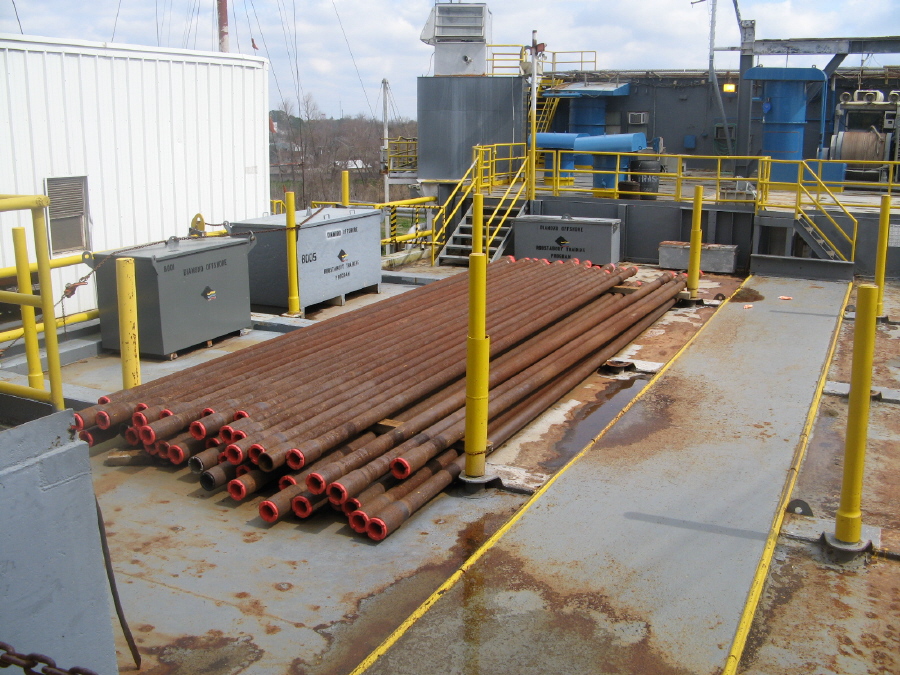
The 32 foot long pipes are racked right next to the drill head. They are threaded onto the drill and screwed together. As the drill drives them into the ground, another is added an so on.


Virgil Allen, our very knowledgeable tour guide demonstrates the drill position, and explained thoroughly how it worked.

After the pipe is threaded onto the drill head, this huge wrench clamps it tight. On older rigs like Charlie, most of these tools were operated manually. Newer rigs are computerized and one man can operate most of the drilling functions from behind a glass wall. I was surprised to learn that the oil companies who own the leases rent the drilling rigs. Some rent for $80,000 to a million dollars a day which means that rig must be put to good use while they have it. The rig companies plan to extend the working time from 14 days out to 21 with so many automated tasks. Its experimental, to see if they can still maintain a good human safety record, keep production humming and lower their transportation costs. Plus, the pipes will be 45 feet long, rather than 32 feet.

Another aspect of oil drilling is a special “mud”. An onshore plant grinds rock to a fine powder. It is then mixed with mi-gel, detergent, chloride and other chemicals and water to produce a mud that keeps the drill from getting too hot, it controls the flow, helps slow pressure and has number of other functions. This mud is used to bring up all the metal filings or any foreign substance that results from drilling. It is screened, packaged and returned to shore so the process is safe and environmentally sound. All waste is returned to shore. Nothing gets dumped into the ocean. The mud room above also helps ballast the rig in the center with its weight. I learned a lot about oil drilling in a very real way.
On the human side, the rig has a slew of washing machines to wash their dirty clothing at the end of each shift. It has a recreation room with television and a cafeteria that serves the crew 4 meals a day. Once clean-up is finished, the workers can make sandwiches, snack on ice cream or anything they like. Seafood is served on Friday, Steak on Sat. All you can eat. Good food is compensation for living on an oil rig. A rig like Mister Charlie used a staff of about 180 people to run things on the rig, transport, and support services on land. On the newer rigs, people are fewer but the sophistication is mind boggling. Check it out at:
http://www.rigmuseum.com
LaBorde took it to New Orleans for Shell Oil in 1954, and the danged thing worked, much to everyone’s surprise. The whole oil industry had someone out watching Mr. Charlie’s debut. It changed the oil industry forever.

Mr. Charlie drilled offshore wells continuously until it was retired in 1986. Mr. Charlie now serves as a rig museum and training station for young well drillers and toolpushers. Rig workers are transported out to the well, work 12 hour shifts (no days off) for 14 days before they are returned to land, home, family, stores, movies, etc. Isolation is a special consideration that will only be worth it to a handful of people.

On site, next to the drilling rig, sits this production station (below) that replaces the drilling rig so it can move on to the next job. From this platform the pumps keep the crude moving into pipelines to shore or to tanks on barges, or to holding tanks in specially built oil tankers.

The 32 foot long pipes are racked right next to the drill head. They are threaded onto the drill and screwed together. As the drill drives them into the ground, another is added an so on.
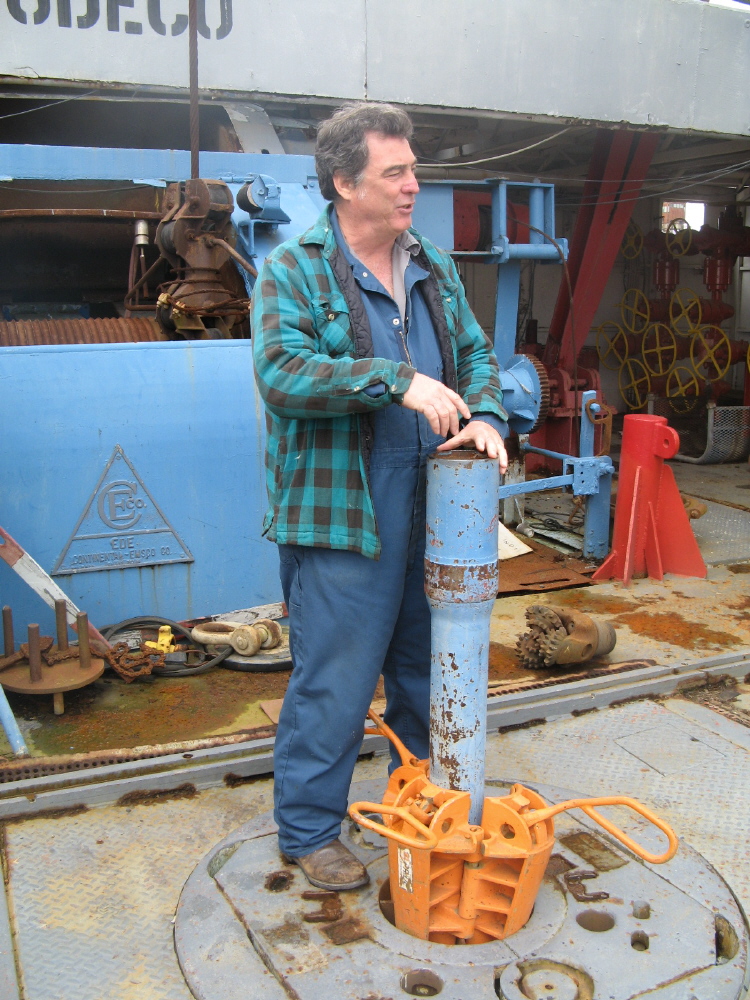
Virgil Allen, our very knowledgeable tour guide demonstrates the drill position, and explained thoroughly how it worked.

After the pipe is threaded onto the drill head, this huge wrench clamps it tight. On older rigs like Charlie, most of these tools were operated manually. Newer rigs are computerized and one man can operate most of the drilling functions from behind a glass wall. I was surprised to learn that the oil companies who own the leases rent the drilling rigs. Some rent for $80,000 to a million dollars a day which means that rig must be put to good use while they have it. The rig companies plan to extend the working time from 14 days out to 21 with so many automated tasks. Its experimental, to see if they can still maintain a good human safety record, keep production humming and lower their transportation costs. Plus, the pipes will be 45 feet long, rather than 32 feet.

Another aspect of oil drilling is a special “mud”. An onshore plant grinds rock to a fine powder. It is then mixed with mi-gel, detergent, chloride and other chemicals and water to produce a mud that keeps the drill from getting too hot, it controls the flow, helps slow pressure and has number of other functions. This mud is used to bring up all the metal filings or any foreign substance that results from drilling. It is screened, packaged and returned to shore so the process is safe and environmentally sound. All waste is returned to shore. Nothing gets dumped into the ocean. The mud room above also helps ballast the rig in the center with its weight. I learned a lot about oil drilling in a very real way.
On the human side, the rig has a slew of washing machines to wash their dirty clothing at the end of each shift. It has a recreation room with television and a cafeteria that serves the crew 4 meals a day. Once clean-up is finished, the workers can make sandwiches, snack on ice cream or anything they like. Seafood is served on Friday, Steak on Sat. All you can eat. Good food is compensation for living on an oil rig. A rig like Mister Charlie used a staff of about 180 people to run things on the rig, transport, and support services on land. On the newer rigs, people are fewer but the sophistication is mind boggling. Check it out at:
http://www.rigmuseum.com
Tuesday, March 2, 2010
ACADIAN HERITAGE
Monday was moving day, from Houma, north west to Thibodaux. Expecting rain, we made it our destination and plan to visit one of a series of National Parks, the Acadian Wetlands Cultural Center here.
The French settled a place in Nova Scotia in the 1600’s and called it Acadie. These Acadians were expelled by the Brits in the 1700’s. Many of them ended up in Louisiana. Called cajuns, every aspect of life in Southern Louisiana has been influenced by the Acadians, and the polyglot of migrants that settled here.
When we visited Eunice, I was enthralled by cajun culture without making a connection to my own background. Across the state, this unique mix of French speaking peoples and their exciting music captivated and excited my interest.
Jim and I have often discussed the similarities in our upbringing, church, religion, food, attitudes and games from our similar French backgrounds. My maternal grandparents refused to teach their children French, claiming, instead, it was best to assimilate. Until I visited this museum, I didn’t realize that assimilation came by threat and laws passed in 1916 banning the French language. Children were required to attend American schools and punished if they spoke French. Children in school had to wet their pants if they could not ask to go to the bathroom in English. They were humiliated and beaten if they were caught speaking French to each other. Suddenly, I understood, rather than blamed my grandparents, for what I considered a regrettable decision, that my mother and her brothers and sisters never learned French. Now I understand why my grandmother would refuse to teach me even a word of French when I would ask. Jim bought a tape for his family to learn about their culture and I bought a book for mine.

The Acadians were self sufficient in Nova Scotia for 100 years and had only remembered ties to France when they were expelled. In Louisiana, they started anew and learned to use cornbread rather than wheat. To weave with cotton, rather than wool.

They did every type of work they could, harvesting spanish moss, fishing, hunting, and trapping while adjusting to the changing terrain of a flooding, sculpting river.

Their music and strong sense of family sustained them just as it had in Nova Scotia. (The washboard above was turned into a musical instrument and is still used today.)

The Parrish here is named Terrebonne, French for good earth.
We exited the facility into the face of the beginning squall predicted for this area.

In minutes, it was pounding and rocking the motor home, cascading in sheets off a building next to us and formed a veritable lake in front of our warm and cozy tube.


Subscribe to:
Posts (Atom)