Timing your travels to catch a local event is hit and miss; catching the Gator Race turned out to be a fun, relaxing day. If you visit New Iberia, the Shadows On The Teche house and museum is a must see. We walked about town admiring some of the marvelous historic buildings to be found here. Friendly people are a staple in these small towns we've grown so fond of.
Sunday, March 7, 2010
THE GREAT 'GATOR RACE
Timing your travels to catch a local event is hit and miss; catching the Gator Race turned out to be a fun, relaxing day. If you visit New Iberia, the Shadows On The Teche house and museum is a must see. We walked about town admiring some of the marvelous historic buildings to be found here. Friendly people are a staple in these small towns we've grown so fond of.
Saturday, March 6, 2010
ST. MARTINSVILLE, LOUISIANA
The tree above is called the Evangeline Tree, supposedly where Emma LaBiche met her long separated love after the deportation. And, supposedly the most photographed tree in the world. Hmmm! I live by Calaveras Big Trees State Park and I’m doubting that “factoid.”
The garden above holds a replica of the deportation cross erected in Nova Scotia, the coats of arms of the initial families that rekindled life here, and a wall of names of all the families and their descendants that settled here. Jim and I both looked for our known family names since we both have French Canadian ancestors. I found several from my genealogy.
The St. Martinsville Catholic Church is on the National Historic Registry, unchanged and unique. Its hold over the community again makes one glad that our forefathers saw fit to separate church and state.
This site also houses an African American Museum that tells the history of slavery and accomplishments of people of color during the 1800’s.
This musical instrument was made of cowhide and common twine. Enslaved people were encouraged to sing and chant to form some sense of community and stave off fear of their predicament as they were herded like animals to their destination.
Most enslaved Africans were sold by other Africans dealing in human flesh and came from the West Coast of Africa in what is now known as Senegal. The slavers from France had the lowest mortality rate on their ships; the Brits, the highest. Since 2001 France has commemorated the abolition of slavery on May 10th each year. A group called the Shackles Of Memory Alliance are attempting to get other countries to do the same and honor the 15 million Africans sold into slavery.
Before the Civil War, free people of color enjoyed many of the rights of whites. They worked hard, bought plantations, (in some cases owned slaves of their own, but more often to free relatives and friends.) They operated their own businesses and regularly won judgments against whites in court. After the Civil war, all of those rights disappeared for “elite” people of color. Laws on the books from then to the 1960’s repressed all people of color.
The town of New Iberia has an old historic Rice Mill that we also visited. More about it tomorrow.
Friday, March 5, 2010
AVERY ISLAND'S RICHES
The process is pretty simple. The peppers at the peak of ripeness are ground with local salt and aged in barrels. The barrels have holes drilled in the top, covered with a thick layer of salt, and the fermentation process takes about 3 years. When its removed, the mixture is stirred for 28 days with vinegar before bottling.
One grandson, E.A. McIlhenny, a botanist, saved egrets from extinction. The birds were slaughtered by the millions by hat making hunters for their beautiful feathers. His breeding grounds today, used by egrets and herons, attracts 10,000 birds to the nesting platforms he built for them. The bird preserve and botanical garden E.A. McIlhenny built, hauls in tons of twigs for the birds nesting materials each year since their isn't enough natural growth to support them on the island.
The egrets recognize there is not enough food on the island to support them and their babies so they do not eat any food from the island. They range far and wide over the bayous to feed leaving the island food for the weaker hatchlings.
The Jungle Garden and bird sanctuary is open all year for tourists. Over 1,000 different specimens of camellias, many bamboos, shrubs, and plants from all over the world are kept here. Old natural oaks dominate the scene along with man made lagoons that attract much wildlife. Beauty is the result.
Thursday, March 4, 2010
GEORGE WASHINGTON DIDN'T SLEEP HERE.
Entering Franklin, we discovered old moss drenched oaks, beautiful antebellum homes and historic buildings.
It was time to have a look around. We talked to a number of friendly people around town. One woman told us we were looking at the back door of the house above. The old mansion's front entrance faced the bayou where all transportation took place when it was built.
Aldon was a fountain of information. Years ago, a local bank was bought and turned into a house. Davey Crockett spent a night there. To our question, he answered, "No, George Washington didn't get this far south."
This gorgeous old clock "...has been here as long as I have," from a local who told us she, without her mother knowing, once drank at the bar where the Nights of Camelia had their meetings. She reminded us that the Nights of Camelia were the forerunners of the Ku Klux Klan. The Confederacy died hard, and markers about town, the Battle of Irish Bend, local notables, etc. refer to the Confederate Soldiers and "The Federals" not the Union Army.
Here, the updated equipment is old. Oscar LeJuene's descendants still operate the bakery which was built in 1884. The building is on the National Historic Registry. I took many pictures that can be seen by clicking the link below.
http://picasaweb.google.com/1579penn/FranklinJeanrette32010#
Wednesday, March 3, 2010
OFF SHORE WELL DRILLING RIG
LaBorde took it to New Orleans for Shell Oil in 1954, and the danged thing worked, much to everyone’s surprise. The whole oil industry had someone out watching Mr. Charlie’s debut. It changed the oil industry forever.
Mr. Charlie drilled offshore wells continuously until it was retired in 1986. Mr. Charlie now serves as a rig museum and training station for young well drillers and toolpushers. Rig workers are transported out to the well, work 12 hour shifts (no days off) for 14 days before they are returned to land, home, family, stores, movies, etc. Isolation is a special consideration that will only be worth it to a handful of people.
On site, next to the drilling rig, sits this production station (below) that replaces the drilling rig so it can move on to the next job. From this platform the pumps keep the crude moving into pipelines to shore or to tanks on barges, or to holding tanks in specially built oil tankers.
The 32 foot long pipes are racked right next to the drill head. They are threaded onto the drill and screwed together. As the drill drives them into the ground, another is added an so on.
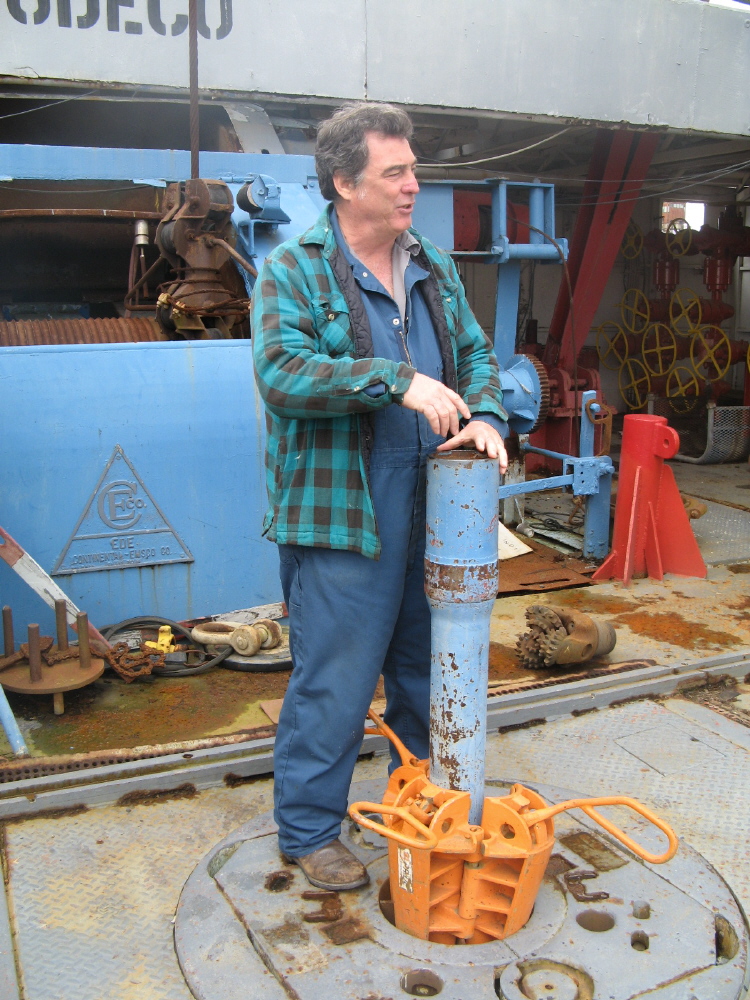
Virgil Allen, our very knowledgeable tour guide demonstrates the drill position, and explained thoroughly how it worked.
After the pipe is threaded onto the drill head, this huge wrench clamps it tight. On older rigs like Charlie, most of these tools were operated manually. Newer rigs are computerized and one man can operate most of the drilling functions from behind a glass wall. I was surprised to learn that the oil companies who own the leases rent the drilling rigs. Some rent for $80,000 to a million dollars a day which means that rig must be put to good use while they have it. The rig companies plan to extend the working time from 14 days out to 21 with so many automated tasks. Its experimental, to see if they can still maintain a good human safety record, keep production humming and lower their transportation costs. Plus, the pipes will be 45 feet long, rather than 32 feet.
Another aspect of oil drilling is a special “mud”. An onshore plant grinds rock to a fine powder. It is then mixed with mi-gel, detergent, chloride and other chemicals and water to produce a mud that keeps the drill from getting too hot, it controls the flow, helps slow pressure and has number of other functions. This mud is used to bring up all the metal filings or any foreign substance that results from drilling. It is screened, packaged and returned to shore so the process is safe and environmentally sound. All waste is returned to shore. Nothing gets dumped into the ocean. The mud room above also helps ballast the rig in the center with its weight. I learned a lot about oil drilling in a very real way.
On the human side, the rig has a slew of washing machines to wash their dirty clothing at the end of each shift. It has a recreation room with television and a cafeteria that serves the crew 4 meals a day. Once clean-up is finished, the workers can make sandwiches, snack on ice cream or anything they like. Seafood is served on Friday, Steak on Sat. All you can eat. Good food is compensation for living on an oil rig. A rig like Mister Charlie used a staff of about 180 people to run things on the rig, transport, and support services on land. On the newer rigs, people are fewer but the sophistication is mind boggling. Check it out at:
http://www.rigmuseum.com
Tuesday, March 2, 2010
ACADIAN HERITAGE
Monday was moving day, from Houma, north west to Thibodaux. Expecting rain, we made it our destination and plan to visit one of a series of National Parks, the Acadian Wetlands Cultural Center here.
The French settled a place in Nova Scotia in the 1600’s and called it Acadie. These Acadians were expelled by the Brits in the 1700’s. Many of them ended up in Louisiana. Called cajuns, every aspect of life in Southern Louisiana has been influenced by the Acadians, and the polyglot of migrants that settled here.
When we visited Eunice, I was enthralled by cajun culture without making a connection to my own background. Across the state, this unique mix of French speaking peoples and their exciting music captivated and excited my interest.
Jim and I have often discussed the similarities in our upbringing, church, religion, food, attitudes and games from our similar French backgrounds. My maternal grandparents refused to teach their children French, claiming, instead, it was best to assimilate. Until I visited this museum, I didn’t realize that assimilation came by threat and laws passed in 1916 banning the French language. Children were required to attend American schools and punished if they spoke French. Children in school had to wet their pants if they could not ask to go to the bathroom in English. They were humiliated and beaten if they were caught speaking French to each other. Suddenly, I understood, rather than blamed my grandparents, for what I considered a regrettable decision, that my mother and her brothers and sisters never learned French. Now I understand why my grandmother would refuse to teach me even a word of French when I would ask. Jim bought a tape for his family to learn about their culture and I bought a book for mine.
The Acadians were self sufficient in Nova Scotia for 100 years and had only remembered ties to France when they were expelled. In Louisiana, they started anew and learned to use cornbread rather than wheat. To weave with cotton, rather than wool.
They did every type of work they could, harvesting spanish moss, fishing, hunting, and trapping while adjusting to the changing terrain of a flooding, sculpting river.
Their music and strong sense of family sustained them just as it had in Nova Scotia. (The washboard above was turned into a musical instrument and is still used today.)
The Parrish here is named Terrebonne, French for good earth.
We exited the facility into the face of the beginning squall predicted for this area.
In minutes, it was pounding and rocking the motor home, cascading in sheets off a building next to us and formed a veritable lake in front of our warm and cozy tube.
Monday, March 1, 2010
ALLIGATOR SWAMP TOUR
Alligator Annie’s Swamp Tours were “famous” in this area. (We are in Houma.) She was the only woman, and one of the first to offer alligator tours. Annie died in 2004. Her son John now does the tours. They begin at a restaurant called Bayou Delight, on Highway 182, where many pictures of Annie, with alligators and guests,
cover the walls. Stories are many that she was a remarkable woman.
We set out with John knowing the water was unusually high; much of the bird feeding grounds are flooded and the alligators at this time of year lay pretty low. In other words, a good chance we wouldn’t see any.
No more than spoken when a small alligator was spotted right across from the restaurant.
An hour out, John spotted this nice fellow…
… and this crusty older specimen. John joked that he has been accused of putting out a rubber alligator, so he is always thankful when they move. They tend to look like a bunch of cut up rubber tires; mostly inactive and motionless in the water during this cold time of year. Nearby was another small alligator almost invisible in the grasses and floating plants.
Less foliage in the swamp provides a better view of the birds. John nicknamed the ibis above “lady slipper”. She looks like she is about to dance.
This little blue egret was enjoying a fine crawfish or crab lunch when we spotted him.
Spanish moss hangs in great gray swathes, the cypress and other trees are stark ghosts without leaves, but even so, there is color and beauty of a different kind with the red maple seeding; large exposed tracts of water with reflections from the banks.
Great gray egrets, 22 ibis, (heavy birds) roosting in the top of one tree, many turtles sunning on logs, a bald eagle, snake birds, ducks, cormorants, pelicans and a panapoly of huge graceful birds in flight, all provided us a memorable afternoon. One fellow on the tour failed to duck his head when we went under a low bridge, his tour will be even more memorable. There were two people from London, three from France, Jim and I and six members of the Diethrich Family.
After the tour, we enjoyed lunch with JoAnn & Jim Diethrich of Stuke Nursery Co. from Gridley, CA. They were on the tour with their son, Rob, and wife Christa and grandchildren, who live in the area. JoAnn is a conservative agriculture activist, a talented speaker, and we hope we’ve convinced her to become a blogger. Watch for it.
Sunday, February 28, 2010
SUN AND MOON
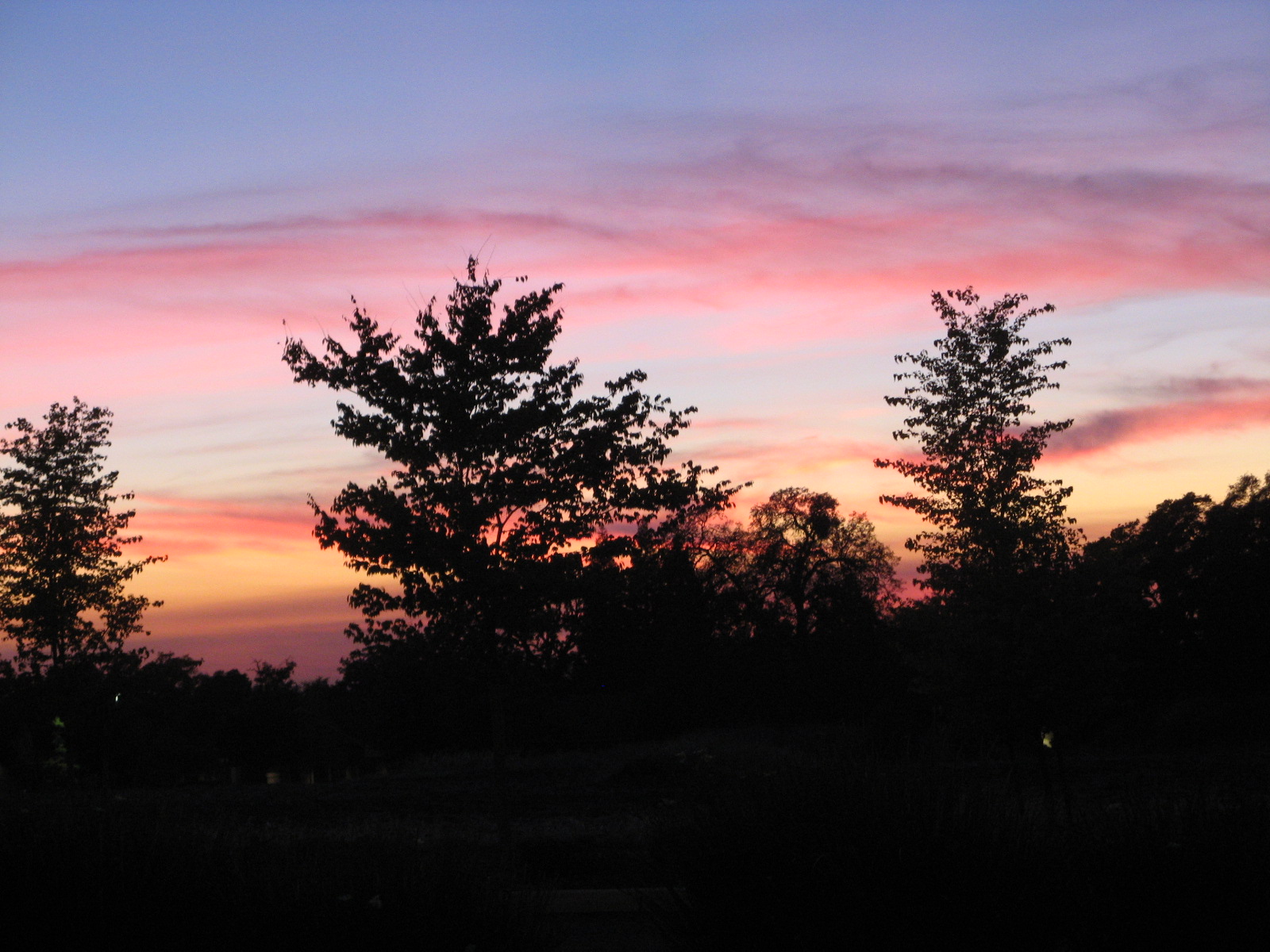
One benefit of being a road gypsy, we manage to see sunrise and sunset almost every day even during the summer. We took a moonlight walk last night and concluded that photographing the moon is tough. You need a tripod and a time lapse option on your camera. Sunsets are pretty easy. The one above was taken in Monroe, WA. The one below, too, along the Skykomish River.
The Yuma Crossing Bridge. We road ten miles on our bikes to get this photo.
This one was at Cypress Cove last week, Venice Louisiana. Winter sunsets are rarer with a lot of color.
Yesterday was chore day. The Bronco still has remnants of some awful grit we picked up in Venice, even after a car wash. The Motor Home is waiting. We found the Health food store closed-for good. Louisianan's enjoy deep fried shrimp and oyster Poboys. They seem less concerned about diet than where I live. People seem happier here, too. Could there be a connection?