I thought I’d return to China 2006 with my guests gone for a week.
I’m remembering the wonderful buffet breakfasts on our cruise ship.
Everything you can imagine. Cold cuts for German tourists, bangors for
the English, sushi for the Japanese, bacon and eggs that American’s
prefer, and so on.

Chinese tourists eat congee. Wanning Determan, the Chinese wife of Judge Dean Determan, was born in China. She teaches us about typical Chinese breakfast. The average Chinese household eats congee which is a gruel similar to cream of wheat only made from several grains, absent wheat or oats or rice. It was kind of bland and sticky and I’m the only one who will try it. The blandness is offset by the condiments of hot spicy pickles, or salty vinegar pickles, made from an assortment of Chinese vegetables, and then adding a small piece of dried fish. It wasn’t exactly tasty to my Western palate, but obviously nourishing; the pickles were good.

Also on the trip was Tedd and Audrey Determan. They were a fun foursome and have a fascinating family history. When Poland was overtaken by Nazi Germany and Communist Russia in 1939, word spread quickly through the land. When the boys grandmother got the news, she quickly took Tedd, who was only two years old, (Dean was not home at the moment,) and she broke both of his little fingers with a hammer and then reported to the Priest what she had done to prove that he was a true heir to the Polish throne. “I had heard the story and barely remembered the incident and didn’t give it much thought, except when my fingers bother me,” explained Tedd, ” until I visited my old village in Poland. A priest knelt and kissed my hands when he realized he was in the presence of the true prince. But, our family had no desire, nor inclination to make any such claims. Besides, Dean is older than me and is the first heir, he just didn’t get the painful “proof” that I did.”
After breakfast, we learned basic Tai Chi and watched a demonstration of acupuncture, and one procedure where a suction cup is used, and scrapings of the skin on the affected part is done. The suction cup treatment looked kind of painful and it left a huge red welt on the volunteer’s back, but he insisted it felt good. The discussion about Chinese medicine and healing reminded me that in town one day, a healer merely touched Michele Maurer and told her she had neck problems, which Michele declared was true. The healer spread some oil on her neck and Michele said it felt great and practically everyone on the tour bought some of the oil. (Not me.)

As we cruise the main Yangtze Gorge, we come across a partially flooded village that has a sign reading 156, the height of the backed up water just reaching 156 meters.

Our guide tells us we will off-load to a sampan for a view of a tributary gorge, one of three that will be flooded by the dam.

This sampan is much more to our liking than the big ship just lumbering along.
A Chinese man perches in a rudimentary rock dwelling with his camera hoping the boat will stop and allow him to take our picture which he will develop and try to sell to us down the line. Our boat does not stop.

This group has a portable radio and they sing for us, hoping we will toss them a few coins. Our boat does not stop, but everyone here scrambles to make a living. The Chinese government has not exactly found occupations for all of those displaced by the flooding gorges, we are told. Promises, promises.

The boatman wears rain gear made of a mat of rushes of some type.

Our tour members enjoyed trying on the rain gear and attempting to paddle the boat up the gorge from a standing position.
Tomorrow, the controversial dam.

Chinese tourists eat congee. Wanning Determan, the Chinese wife of Judge Dean Determan, was born in China. She teaches us about typical Chinese breakfast. The average Chinese household eats congee which is a gruel similar to cream of wheat only made from several grains, absent wheat or oats or rice. It was kind of bland and sticky and I’m the only one who will try it. The blandness is offset by the condiments of hot spicy pickles, or salty vinegar pickles, made from an assortment of Chinese vegetables, and then adding a small piece of dried fish. It wasn’t exactly tasty to my Western palate, but obviously nourishing; the pickles were good.

Also on the trip was Tedd and Audrey Determan. They were a fun foursome and have a fascinating family history. When Poland was overtaken by Nazi Germany and Communist Russia in 1939, word spread quickly through the land. When the boys grandmother got the news, she quickly took Tedd, who was only two years old, (Dean was not home at the moment,) and she broke both of his little fingers with a hammer and then reported to the Priest what she had done to prove that he was a true heir to the Polish throne. “I had heard the story and barely remembered the incident and didn’t give it much thought, except when my fingers bother me,” explained Tedd, ” until I visited my old village in Poland. A priest knelt and kissed my hands when he realized he was in the presence of the true prince. But, our family had no desire, nor inclination to make any such claims. Besides, Dean is older than me and is the first heir, he just didn’t get the painful “proof” that I did.”
After breakfast, we learned basic Tai Chi and watched a demonstration of acupuncture, and one procedure where a suction cup is used, and scrapings of the skin on the affected part is done. The suction cup treatment looked kind of painful and it left a huge red welt on the volunteer’s back, but he insisted it felt good. The discussion about Chinese medicine and healing reminded me that in town one day, a healer merely touched Michele Maurer and told her she had neck problems, which Michele declared was true. The healer spread some oil on her neck and Michele said it felt great and practically everyone on the tour bought some of the oil. (Not me.)
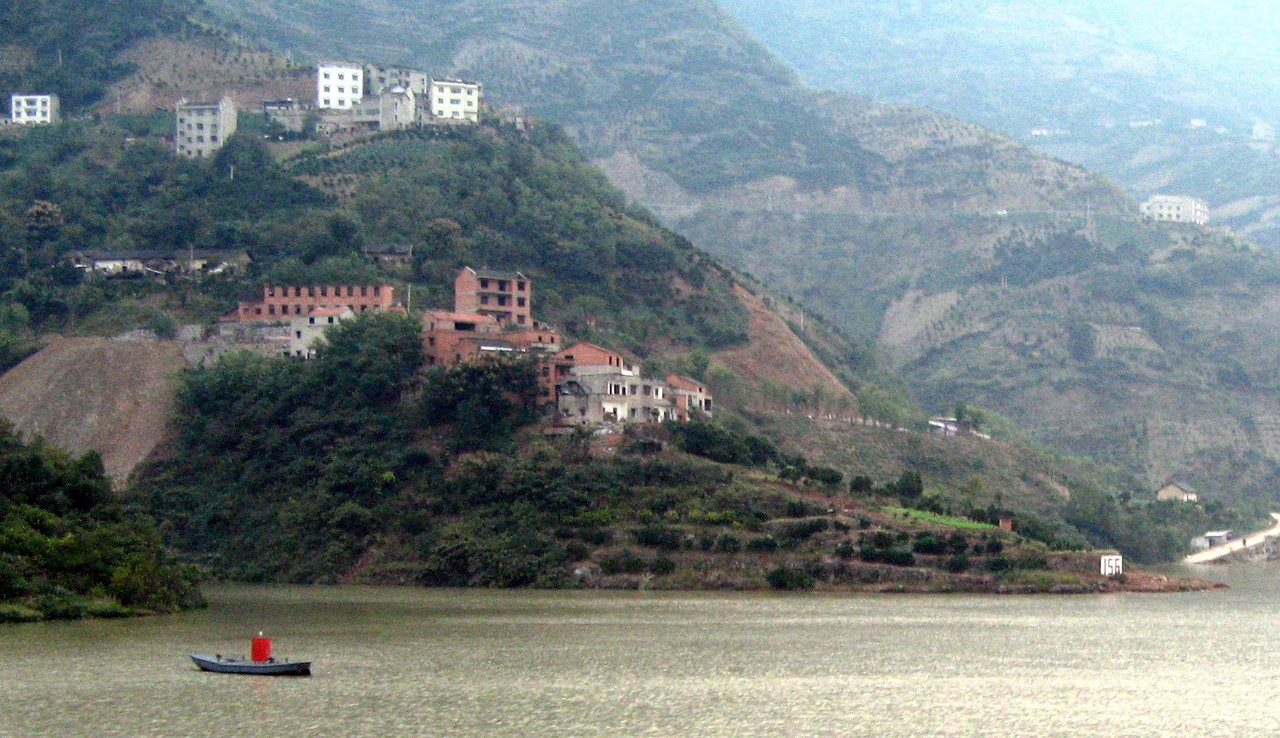
As we cruise the main Yangtze Gorge, we come across a partially flooded village that has a sign reading 156, the height of the backed up water just reaching 156 meters.

Our guide tells us we will off-load to a sampan for a view of a tributary gorge, one of three that will be flooded by the dam.

This sampan is much more to our liking than the big ship just lumbering along.

A Chinese man perches in a rudimentary rock dwelling with his camera hoping the boat will stop and allow him to take our picture which he will develop and try to sell to us down the line. Our boat does not stop.

This group has a portable radio and they sing for us, hoping we will toss them a few coins. Our boat does not stop, but everyone here scrambles to make a living. The Chinese government has not exactly found occupations for all of those displaced by the flooding gorges, we are told. Promises, promises.

The boatman wears rain gear made of a mat of rushes of some type.

Our tour members enjoyed trying on the rain gear and attempting to paddle the boat up the gorge from a standing position.
Tomorrow, the controversial dam.


