Showing posts with label artifacts. Show all posts

Wednesday, May 14, 2014

STREET SCENES, FOOD THE GRAND BAZAAR.

DSC04454 (Copy)
As I continue posting our trip to Turkey, the major attractions are a wonder to behold, but the street scenes and our surroundings also draw the eye, like this brass shoe shine stand in the hotel lobby. I was approached by a gypsy on the street with this very same piece of equipment. And I really needed my shoes polished, but we were on the move and we couldn’t stop on a street corner for me to have my shoes refreshed.
DSC04655 (Copy)
During our bus ride to the Turkish bath, Usla pointed out the recycler following the garbage truck. Joan Zucker pointed out that the garbage trucks play classical music while picking up garbage. Isn’t that a hoot?DSC04455 (Copy)
A fancy birdcage greets us every morning in the hotel on our way to breakfast. The food changes somewhat every day, but the food buffets at our hotels, knock your socks off.
DSC04457 (Copy)
You can see fruit, yoghurt, honey, baklava, sausage, cucumbers, cheese, tomatoes, mushrooms, eggs, black and yellow apricots, raisins and at the back, strawberries, cereal.
DSC04459 (Copy)
Here we have olives, carab pods, garbanzo beans, nuts and marinated cheeses with herbs, rice and cereals. At the back is syrups and seasonings of all sorts and milk.
DSC04458 (Copy)
The cheeses are many and varied. You can see dried figs, beets, turkish delight, cashews, pomegranates, and parsley.
DSC04462 (Copy)
The juice bar.


DSC04456 (Copy)
The hot dishes, savory filled roles, egg dishes, stews and meats with rice and breads.
DSC04460 (Copy)
Of course there was turkish coffee, tea and water. We sat at tables that looked out through open windows on the beautiful Marmara Sea. This day was overcast, but other days were sunny. And one of those days a big gull came in and began eating off the plate of someone who left the table to get something else. And, as unbelievable as it sound, all breakfasts were like this one or better at our hotels.
DSC04650 (Copy)
And if you need a snack while you are out, you can always pick up a boiled egg from the lobby. This basket of eggs was about two and a half feet long. We don’t know if they were part of the wedding or what?
DSC04817 (Copy)
Yesterday, I posted Topkapi Museum? Immense color portraits of these interesting sultans in colorful garb don’t compare to these small black and white drawings in the lobby. It is the same inspiration we might find in our hotels or public buildings, a reminder of our great leaders with pictures of  Washington or Lincoln.
DSC04820 (Copy)
They kind of remind me of youthful meanderings after reading Arabian Nights, the romantic Calef riding across the desert with a sword by his side and rescuing the equally exotic princess.
DSC04821 (Copy)
They are just ordinary to the locals. Ahh, I know exotica and relish it when I see it.
DSC04590 (Copy)
But I dally. On to the Grand Bazaar, one of the oldest and largest covered outdoor markets in the world. It has 3,600 shops and 58 streets. They have categories, gold, silver jewelry, leather shops and so on. Here you can find anything you want.
DSC04594 (Copy)
Things made with Crystals.
DSC04593 (Copy)
Ceramics of great beauty.
DSC04743 (Copy)
You can find quality and glitz.
DSC04742 (Copy)
Or a tailor to hand make your clothing. Obviously this short man cannot buy clothing to fit off the rack.
To the spice market
And food in bulk, just like in the spice market.
DSC04607 (Copy)
When you buy these stuffed black and yellow cots, or hazlenut chocolate delights, they are packed in fancy boxes and make great gifts.
DSC04741 (Copy)
The main street is a wide avenue.
DSC04740 (Copy)
Owen and I wandered some of the smaller side streets and it is important to know your direction to get back to your original entrance. Owen bought a souvenir dagger, similar in size as the Topkapi dagger.  And, luckily he has a good sense of direction or I probably would still be wandering the bazaar.

DSC04602 (Copy)
I looked at textiles because cloth items are easier to carry in a suitcase. I wanted something with the famous tulips on them.
DSC04604 (Copy)
There were many choices.DSC04739 (Copy)
I like scarves and the market had many scarf booths. I ended up here and bought three scarves for $400 after a lot of dickering. The merchant wanted his picture taken with us and gave us his card. I left there thinking to myself, did I really pay $400 for three scarves? DSC06874 (Copy)
They are pretty persuasive salesmen. And the scarves are cashmere and silk. This one from the Mevlana area.
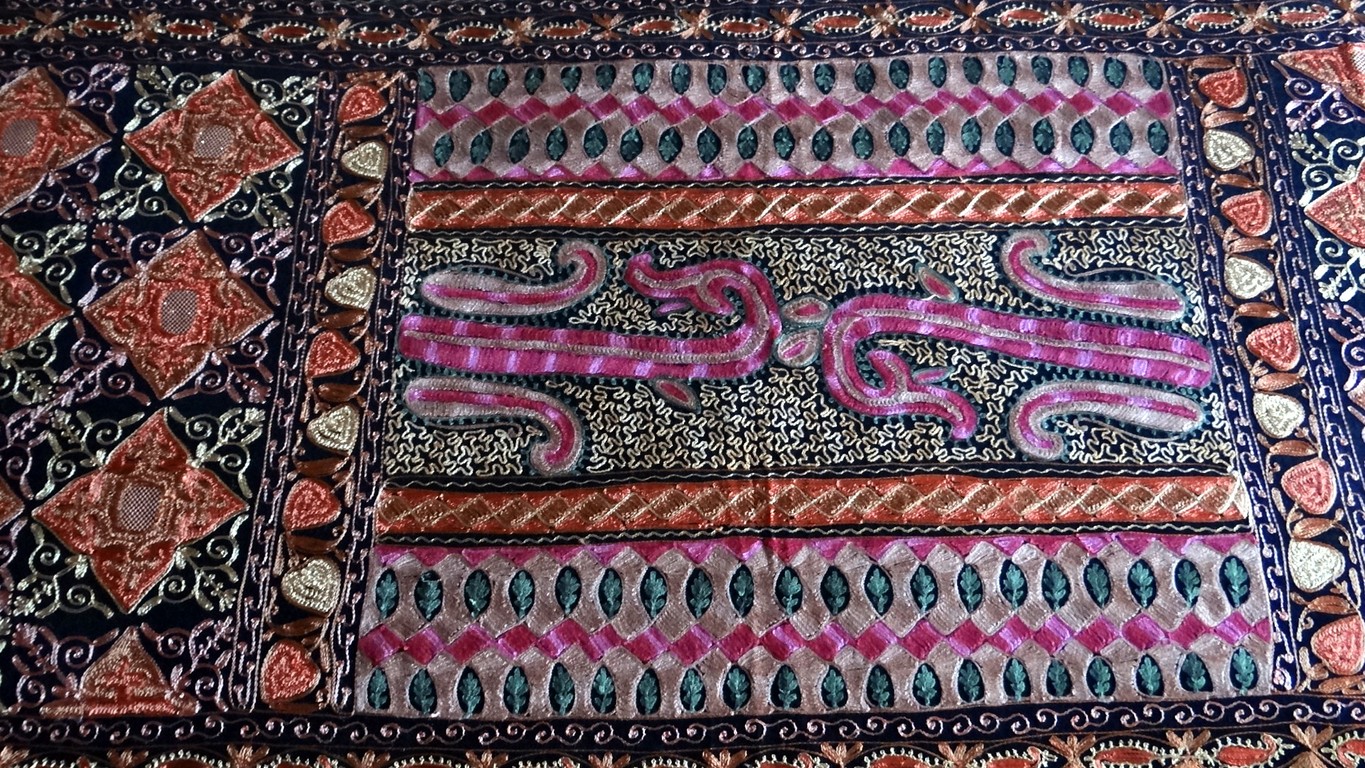
DSC06875 (Copy)
This one is Kurdish with two Moslem letters or words from the Ottoman Empire and sewn with some gold threads.
DSC06876 (Copy)
Cappadocia with a beautiful leaf repetitive pattern. They are of excellent quality and feel like velvet. Long enough to stretch from one side to the other of my queen sized bed.
I hope you are appreciating that so far, all my Turkey blogs, are excursions we made on our first day in the country. You can double-click on any of these pictures to enlarge them and arrow back to return to the blog. I hope you are enjoying taking this trip with Owen and me. And, I cannot find a spelling or definition for the word Calef that I believe is a word for a leader similar to a general or minor Sultan. If anyone can help me, please do. More tomorrow.

Tuesday, May 13, 2014

TOPKAPI PALACE

DSC04695 (Copy)
Above is the kiosk to Topkapi Palace built by a later sultan who wanted to stop people before they approached the main gate of the palace. Here they could wash at the fountain, give their animals a drink or rest after a long journey.

DSC04689 (Copy) I’m calling it a kiosk, probably not the right term, but it is a beautiful building, beautifully carved overhang, with gorgeous tiles.  I guess nothing was too opulent for a Sultan.
DSC04699 (Copy)
The main gate to the palace is inside of a courtyard filled with flowers and gardens. It is hard to imagine troops of the Sultan’s soldiers mustered in front of this opulent place, though in the old days, the walkways were not pure marble as seen here.

DSC04700 (Copy)
And the overhang is embellished with gold not brass. The Topkapi Palace was built on top of and inside the walls of the Byzantines. When the Ottomans overran Constantinople they chose this same safe spot surrounded by the protection of the Marmara Sea, the Bosporus River and the Golden Horn. They had great difficulty getting into this site which was considered unconquerable because Constantinople did its business with a great chain across the channel, forcing any would be conqueror to go a long way around and make their way across land, and across the river to get to them. But the Ottomans built skids of timbers and lifted their ships out of the water, slid them across the short end of the peninsula and landed inside the shipping channel to overtake the unconquerable city.
DSC04708 (Copy)
Through the Royal Gate is a courtyard of surrounding buildings that was not only the home of Sultan Mehmed II, who built it in 1460-1478, but it was the seat of government where they held court, met with other leaders for state ceremonies, kept the royal treasure and relics, and did all the state’s business.

DSC04706 (Copy)
Those treasures and relics are still here at Topkai today. The riches of this museum rival other great museums with priceless treasures. This is only one of 6 or 7 courtyards on the grounds, the only one open to the public. The Library, (under restoration was closed) the arms room, the reliquary, the grand treasures studded with unbelievable amounts of jewels and gold are awesome. A bowl that Jesus drank from, a piece of the real crucifixion cross and other Christian relics are here as well. Very biblical.
DSC04711 (Copy)
You can buy a book with many pictures of the treasures, jewel-studded chairs, cradles, a bed and then smaller items like pots, scepters, bracelets, belts, armor of sorts. Armor and guns of high decoration from the armory have a separate building.  Portraits of the Sultan’s hang in the portrait room.
DSC06877 (Copy)
Postcards of the two most famous pieces in the collection, the Topkapi dagger was made famous by a movie, called Topkapi, made in 1964, about thieves who tried to steal this treasure, and the Wooden Spoon Diamond, of 86 carats. It is so-called because a man was bringing a stone he knew to be a diamond to the Sultan as a gift. He was followed by thieves and before they got to him he flung the stone in the palace dump outside the gates. Later, a poor man found the stone and thought since it was in the palace dump it might be worth something. He exchanged it for four wooden spoons. The spoon maker took it to a jeweler who, like the spoon maker, recognized that it was an uncut diamond stone.  A website tells many tales about the diamond, but this is the one our guide told us and the tale the locals apparently consider the true tale of the diamond.
DSC04709 (Copy)
The priceless blue tiles throughout the buildings are just as beautiful as those of the Blue Mosque and from about the same time period.
DSC04710 (Copy)
No pictures are allowed in the treasure rooms. But a huge book for sale showed the whiskers of a particular saint or sultan. I kept peering into the darkened glass cases and couldn’t see any whiskers. This book shows they were a few simple wiry hairs from a beard or head. A man (several, actually)  in the reliquary room sits and reads the koran aloud for 24 hours a day, endlessly.
DSC04696 (Copy)
The sultan kept a harem of girls from the country side. Girls from age 6 to 12 were brought to the palace and placed in the harem to learn the language, to sew, embroider, dress hair and learn about perfumes and lotions, jewelry and the baths. Guarded by Eunichs, not all of them became concubines of the Sultan. Many were placed as wives with important men of his kingdom. Some concubines had children by the Sultan, and he could have many wives and could marry a concubine. He also had a tower where he listened to his court conduct business secretly behind a screen to make sure they were following his rules. They knew the screen was there and he could listen, so they adhered to the rules. The Sultan could order people to be executed and they placed the heads by the executioner’s fountain to drain away the blood and to show the people what happened when the Sultan was deceived.
DSC04719 (Copy)
The only room we could photograph, was the Sultan’s meeting chamber where he held court for visitors to beseech him.  The people could ask favors and get problems solved by his superior judgement.  A building of great beauty, too, with the typical rotunda and arched ceilings.
DSC04720 (Copy)
..
DSC04722 (Copy)
..
DSC04721 (Copy)
Such beauty takes your breath away.
DSC04726 (Copy)
On the way out, Usla pointed out an ancient cistern that was recently found. They have yet to excavate and examine it more closely.
DSC04727 (Copy)
Usla’s assistant, Owen would hold the umbrella for Usla. The umbrella was held aloft so all of us could see where he was walking. In the crowded Blue Mosque I followed the umbrella, only to find I had followed another guide with the same umbrella. The Grand Bazaar and more tomorrow.
REMEMBER: you can double click on any of the pictures to make them larger. Then back arrow to resume reading the blog.