Showing posts with label Silk Road. Show all posts

Monday, June 2, 2014

CARAVANSERAI, SILK ROAD, WHIRLING DERVISHES

DSC06269 (Copy)
We enter Sultanhani Caravanserai through this beautiful carved marble entrance which faces East. This caravanserai was built in 1229. After a fire, it was restored and extended in 1278 and became the biggest  and best Caravanserai in Turkey.
DSC06262 (Copy)
Traveling the Silk Road, parts of it now preserved  in Turkey,  because of its historical importance, Usla knew I was excited about "...walking in the steps of Marco Polo."  He'd point to a caravanserai from a distance. "There's one!" I could never spot them because I was trying to see a huge desert area surrounded by trees, a source of water and many bedouin tents set up to show what it must have been like to travel across huge stretches of hot sand, and take refuge with camels laden with goods in a safe spot for the night. Instead we entered a huge courtyard, with winter rooms on the left and summer rooms on the right.
DSC06264 (Copy)
To the right of the entrance, are summer kiosks where the merchant put forth his goods. The arches to the right of the kiosks is a Turkish bath.  First, servants would come and unload the merchandise while the travelers bathed. The horses or camels were taken to a stable in the back of the building. To the immediate left of the entrance is a stairway leading to the top of the wall where guards patrolled. And huge rooms where the servants and travelers slept and had their meals and displayed their goods during winter months.
DSC06464 (Copy)
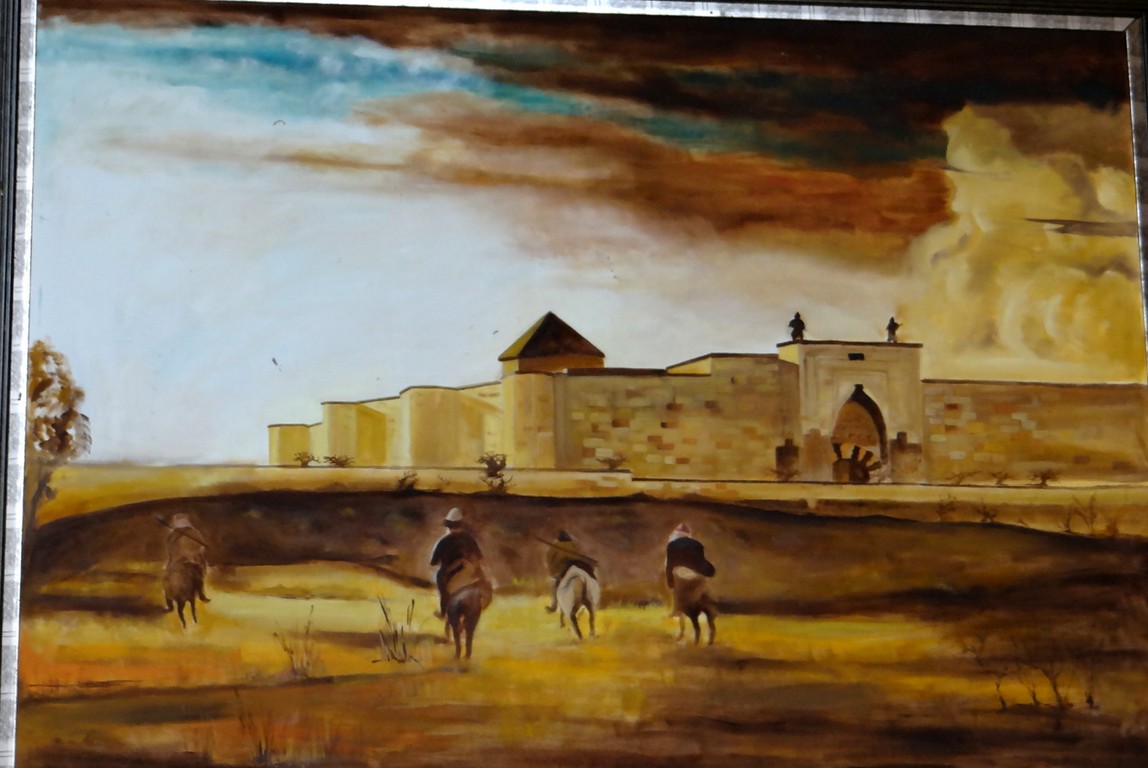
This painting shows what it was like, guards on the rim, travelers seeking refuge, not only merchants. The guards could signal with smoke signals from one caravanserai to another in the distance to know who was coming so they didn't let in robbers who would lay in wait for a caravan and try to relieve them of their goods.
DSC06263 (Copy)
In the center is a small Mosque.
DSC06265 (Copy)
You entered the Mosque by this set of stairs, identical to the stairway leading up to the top of the walls.
DSC06267 (Copy)
The stables, a dark and foreboding place, lit by torch light and now electrified for tourists.
DSC06271 (Copy)
The rooms are now quite barren. Black smoked walls identify the kitchen area.
DSC06272 (Copy)
The cold marble does not exactly suggest comfort station to me. I think I'd prefer a tent.  I didn't see the W.C.  But, according to others it is now a modern toilet unlike what it must have been with stone seats and a runnel. In my mind, I see Marco Polo, in awe of his surroundings as he traveled to China, and all over Asia, an epic 24 year journey, and back to Italy with Noodles, rugs, silks, porcelain, pearls, jade, jewels but most of all, a detailed history of the marvels of the world he visited.
Kapadokya Lykia Lodge
We returned for dinner at our new hotel in Cappadocia, the Kapadokya Lykia Lodge. I swore I wasn't going to picture another buffet, they are all so splendid, but this one outdid  the others. This is one wing of the salad bar. Behind you can see a long dessert bar. Thirty three different desserts and Owen managed seven of them before his dinner.DSC06282 (Copy)
We enjoyed multiple choices from huge chafing dishes, or a vegetarian bar, and a breakfast bar, omelets made to order, etc. available all hours. Overwhelming choices.  But, enough.
DSC06461 (Copy)
Our evening optional tour brought us to another, smaller caravanserai to see the whirling dervishes. To the left is  gift shop. The place had beautiful paintings of caravanas.
DSC06467 (Copy)
You can see how much smaller this courtyard is from the big one we saw. It has a fountain in the middle.
DSC06470 (Copy)
Inside a staging area surrounded on three sides by seating. The musicians enter first, you see them at the back of the room. The dervishes are dressed in black like the guide. They allow no pictures during their ritual. After the ritual, they perform for a few minutes for the camera. No words are spoken. No announcements made. This is how they start, heads bowed, arms crossed.


They begin circling with eyes open.


 They begin circling with their eyes closed.


They whirl with arms in an upright position, never letting them down for about 13 minutes. They return to rest position for five minutes and then begin again in a trance like state for another 13 minutes. Then they return to rest state.

Then they silently file out of the staging area the same way they entered. No words are spoken, no eye contact made. They do not discuss their ritual and what it means to them. Norman saw a Dervish Ritual in Iran and said they came out with swords clashing and whirling. It was a "show". This ritual is said to be the real thing, very pure form, nothing flashy. I was astounded that anyone can keep their arms in the air, and whirl dizzingly with eyes closed for 13 mintues, without falling over or resting their arms. A truly amazing feat. Very subdued, but amazing. I can't hold my arms up in the air for two minutes. I was totally impressed.


Saturday, July 28, 2012

LAST DAY IN JILIANG.

The Hun Dynasty is from 200 B.C. Most Chinese are Han Qiang (han-chung)) The greatest challenge to China is the Tibetan people.  China seems to step all over itself when they try and crack down on Tibet with the  whole world watching. There was a border incident just after we left where two Tibetan’s were killed. Yunnan Province borders India, Burma, Laos and Vietnam and was once the powerful kingdom of Nanzhao that defeated Chinese armies and controlled the trade routes to India and Burma before Khublai Khan. America’s Flying Tigers were based here and thwarted  the Invasion of China by Japan in the 1940′s.  The province of Yunnan has 25 different minority groups. China is  still  leery of minority people who might try to be independent and form their own government. It is so peaceful and beautiful here, we find it hard to understand. Viki tells us that at one time China was set into strict class lines. Her grandfather was a scholar and was sent to Shenyang Province and lived with the Uygurs or Greware people, under very tough living conditions. He married there and  Vicki’s mother was born there and married  an Ethnic born in Urumki. He was persecuted and sent to a “struggle” meeting and made to live in a cow shed. He tried to kill himself but Grandmother was strong and he survived and eventually the family was allowed to move to the city.  When Viki  was a child, learning how wonderful Mau was, she once heard her Grandfather say, “Mau is a bad guy” knowing he could be killed for saying so.  One of her Uncles was a Red Guard and considered her father a traitor and accused him of crimes and persecuted his own brother. When Mau died, everyone went crazy. Some wanted revenge, others shed tears. Afterwards, they wondered how stupid they could be. Life under Mau was unpleasant for most people. We really appreciate Vicki’s  openness  about China’s infamous past and faux pas of the present.

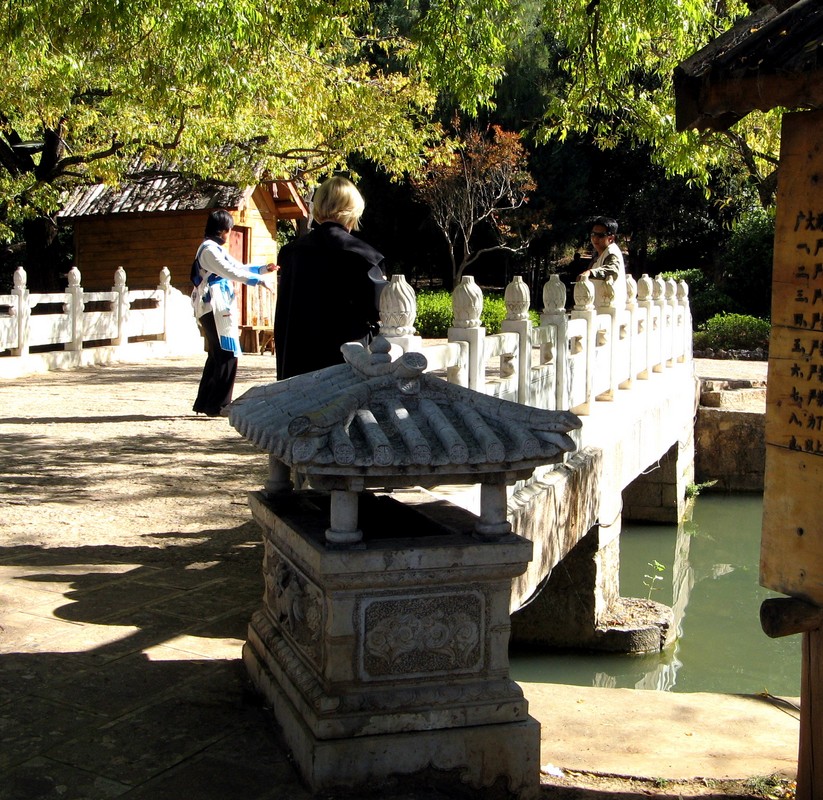
This is the walled entrance to Jiliang where modern vehicles can drive. Buses are not able to drive into the city.

Tourists unload and walk into the city or load into a smaller vehicle. I took this picture mainly because the  baby boy is wearing split pants. You can’t really tell. But Chinese children traditionally were  not diapered. Some still wear split pants and are set down to urinate or poop and the parents pick up the waste and deposit it somewhere just as in the old days when human fertilizer was saved for the fields. The government, according to Viki,  discourages the practice and most city babies are diapered.

And, as expected, modern vehicles share the road with the more common bike-trucks.

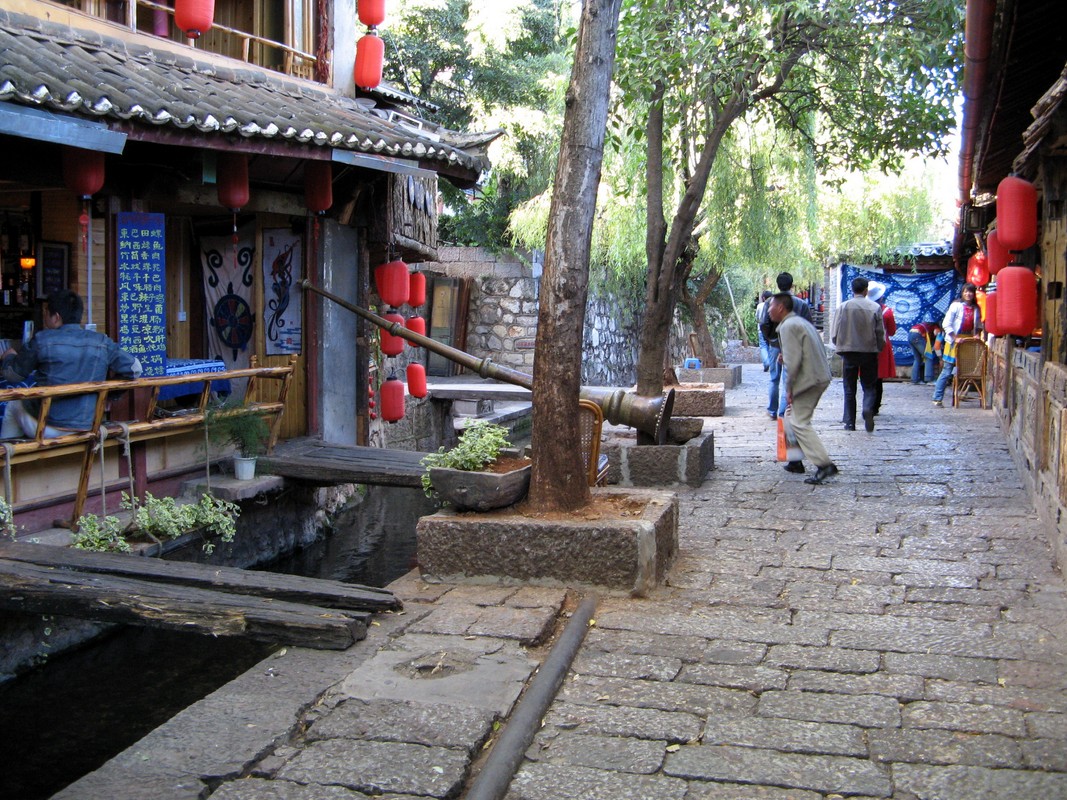
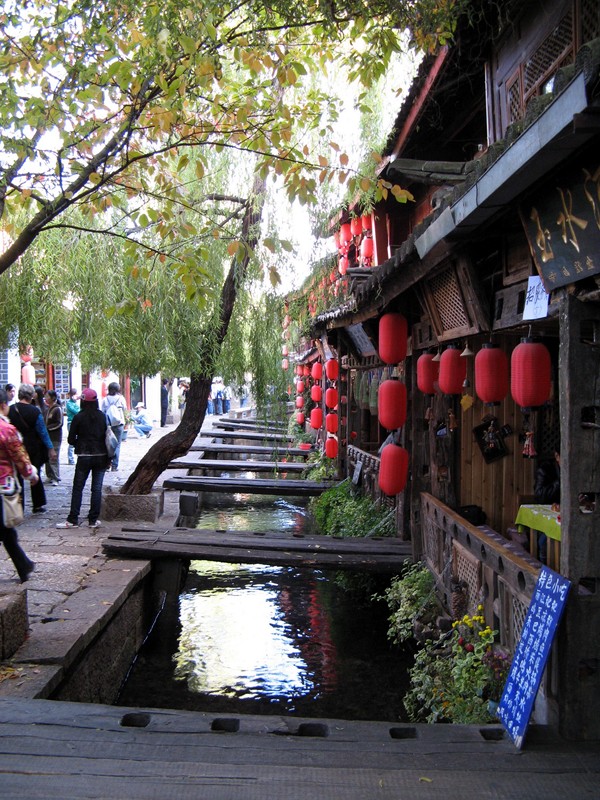
The river and the ancient water ways dominate the city which sits at the confluence of three different rivers.  Before the fire burned half the city down, every street in Jiliang  was narrow for people walking or on horse back with a waterway beside  the walkway.

Entrance to each shop next to the waterway is a rudimentary bridge, often old planks.

The streets are teeming with customers and no one would even think it was dangerous. The U.S. would bring it up to code and ruin this ancient city, we think. It is at least 3,000 years old.

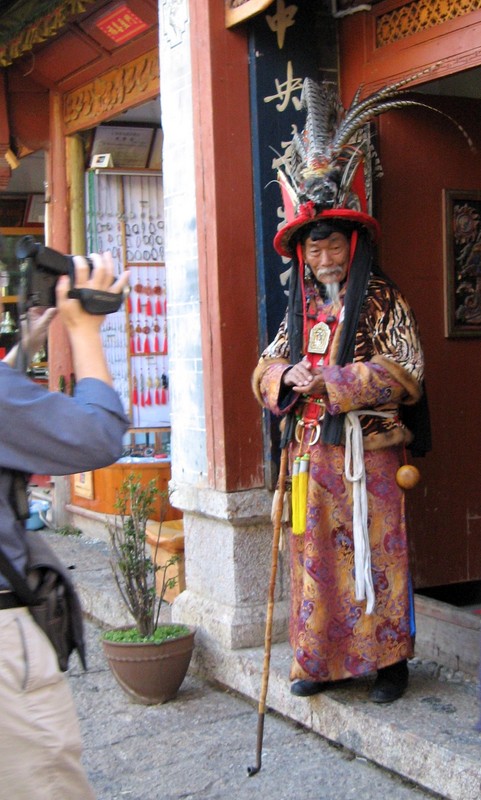
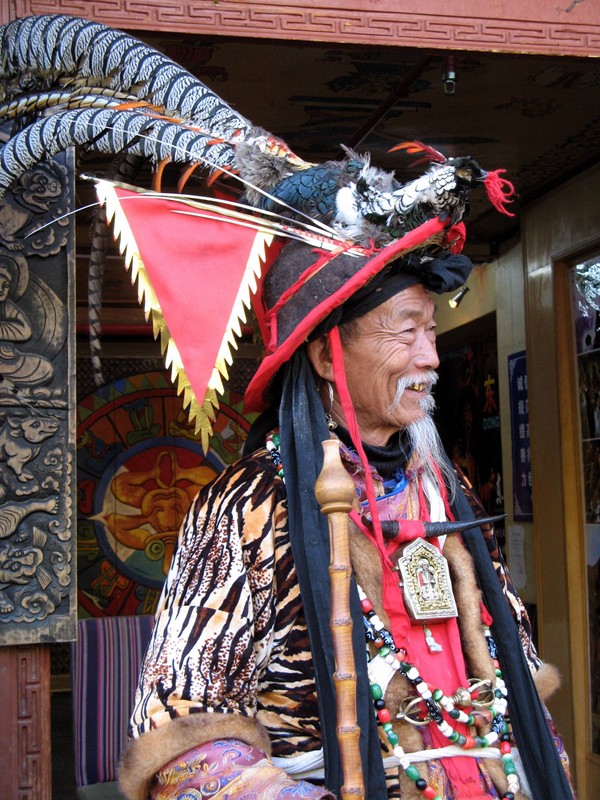
In front of this shop is a character asking people to pay to have their picture taken with him in his native costume.  His pipe reaches to the ground.

I’m entranced and sneak a picture of him. Isn’t he gorgeous? Oh, to have the language!

Water loving willows grow profusely and grace many of the old buildings.

But, most of the activity is on the square.

These sturdy little horses are called Jiliang Horses and are a desired commodity among the mountain people of this area. At one time they were a trade commodity along the famous Silk Road. The horses outlived the market for silk and eventually tea trade dominated the Silk Road.

These horsemen had parked their steeds and didn’t mind having their picture taken. They appeared to be working wranglers or traders of some sort.

The square is always filled with entertainment, like this  Naxi group dancing  and singing. I curse myself for not taking more pictures. There were tumblers, jugglers and magicians with a vessel out for donations much like break dancers and musicians do in San Francisco. This day is Oct. 30th, a double nine (lucky) lunar holiday. (I have no clue what that means.) It is wonderful to have a day in this ancient city that began as a stop along the Tea-Horse Road, a network of high paths and dangerous passes over the mountains into Tibet and other parts of China. The tea was packed in bricks and bales and we still see it sold that way in bricks, bales and huge hat shaped rings.  We couldn’t figure out what the bales were until we left Jiliang and asked Vicki who explained that those tea shops we saw, with myriad tea pots and cups, were really selling tea.

Michal and I do some last minute souvenir shopping and arrange to meet Wanning and Judge Dean Determan for dinner on the moat adjacent to our hotel which is the only food court in town where all the exotic foods, the music and night life happens. The paving stones were once washed by a trick of the ancient water system where the town streets and square was flooded and rinsed  debris back into
 the river. 
 

 Wanning shows us her haul, beautiful scarves about six feet long and three feet wide for $4 each.  She leads us back to the shop at dusk and we get them for $3. She says, “And I’m Chinese, I’ve been taken.”  We all laugh. On our way back for dinner, a vendor tried to sell us fried grubs, inch worms and cockroaches for a snack, but we declined.  We instead opt for a dish Wanning and Dean recommend with a tomato broth and noodles with bits of water buffalo and beef. But before we decide, one animal on the butcher block looks familiar but we can’t identify what meat it is. “Dachshund,”  says Vicki who is always around on the fringes of our activity to answer questions. We  groaned but Vicki is very forthright and doesn’t try to protect our western squeamishness or apologize for their customs. We decide the people in this area like their pets too much.
We  keep gawking fascinated by every thing we see.  The octopus, urchins, shelled creatures we can’t identify. Fish with heads and eyes and fins still intact. The insects and beetles, turtles and strange colored mushrooms. Pickled vegetables we have never seen before. Seeds and pods and edible grasses and baked delights in neon colors. We can’t decide which is most fascinating, people watching or cruising the food court; listening to thousand year old  music, or the hum of exotic languages;  “hiyee!”   sharp musical calls from waiters scurrying back and forth between tightly packed tables. The glow from ambient lantern and torch light;  people stooped or sitting cross legged  in dark corners.  We know we are glimpsing the threads of an ancient past, with no definition but magical.  Unforgettable.