
It was a cold morning and we waited until 10:30 to make our way to Rialto Beach. It knocks your eyes out to see the massive amount of trees dead on this beach. From the picture, in the background you can see a whole line of dead ones that haven't fallen yet.

The wood lying on this beach could build a city.

Stacks mark an ancient measure of the elevation of the land that once filled this beach area. It is a pretty beach about 3-4 miles long. Sunday, and people were out in force. The beach is part of the Olympic National Park.

I like to spend my time picking up pretty rocks. Each one you see is different from the one you just picked up. I won't keep them, I just like doing it. In the process I spotted this little dried up starfish.

And a type of jelly fish I'd never seen before. Double click the photo and you can see through its mass and see a little stones under it. When the waves woUld come in, it would fluff up as though it can survive this sunny inconvenience.

We drove to the Quileute Reservation for lunch. This totem sits in front of the River's Edge Restaurant where we had good chowder and salads at reasonable prices.

This was the view from the restaurant window.

We walked around the waterfront taking pictures.

Gulls feed in the shallows and habit the docks and harbor.
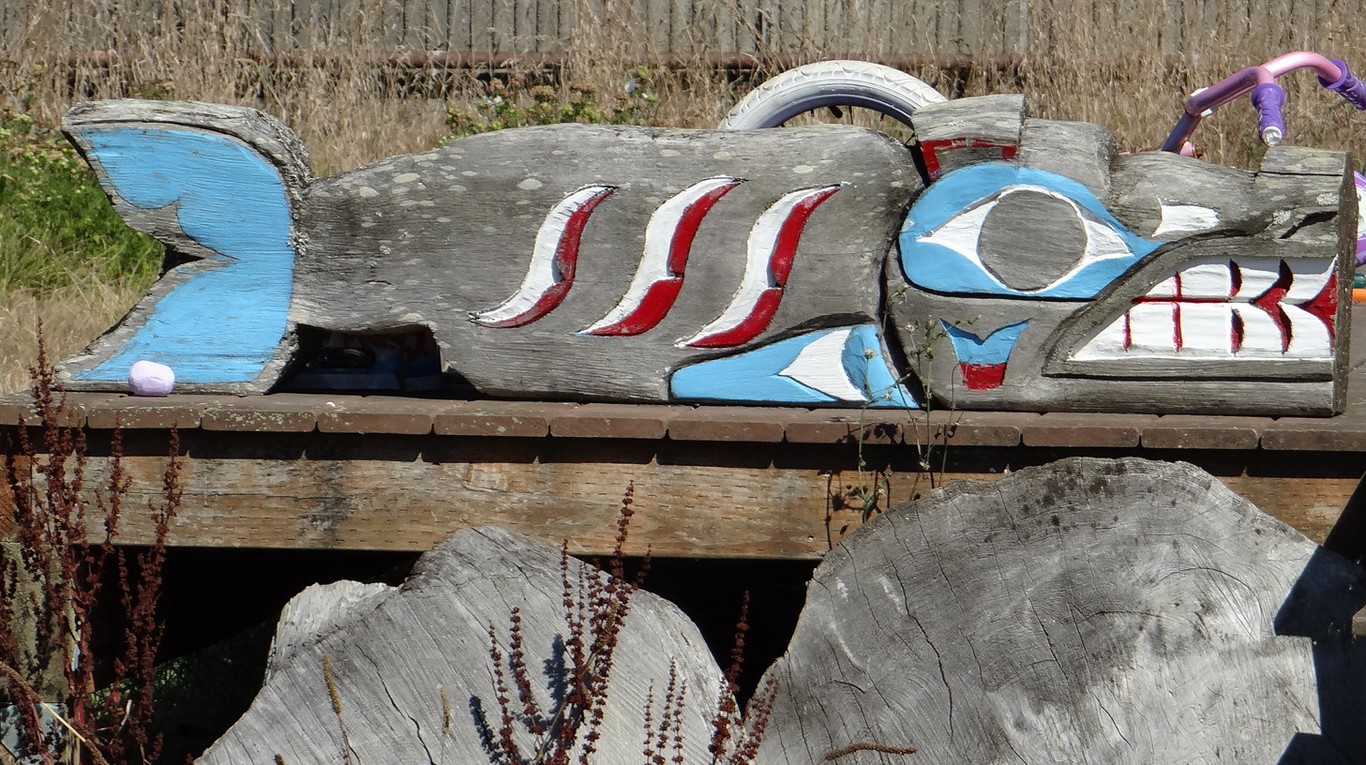
On the reservation, houses have personal totems.

This is a nice interpretation of eagle, dog and fish.

Businesses and houses commonly decorate with native art.

We moved on to La Poch, pronounced La Push which is a changeling French word for La Bouche, mouth, as in mouth of the river. Jim says he heard ferme la bouche a lot During his childhood, which means close your mouth. In other words, shut-up! The path was very steep at times but not nearly as long as the trail to Cape Flattery.

La Poch has three beaches, Beach One, Two and Three. A woman at Rialto told me Beach Two required a three-quarter mile hike to get there, but she saw thousands of jelly fish sparkling on the beach like diamonds. I saw several small ones at Rialto, dime, quarter and cup size. We hiked to Beach Two.

By the time we got there, the tide had come in. The jelly fish were gone, but the beach was pretty. Quite full of people, some swimming or sunbathing. People back-pack in and spend a couple of nights on the beach, then curse their way back, packing ice chests up the steep cliff, complaining of aching shoulders and why did we do this, jokingly offering money if we'll help them carry.

The light was right to photograph a stack up close.

And this one into the sun, shows two climbers testing their skills.

On the way back we happened upon a snake eating a frog. The frog didn't move. You could see it's heart beating. A woman theorized that once the snake bites the spine, it paralyzes the frog. It looked like a small snake compared to the frog.

But as we passed it, the snake is bigger than our first look. I'm not familiar with this snake. It resembles the garter snakes I played with as a kid.


