Tuesday, August 27, 2013

FINDING PLACES, IRON MOUNTAIN

scan0004 - Copy
Jim and I have been on a limited time to wander the Upper Peninsula of Michigan since this two year circumnavigation of the United States is coming to an end. He has firm dates in the State of Washington for his drivers license renewal and his bi-annual physical since even full time roadies have to have some sort of permanence and a  legal address.  He wanted to see where I lived and grew up and I wanted to find old friends and haunts, and we did that with great success.
Jim and I  missed one spot, Birch Creek, Michigan where I  lived as a kindergartner. I lived in Iron Mountain in this house above,  on G Street,  after the fire. My dad found work at the Kingsford, Ford Plant. We left our dog in Hardwood with a friend of my dad's because he knew we would be renting. Four months later, Duffy came crawling up the stairs weak and bedraggled waggiing his tail. This is the first house we lived in that had a connected garage. It had a laundry shoot from the bedroom over the garage that we loved to slide down when mom wasn't looking. We didn't get an allowance. My  brother sold Grit Magazine.  I applied for my own route and Grit turned me down because I was a girl. Bill decided to give his route to me and I turned out to be a terrific sales person. (Sometime in the 1980's, I sold an article to Grit Magazine about a chain saw wood carver.) So,there, Grit!!
img507Visit by Sharon Maroff, from Iron Mt.
On G Street, my best friend was Sharon Moroff who lived across the street from me. This photo was taken in Escanaba, where she visited me after we left Iron Mountain. Dad got a better paying job at Harnischfeger.
img535Mrs. Moroff's mother, Mrs. Robert Moroff, Moroff sisters, & father Bob-Moroff. Iron Mt, Neighbors.
The Moroff family from a photo sent to us when Sharon's sister became a novitiate. Sharon was about two years older than me.
Mrs. Carlson was my 4th grade teacher at the Iron Mountain Grammar School which has  been torn down and rebuilt. She considered us "transients" and said so on my report card as in, "The best you can expect from a transcient." She refused to help me with math when I asked. My dad would tell me, "No teacher will refuse you help, you are just to shy to ask." He was wrong..
 We visited the street between raindrops since it thundered and stormed all night long and most of the morning.  We grocery shopped, and did laundry. Our umbilical cord to the "toad" is improperly wired and shorting out fuses right and left. We had an appointment at Scotty's Garage to have it fixed and will be detained here for possibly two days which gives us time to be real tourists in the area and get to a Glider Museum they have in town as well as to my Grandmother's house.

My Dad's sister owned a store in Kingsford that we will try to find today. My Grandmother bought it from my aunt. The house was behind the store and I have great memories of our visits to that house and store. The Menominee River ran right in front of it and we sailed out over the water on a rope hung from a tree and dog-paddled back to shore. It kept us cool.
img5062nd-3rd-EsterD~1
While I was rummaging around my old photo disk, I found my only school picture at Longfellow school, third grade. I am in the back row, first on the left. Third and fourth from the left is Judy and Karen. At home, I have all of their names. Teacher was Karen's Aunt, Ester Dawe.
My travel blog has been a personal sally with little about the area for potential visitors. We chose Highway 2 because Road Trip USA  lists it as one of the best cross-country highways in the country. From Mackinac to Iron Mountain, numerous places called to me. Not all are on Highway two.  Drummond Island, Fayetteville State Park, the Locks at Sault Ste. Marie. Two historic logging museums, one at Tahquamenon another, the IXL at Hermansville, near by. Seul Choix Lighthouse park and museum at Gulliver. Hundreds of years ago,  a group of french Sailors were caught in a fierce storm and sought shelter and landed on a rocky harbor to wait out the storm. They called it  (Sis-Shawa, Only Choice.

Off Highway 2 you can find private attractions such as a snowmobile museum, at Naubinway, or a natural wonder, the "Big Spring", Kitch-iti-Kipi at Indian Lake.

Here in Iron Mountain you can visit Pine Mountain, home to what at one time was the biggest Ski Jump in the world.  Iron Mountain Iron Mine at Vulcan. There is a Forest Service map available at the Visitors Center that invites you to follow along to see great forests and meadows, especially valuable to see fall color in October, November.and December.

It is pouring as I write. We'll be dancing with raindrops again today and make up the time spent here on the road ahead. "Splish Splash, I was takin' a bath..."

Monday, August 26, 2013

QUINNISEC AND SERENDIPITY TWICE.

DSC08908 (Copy)
Leaving the Cousineau’s farm, a quick hug with Bernice before she went to work. Warm good-byes to Marie and Mark. We left with a mixture of reluctance and joy at the great memories we forged and excitement to be back on the road again, looking for what’s around the bend. We headed for Iron Mountain and Kingsford, another place I lived and where my grandmother Lydia Moore Kraus lived before she died. Her funeral  was the first time I had ever been to one.
DSC08915 (Copy)
From Karen Halderson Bruchman we learned my other best pal, Judy Gedvick Orler lived in Quinnesec. I love the name Quinnesec, and  Keewenaw, Ispeming, and so many other Native American names that dot the Upper P. And, of course, I love Pasty. We had a brochure like this one on our dashboard and bingo, there it was in Quinnesec which is on the way to Iron Mountain.
DSC08916 (Copy)
We pulled in and enjoyed an early lunch. I can honestly say, this was the very best pasty we’ve tasted so far.  Moist, enough meat, flaky crust. Scrumptious. We bought two extras for the freezer and if there had been more room, I’d have filled it up with pasty.  A full one pounder for $4.24. How can you beat that?
Since Karen gave us rudimentary information from memory about Judy’s whereabouts, her married name, Orler. She lived on a street that sounded like Maple but wasn’t, probably Mapes?  I asked to borrow a phone book at the Pasty Oven but they didn’t have one. At lunch, Jim whipped out the computer and checked Google Earth. No maple or mapes, but he found a street a short distance from the The Pasty Oven called Marpe.  We drove up Marpe St. about a half block when I spotted a guy outside working near his garage. I walked up and asked him if he knew the Orler family, I was looking for Judy Orler a childhood school friend.
“The woman across the street is a Judy, about your age. I don’t know her last name, though.”
DSC08919 (Copy)
And, it was the right Judy from Longfellow School in Foster City. She didn’t remember me but I remembered her and Karen with such great fondness. No one knows how meaningful a childhood friendship can be or what affect a person you meet along the way will have on you or you on them.  She and Karen would periodically come to mind and I would think about my school days, and wish that someday I could see them again. I would  wonder what happened to them and what their lives were like. Serendipity twice. It was a full circle for me of pleasant surprises, and I am so grateful that on this trip to Michigan I found them both. I really believe that memories light up our lives.

Sunday, August 25, 2013

DOWNTOWN HARDWOOD,MICHIGAN.

DSC08845 (Copy)
Continuing my personal saga through the Upper Peninsula of Michigan, Bernice, Marie and I set out for Hardwood, where my father, myself and a brother were born. When I saw the Downtown Hardwood sign on the only store in this very small town, I chuckled a bit. This is it. Not even the original Robinette’s Store exists which was the unofficial “center” of town where everyone met, and exchanged a bit of gossip. “Don’t telephone, tell a Robinette,” was a tongue in cheek refrain.
DSC08883 (Copy)
Even the post office is closed. In fact, the whole Main St. (Hwy M69) has been rerouted and changed since I lived here, not surprising since we are going back over 60 years ago. The warm-hearted people we knew and cared about, finding even distant old friends, seeing my generation now the elder citizens of the community, still makes a home place precious and significant.  With Bernice and Marie’s help, I was lucky enough to find some of them.  Thomas Wolf said “You Can Never Go Home Again.” He was wrong.
DSC08855 (Copy)
Shirley Robinette Johnson was surprised that I remembered her Dad, Joe. I left Hardwood as an eight year old and walked into his store in 1974, a married woman with four children and said, “Hi Joe!  Do you know who I am?” He said, “Yes, your are Billy Moore’s kid.” Just like that. Shirley confirmed her dad had a great memory for people and names. Joe and my dad grew up together, hunted together and were great friends.
DSC08857 (Copy)
Joe died in 1975. His son Marshall ran the store which burned down many years later. Shirley’s grand-daughter drew a picture of the store and the Robinette house right next to it.
DSC08896 (Copy)
The house is still there.
DSC08888 (Copy)
Our next stop, Betty Robinette Kerry gave us a warm welcome. Marie said, “The minute we left Shirley’s she must have called her sister.”  She did. Now it is the Hardwood Hotline, instead of telerobinette. Betty is so lively and energetic and fun to talk too.
DSC08885 (Copy)
She has a good picture of her parents, Joe and Lou, that I tried to shoot through the glass with okay luck.
DSC08806 (Copy)
Next, we visited my old home site where we burned out. I stood on the plot of our neighbors, Patsy Robinson’s house looking down the road. The left turn went to Bernice and Marie Cousineau’s family farm.  We lived straight ahead at the end of the road.  The school bus dropped us at Cousineau’s road.
DSC08814 (Copy)
Some one bought our place and built a little camp on it. The fire scar is all grown over.
DSC08816 (Copy)
Appropriately enough, someone cut a load of cedar post and stacked it across from where we lived. Appropriate because my dad cut, peeled, and sold pulp for the paper mills and there was always huge stacks of wood in various stages on our property. Between that income and our garden and hunting, we lived off the land. It was where my dad was happiest. My dad bought the “old Peronto” place of nine forties which is the common denominator around here. That is how Bernice and Marie speak of their land. Bernice has 9 forties. Marie is down to two forties. Everything measured by forties.
DSC08819 (Copy)
We followed Massie Road to Warmuth’s place. The tar paper has been covered over with siding and a new expanded front attached and a new foundation.
img448My 1st Communion after the fire. We moved to Warmuth's  old two room shack.
This is it what it looked like when we lived there after the fire. We spent the summer there with my Uncle Marvin helping out while my dad looked for work in Iron Mountain and Escanaba. The Bishop didn’t get to rural areas like Hardwood every year. Every couple years, all the kids who missed, took First Communion together.
DSC08824 (Copy) (Copy)
The railroad followed M69.  Rails and cross ties are gone. My dad would deliver his wood here on the highway where it was picked up by rail and delivered to the mills. The Mill would send a check. On occasion, my dad would take us for a wild ride in his Model T on the tracks. The tires would line up perfectly with the rails and off we’d go, sailing, way too fast,  as far as Foster City.  “Don’t tell your mother,” he’d say. She thought it was dangerous and it probably was.
DSC08891 (Copy)
That Hardwood Downtown store is owned by Maureen (Kerry) and Bob Meghinny. My brother had a mad crush on her when they attended school. “And, I with him,” she told me. She is a real beauty all these years later, but somehow, didn’t smile for this picture.  I told her my brother named his first child, Maureen. We call her Reena.
DSC08863 (Copy)
I went to school at Longfellow School in Foster City. And, my two best friends, Karen Halderson and Judy Gedvick lived there. We stopped at Gedvicks and met Anita Gedvick Mattson who lived next door to Halderson’s former house. She bought it and turned it into a Bed and Breakfast.
DSC08880 (Copy)
Anita decorated the place with old pictures of the Morgan Mill that gave birth to Hardwood, a company town, where everyone worked, including my Grandfather. Anita has pictures of Long Fellow School, some class photos, Mill Photos and other historic memorabilia.
DSC08866 (Copy)
One photo has Bernice, (bk row, 3rd from right), Maureen Kerry, (bk row 4th from left), my brother Bill, (2nd row first on right), and others we know.
DSC08873 (Copy)
An incredible wedding picture of Nurse Carlson who was the only medical person in the area at the time. She delivered babies, sewed up huge gashes, gave shots,  and if a baby died, it was buried sometimes without a County Record of the birth. She literally held life and death in her capable hands and everybody loved her.
DSC08858 (Copy)

All  that remains of our elementary school is this old bus barn and a degraded stone wall.  Where our school stood was is a gravel  pit.
DSC08843 (Copy)
We were just headed out Hungry Hollow to visit Jimmy Cousineau, a cousin of mine by marriage. Bernice’s car was stalling and over-heating and finally boiled over and began steaming. It dumped anti-freeze as we parked and pulled over.
DSC08842 (Copy)
A local woman named Paula, (last name unknown.) Stopped and called Jimmy Cousineau for help. While we waited, she fed us blackberry’s she had picked.
DSC08840 (Copy)
One year she picked 50 gallons of berries. They were delicious and thirst quenching.
DSC08844 (Copy)
My cousin, Jimmy came with a can of water and got us on the road again. He followed us half-way to La Branche to make sure the car was running well. We picked up Marie’s car and continued our trek.
DSC08850 (Copy)
Back at Hardwood, we passed the Kraus farm. All that remains is an old block barn he built. Kraus was married to Lydia Moore, my father’s mother. Ed Kraus, her fourth husband, outlived her.
.
DSC08837 (Copy) (Copy)
This community center is where all events take place for Hardwood and Foster City residents. Our school plays were held there. I saw my first movie, Lassie, that was set up by caring parents for we kids. It is now modernized with handicapped accessibility and a valued community asset.
DSC08897 (Copy)
Anita Gedvick told me one of my most cherished, childhood friends had a summer place on the lake near my cousin Jimmy’s place. We had directions and tried to find it. Then, we drove up a driveway where two guys were barbequing and asked if they knew where Karen Halderson Bruchman lived.
DSC08898 (Copy) (Copy)
“That’s my wife, who are you?” This is Bob Bruchman and his wife, Karen, who were visiting Wayne Nelson. Had we found her house, we would have missed her. I think I was in shock to think I’d finally located Karen. Just to know that she was well, and happy was a long-time dream come true. What serendipity. And yes, you can go home again.

Saturday, August 24, 2013

JOHNSON'S DAIRY OF BARK RIVER, DEER CAMP.

DSC08659 (Copy)
Bernice has split days off, Thursday’s and Saturdays. She left for work;  Mark took us for a tour of a modern dairy.  Casey Johnson’s Dairy milks and holds some of the cows and calves that belong to Mark and possibly other area farmers. Mark has a pasture full of young bulls and cows, and they have some kind of cooperative arrangement. Every cow is numbered and tagged. This barn holds 100 cows.DSC08678 (Copy)
Casey had just fed the cows and his  boys their breakfast before we arrived. His wife had already left for work. In Casey’s words, you have to love work and hate money to be a farmer of any kind. The oldest son went to finish a project. He is only six but he can operate a power drill. He is drilling holes in a board, collecting the sawdust to sell. Of course, we all chuckled. Not much different from the lemonade and zuchinni stands of city kids, I expect. DSC08662 (Copy)
If you’ve never been in an old-time dairy barn, you know immediately how innovative and clean this operation is. The food is on clean dry cement and has no chance of mixing with muck, manure or anything dirty. The cows reach for the feed. When it is out of reach, a small tractor plows it back within reach. It isn’t only hay. A sweet-smelling ground mix of corn and barley is also fed with the hay. The cat gets a bath from the cows who seem to like her just fine.
DSC08668 (Copy)
The cows are lounging around chewing their cud in the middle of the barn on sand. I couldn’t believe they used sand. It is cleaner than hay.  There is no other place in the barn to lie down. The stanchions  are positioned so they have to go in front first to rest so most of the manure goes in the trough.
DSC08669 (Copy)
In the trough you can see a crevice under this cow. Two steel cables are operated mechanically to lift up and scrape the manure to one side where it is then machine scraped to the end of the building for the fertilizer sales. Easy, clean.
DSC08652 (Copy)
The cows are a mix of guernseys, (above) the black and whites are holstiens, and a few mixed breeds. (I hope I have that right. It has been a long time.)
DSC08664 (Copy)
You can see how full their udders are. They get milked twice a day, 7 days a week. No days off for a dairy farmer.
DSC08665 (Copy)
This cow didn’t get de-horned. My youngest daughter raised dairy goats and the same theory prevails.  Horned animals may fight and hurt each other, so they are de-horned. We both hated de-horning. Mark contends that a cow with horns seems more content.
DSC08684 (Copy)
At milking time, Casey gets behind them and gets them moving. They walk through the bath area.
DSC08715 (Copy)
The cows load into the milk room automatically. They push a gate aside to get into the stanchion. The lead cow knows to go all the way to the end, not a spot can be missed. They cannot turn around or pass another cow. It is very controlled.
DSC08690 (Copy)
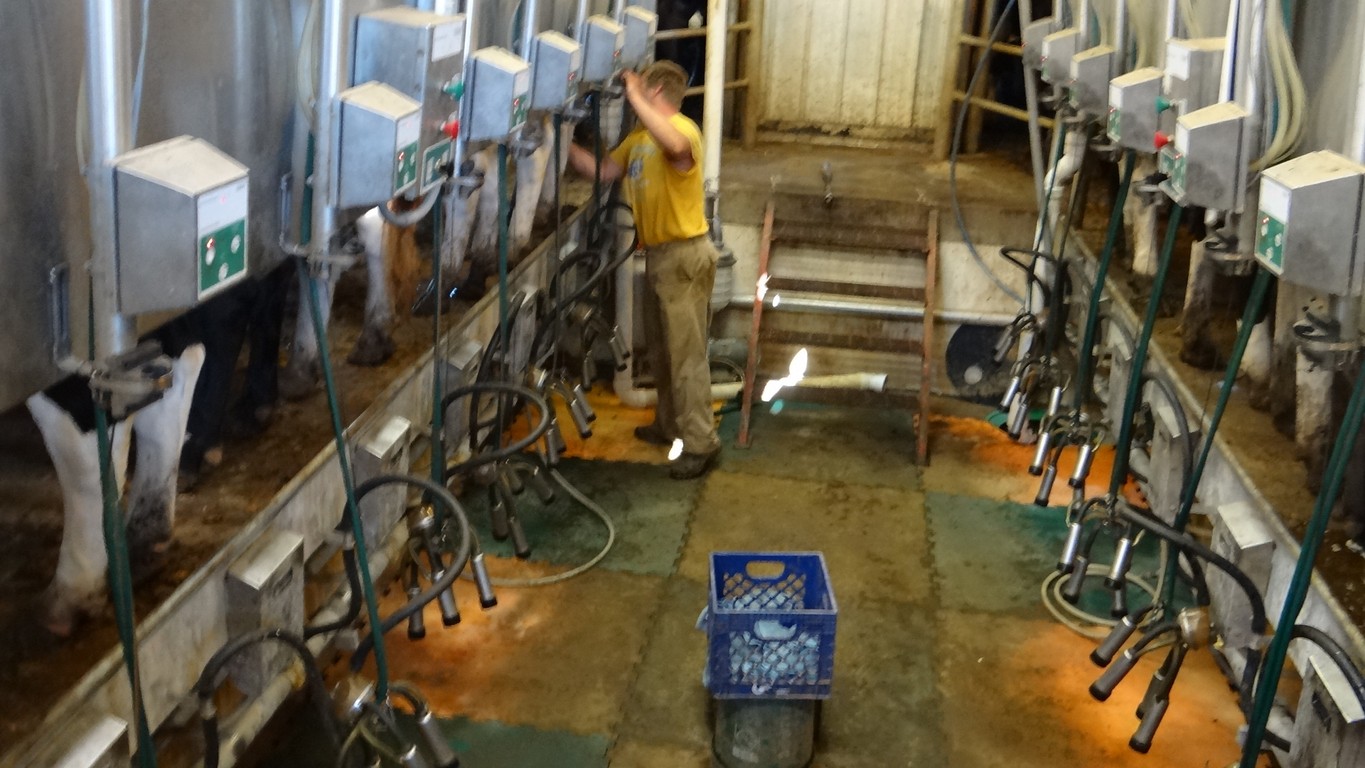
Down in the pit, with seven cows on each side, Casey wipes down all the udders before attaching the milking machines.DSC08704 (Copy)
It takes only 3 and a half minutes to milk the cow. The machine records the amount of milk  from each cow. The dairyman knows what cow produced how much milk. Older cows give more milk than younger ones. They live about 20-25 years so they know their place in the line-up like school children going to the same desk.
DSC08718 (Copy)
Turned loose with slack udders, they return to the feed barn. The muddy spot they walk through has a powerful bacteria killer that keeps their feet from tracking in disease carrying pathogens.
DSC08708 (Copy)
City boy, Jim, wasn’t too sure he wanted to go to a dairy, but even he was surprised how odorless the barn was. OMIGOD. Not like days of old. At school, especially on the bus,  your nose knew what kids milked cows before school each morning. We bought milk from Bernice’s family, they had dairy cows. They didn’t smell of barn. Maybe certain families didn’t have good washing machines, or didn’t change clothes before coming to school, or maybe they didn’t bathe frequently enough.
DSC08723 (Copy)
On the way to the calf barn, we stumbled upon the sawdust operation. The little guy was off playing somewhere else, so we didn’t catch him in action.
DSC08729 (Copy)
I kept feeding the calves grass and this one calf liked my fuzzy jacket. I finally got a photo of that raspy tongue reaching out to grab my sleeve.
DSC08732 (Copy)
Two of Mark’s calves are separated out because they have the scours, (dysentery). Some don’t live through it.DSC08738 (Copy)
This healthy calf is recuperating from a leg wound. His hind leg is swollen and hurt from getting entangled in some machinery. He can hobble around the yard and will survive.
DSC08741 (Copy)
Mark pointed out how hay is handled.  An expensive machine that hooks to the back of a tractor drives the round hay bales into a plastic sheath while machine drying it so it cannot mold. The green food has a higher nutrition rate. No more expensive barns with hay lofts. The hay can lay on the ground (or inside under during winter) and be available constantly by peeling back the plastic.
DSC08740 (Copy)
Corn and barley silage is handled in a different type of bag called a Band-it with the same principle. Quite an operation.
DSC08748 (Copy)
We returned to the motor home for breakfast and some work on our electrical connection. Mark took off on his oldest tractor to do some spraying. I didn’t know you needed four tractors to be an efficient farmer.
DSC08755 (Copy)
The electrical problem was tricky and we blew some major fuses. Jim had to take off for Escanaba to get help. So, he didn’t come with Bernice and I to Marie’s house. The road is named for her family, Gaber Rd.
DSC08757 (Copy)
Like Bernice, she loves antiques. I took a picture of this family heirloom, a beautifully carved rocking chair.
DSC08764 (Copy)
I had to take a picture of this old clothes line pole. My mom was short and the lines had to be reachable. So, like Marie’s we always had a pole to lift the wet clothes up high off the ground once you got them hung. What a hoot.
DSC08765 (Copy)
Her house is modernized but she keeps the old house “outback”, “…just in case..”  Pipes freeze, emergency plumbing is expensive…DSC08766 (Copy)
We never had such a fancy place as this two holer. Marie paints everything, her favorite color, baby blue.DSC08774 (Copy)
Through Marie’s half section of land, this line was put through. She sold some land and now only has two forty acre pieces. We took a drive out Electric Line Rd. to Bernice’s Camp.
DSC08791 (Copy)

Several deer blinds are set up along the road, and other camps besides Bernice’s Camp. She hunts almost every year and get’s her deer. Hunting season in November is like a big holiday. All their friends gather and use the camp. And when the deer come in they dress and hang them and out comes the whiskey and beer for a big toast. The women cook up a storm and it is party time. It reminded me of that movie and play, Escanaba In Duh Moonlight. When I mentioned that, Bernice told me how offensive that movie was to Yoopers. My dad was a true hunter. He would not understand the change in hunting practices, of setting up a feed station, then killing deer from a blind.
img167Billy in homemade Soap Box  Derby Go-Cart. Hardwood house about 1947. House burned in spring of 1949.
This is our house that burned down. The building barely visible in the back is an old gas station building my dad owned. He hauled it on a logging dray to our property and turned it into a hunting lodge during hunting season. We saw many a huge buck leave our property on somebody’s fender. My dad hunted rifle and bow season and always got his buck, plus any number of others he wanted for table meat when the game warden wasn’t looking.
DSC08787 (Copy)
At Bernice’s Camp, she wanted to clean out the mouse traps.
DSC08788 (Copy)
She put clean water in the buckets and fresh peanut butter on the can. Very effective.
DSC08781 (Copy)
Her camp has no electricity. The double bed sized bunk beds are welded angle iron and regular boxsprings and mattresses. Very comfy. They keep anything that spoils in the old fashioned metal bread boxes so mice can’t get into it. It was a fun day. Bernice took me to the Island Casino where she works and bought ice cream treats, (you know where that ice cream came from,) before we dropped off Marie and headed home.